

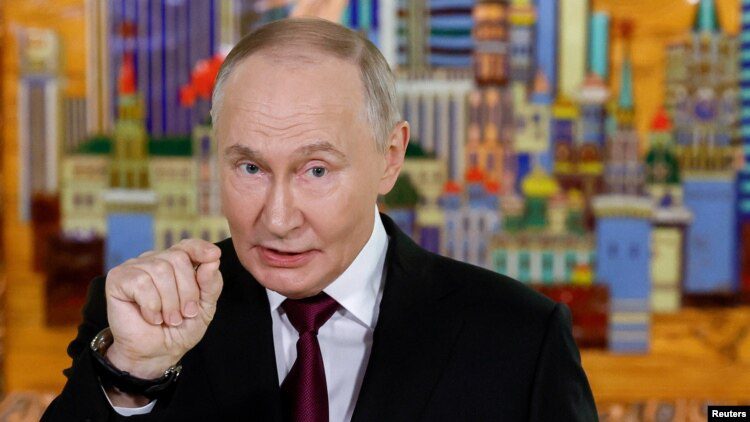

Russian President Vladimir Putin rejected the US-Ukraine peace proposal during a meeting with the US delegation in Moscow on 2 December and remains unlikely to agree to any compromises other than his original military goals, the US Institute for the Study of War (ISW) said in a report on the outcome of the talks between the US delegation in the Kremlin.
The analysts drew attention to the Kremlin’s statement that the US and Russian delegations agreed not to disclose the essence of the talks. “This is consistent with ISW’s previous predictions that the Kremlin plans to refrain from publicly discussing the results of the meeting in order to cover up Russia’s rejection of the US-Ukraine peace proposal. Senior Kremlin officials, including Putin, have consistently rejected the 28-point peace plan and its subsequent versions since they first appeared in mid-November 2025 because the proposed plans did not address all of Russia’s maximalist military demands,” the report said.
ISW says that statements by the Kremlin and those close to it after the talks are likely aimed at concealing Putin’s “real, more extreme goal of taking control not only of the entire Zaporizhzhya and Kherson regions, but of all of Ukraine.”
In addition, analysts note that Putin attempted to preemptively shift the blame to Europe for Russia’s rejection of any peace plan options.
The Russian leader, responding to reporters’ questions on 2 December before meeting with a U.S. delegation, said that Europe was obstructing U.S. President Donald Trump’s peace efforts and had created peace proposals with clauses that were “absolutely unacceptable” to Russia, and that Russia would “allow” Europe to return to the negotiation process only if Europe accepted “the realities on the ground.” Putin aide Yuri Ushakov said after the US-Russia meeting on 2 December that European leaders were resorting to “destructive actions” in the peace process.
“Senior Kremlin officials have repeatedly signalled in recent weeks that the Kremlin is not going to accept any peace agreement that does not meet Russia’s maximalist demands, including the initial 28-point peace plan proposed by the United States. The Kremlin is likely setting the stage to blame Europe’s inclusion of unacceptable points in the peace plan on Russia’s refusal to accept it, essentially using Europe as a scapegoat for its own obstruction of the peace process,” the report said.
The Institute for the Study of War also commented on Putin’s threats against Europe and his “veiled nuclear threat.”
“Putin stated that Russia has no intention of going to war with Europe, but will be” ready right now” if Europe suddenly wants to go to war with Russia. Putin made a barely veiled nuclear threat, saying that if Europe went to war with Russia, “a situation would quickly arise” in which Russia “would have no one to negotiate with.” The Kremlin’s threats to Europe are likely aimed at deterring Europe’s participation in the peace process, as well as undermining the strengthening of its defence capabilities for fear of allegedly provoking Russian aggression,” the report said.
On 2 December, a US delegation held talks with Putin in Moscow for almost five hours. The US delegates were President Donald Trump’s special envoy Steve Whitkoff and Trump’s son-in-law Jared Kushner.
Russian state agencies quoted Kirill Dmitriev, a participant in the talks and an envoy of the Russian president, as calling the meeting “productive”. Putin’s aide Yuri Ushakov said “some American developments are acceptable to Russia, some are not suitable”.
“So far no compromise option [for a peaceful settlement] has been found, but some American developments look more or less acceptable, but they need to be discussed. Some of the formulations that were offered to us do not suit us. That is, the work will continue,” Ushakov said.
He said Moscow had received the U.S. plan with four additional documents, with no details on what they were about.
Putin and the US delegation also discussed territorial issues, “without solving which we do not see a way out of the crisis,” Ushakov said.
He added that a meeting between Putin and US President Donald Trump was not planned. A possible meeting “will depend on the progress that will be achieved,” the Russian presidential aide said.
US Secretary of State Marco Rubio said after the talks that the end of the Russia-Ukraine war depends on one person – Putin.
Ukrainian President Volodymyr Zelensky noted on 2 December that he was waiting for signals from the US side after the meeting in Moscow.
Before travelling to Moscow, Witkoff, as a member of the US delegation, participated in a meeting with a Ukrainian delegation in Florida on 30 November. Various aspects of the US peace plan were discussed. Both sides described the meeting as constructive and said that they were moving forward, but no specific agreements were reported.