

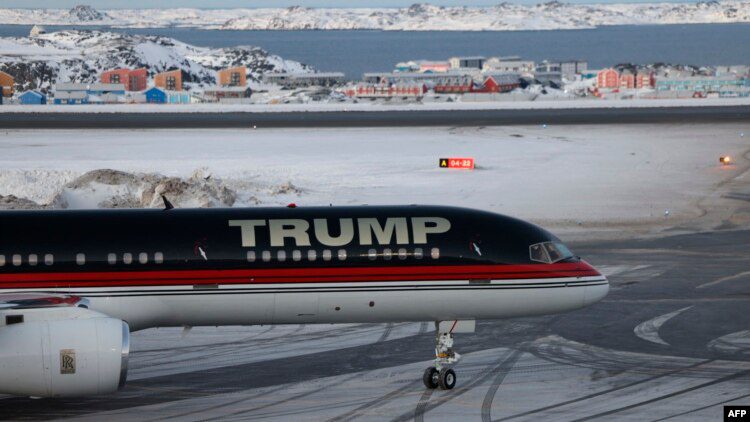

Only Denmark and Greenland can decide on their relationship, the leaders of France, Germany, Italy, Poland, Spain, Britain and Denmark said in a joint statement released on 6 January.
“Greenland belongs to its people. Denmark and Greenland, and Greenland alone, should decide matters concerning Denmark and Greenland,” the document said.
The statement is a reaction to a new wave of statements by US administration officials who insist that this autonomous part of Denmark should be incorporated into the US.
“We need Greenland. It is strategically very important right now. Greenland is surrounded by Russian and Chinese ships. We need Greenland from a national security standpoint, and Denmark can’t do it,” US President Donald Trump told reporters on 4 January, adding that Copenhagen recently beefed up the island’s security with “one dog sled”.
Trump’s claim to Greenland is not new to the world. Back during his first White House cadence, he spoke of his willingness to buy the largest island on the planet from Denmark, offering it $600 million annually.
Before his next inauguration in 2025, the US president-elect did not even rule out the use of military force to control the island. The European Union responded with statements about the inadmissibility of attacking its sovereign borders.
“You cannot annex another country, even with a security argument,” Danish Prime Minister Mette Frederiksen addressed Trump in English from Greenland. The island is an autonomous territory of the Kingdom of Denmark with its own government and parliament.
The debate was also fuelled by a post in X by the wife of US Presidential Homeland Security Advisor Stephen Miller. On 3 January, Kathy Miller published an image of a map of Greenland painted in the colours of the American flag. The message was accompanied by a single word: “Soon.
The leadership of the European Union and many EU countries have repeatedly declared their support and “full solidarity” with Denmark and Greenland, as well as respect for the territorial integrity and sovereignty of states as fundamental principles of international law.