

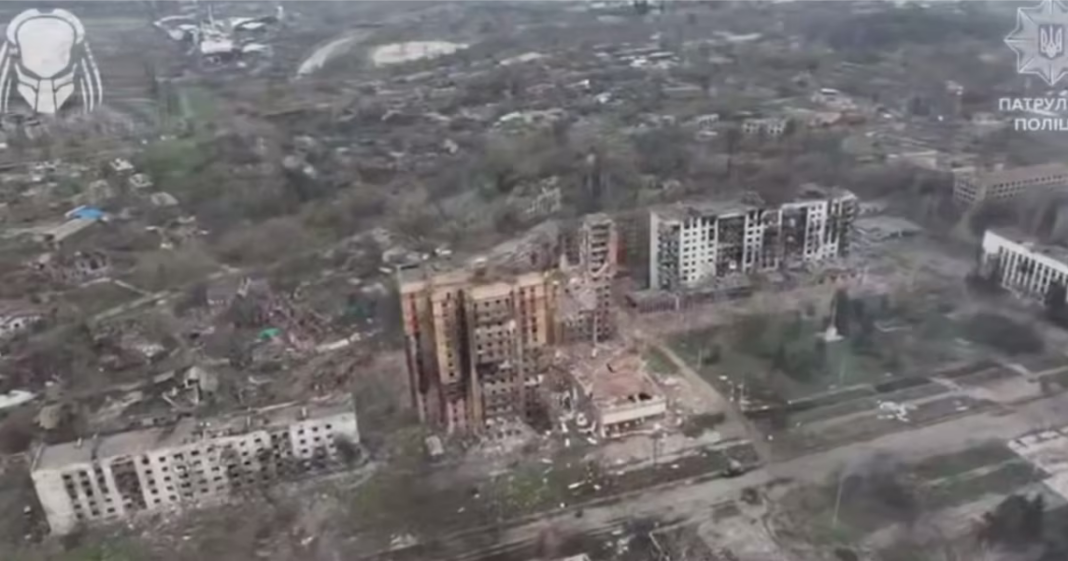

The Institute for the Study of War (ISW) believes that the ceasefire proposed by Vladimir Putin in Konstantinovka, in the Donetsk region, cannot be compared to the recent ‘quiet regime’ in the occupied town of Oleshky in the Kherson region. According to analysts, the situation on the front line in these areas differs significantly, so it is impossible to replicate this format of a truce there.
Oleshky is fully controlled by Russian troops and lies approximately 3.7 km from the front line. In the Kherson sector, it was sufficient for Russian and Ukrainian forces to agree to cease attacks across the Dnieper, which separates their positions. This allowed humanitarian aid to be delivered and civilians to be evacuated.
The ‘ceasefire’ in Oleshky was in place from the night of 27 October until 1 November. On 30 October, two convoys left the occupied town: one headed for territory controlled by Ukraine, the other for Russia. The number of people evacuated in each convoy is unknown; on the same day, the evacuees arrived in the Chernihiv region.
US First Lady Melania Trump, through whose mediation the ceasefire was agreed, described the humanitarian mission as a success: she said the region had received much-needed aid and that nearly 800 people had been successfully evacuated. She did not specify how many of them had arrived in territory controlled by Ukraine.
Meanwhile, Sky News published footage showing the rotation of Russian forces and the deployment of heavy equipment in Oleshky. Ukrainian President Volodymyr Zelenskyy also reported on the redeployment taking place under the cover of the humanitarian mission. According to the command of the 34th Separate Marine Brigade, Russia took advantage of the ceasefire to redeploy more than a thousand troops to the occupied part of the Kherson region.
A Kremlin spokesperson suggested that questions regarding the redeployment of troops during the ceasefire should be directed to the Russian Ministry of Defence, describing such actions as ‘standard practice’. The ISW notes that the Kremlin is using humanitarian crises created by Russia itself as a tool of influence and is seeking, in this way, to curry favour with the administration of US President Donald Trump.
The original version of this article first appeared on Glob-News.com.