

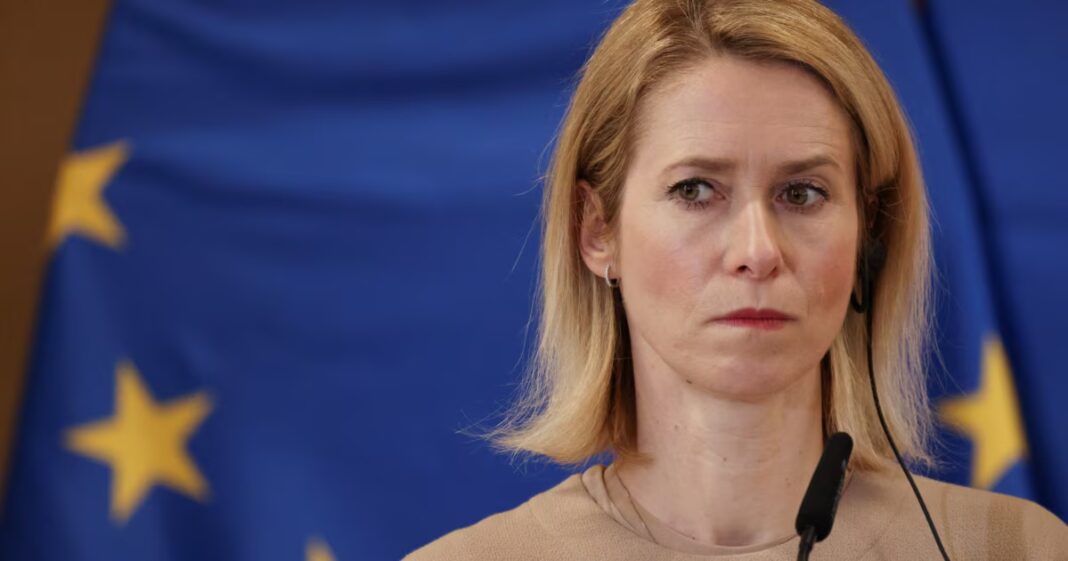

EU High Representative for Foreign Affairs and Security Policy Kaja Kallas is not surprised by the Russian side’s rude, as reported in the media, response to the request of delegates from France to involve Europe in negotiations on ending the war in Ukraine. Kaja Kallas told reporters in Brussels on 16 March ahead of an EU Foreign Affairs Council meeting, Radio Liberty reports.
“Russia has shown that it doesn’t really want to negotiate. It is actually stepping up its attacks on Ukraine because it wants its maximalist goals to be satisfied. And so, since the Europeans are not prepared to give them these maximalist demands, of course, why should they talk to us?” – Callas remarked.
The EU top diplomat emphasised that pressure should first of all be increased on Russia, in particular to enforce a maximum ceiling on oil prices, to fight the so-called shadow fleet transporting raw materials to circumvent restrictions, and to agree on a $90 billion loan for Ukraine.
“All of these are important for us to put pressure on Russia to move from pretence negotiations to real negotiations… The United States’ relaxation of sanctions on Russian oil is a dangerous precedent because what we need now is for them to have less money to wage war, not more,” Kallas noted.
The Financial Times reported the day before, citing unnamed officials and diplomats, that US attempts to mediate a peaceful resolution to the war between Russia and Ukraine have stalled as US President Donald Trump is losing interest in the talks.
One of the reasons is cited as the US and Israel’s war against Iran, which has diverted Washington’s attention from the Ukrainian direction. According to European diplomats, US officials told their EU counterparts last week that the US will not tighten sanctions against the Russian oil industry.
Also, according to the Financial Times, Russian presidential aide Yuri Ushakov bluntly rebuffed French representatives who were trying to persuade the Kremlin to allow Europe into peace talks.
A senior European diplomat said that French presidential advisers Emmanuel Bonne and Bertrand Buchwalter travelled to Moscow in February for talks with Ushakov. The Russian presidential aide allegedly responded to a request for EU representatives to attend talks between Russia, Ukraine and the United States by using profanity.
“Sorry, actually, no we don’t, fuck you,” the Financial Times quoted Ushakov as saying (Sorry, actually, no we don’t, fuck you).
Commenting on the meeting, Kremlin spokesman Dmitry Peskov told the Financial Times that European countries “do not want to help the peace process”. “When the French representative arrived, he did not bring any positive signals,” Peskov said.
He said the Europeans were “spending all their efforts to convince the Ukrainians to continue the war,” but Russia was “confident that it is winning” and “the dynamics on the front” for the Russian army were positive.
US President Donald Trump, in turn, said in an interview with NBC News that the conclusion of a peace agreement is hindered by the position of Ukrainian President Volodymyr Zelensky. “I’m surprised that Zelensky doesn’t want to make a deal. Tell Zelensky to make a deal, because Putin is ready to make a deal. Zelensky is much harder to make a deal with,” Trump said.
Ukrainian President Vladimir Zelensky said the U.S. should put more pressure on Russia, not him. “We don’t trust Russia, but I think and believe that the Americans really want to end this war. I hope they will help us, but more pressure should be put on Russia, not me,” Vladimir Zelensky told Politico.
Trump also noted that the temporary easing of sanctions against Russian oil was related to the energy crisis following the closure of the Strait of Hormuz.
“I want there to be oil in the world,” Trump said. The US president clarified that the sanctions will return once the Iran-related crisis is over. Trump noted that Iran wants to make an agreement, but the White House is not yet planning agreements with Tehran “because the conditions are not good enough yet.”
The first rounds of talks between Russia, Ukraine and the United States were held on 23-24 January and 4-5 February in the United Arab Emirates, while the third round was held on 17-18 February in Switzerland. The next meeting was planned for early March, but the fighting in the Middle East prevented its organisation.