

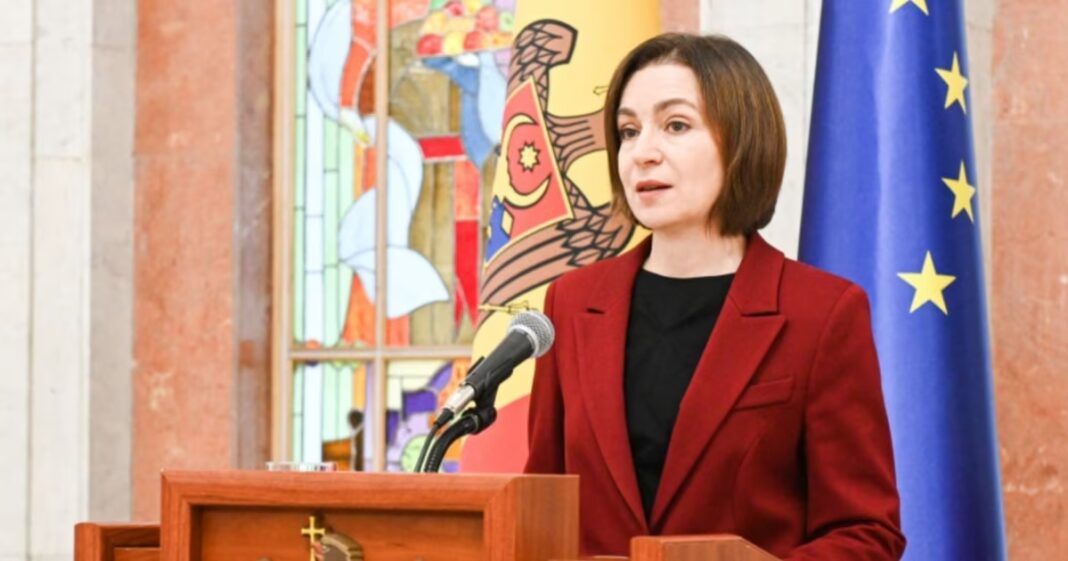

Moldovan President Maia Sandu has criticised Russian President Vladimir Putin’s decision to make it easier for people from Moldova’s breakaway region of Transnistria to obtain Russian citizenship, calling it a mobilisation tool for a full-scale Russian invasion of Ukraine.
“They probably need more people to send to war in Ukraine,” Sandu said at a security conference in Tallinn on 16 May. Her words were quoted by the Politico publication.
The Moldovan president said that Moscow’s decision might be an attempt to increase pressure on Chisinau. She also recalled that after Russia launched a full-scale war against Ukraine, some residents of Transnistria received Moldovan citizenship “for security reasons”.
Sandu urged Transnistrian residents to be cautious about the possibility of a simplified Russian passport.
Asked whether Putin could block Moldova’s EU membership because of the Transnistrian case, Sandu said that “only the EU can decide whether Moldova can become part of the European Union or not. Russia has nothing to do with this”.
On 15 May, it became known that Russian President Vladimir Putin signed a decree on simplified admission to Russian citizenship of residents of Moldova’s breakaway region of Transnistria. The document was published on the official portal of legal information of the Russian Federation.
According to the decree, the right to simplified citizenship was granted to adult foreign citizens and stateless persons permanently residing in Transnistria at the time of entry into force of the document.
For them, the requirements of five-year residence in Russia, proof of knowledge of the Russian language, Russian history and the basics of Russian legislation are cancelled.
It will be possible to apply through Russian diplomatic missions and consulates. The decree states that the decision was made “in order to protect human and civil rights and freedoms”.
Ukrainian President Volodymyr Zelensky said that Putin’s decision means that the Russian Federation is interested in “far from only Donbass”. According to the head of state, he discussed the issue with Ukrainian Foreign Minister Andriy Sibiga and instructed the Ukrainian Foreign Ministry to contact Moldova regarding “joint assessment and joint actions”.
Transnistria is a separatist region of Moldova that has been effectively outside of Chisinau’s control since 1992. Russia formally recognises Moldova’s territorial integrity, but supports Transnistria politically, economically and militarily.
A Russian military contingent is stationed in Transnistria and has been in the region since the 1990s.
According to various estimates, the number of Russian military personnel is around 1,200-1,500. Moscow considers the presence of its military to be legal, citing a 1992 agreement. Chisinau, on the contrary, calls the contingent illegal and demands its withdrawal.
In April this year, the secretary of the Russian Security Council, Sergey Shoigu, said that more than 220,000 Russians live in Transnistria, whose interests are allegedly threatened by the actions of the Ukrainian and Moldovan authorities.