

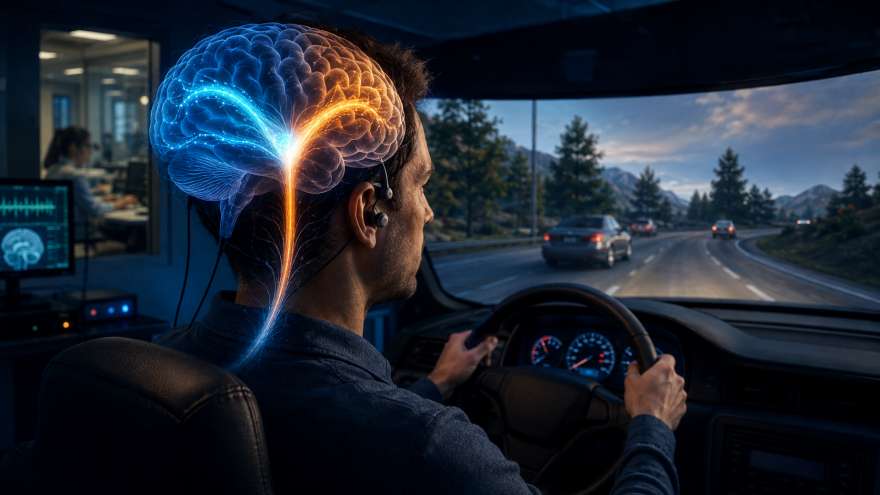

A study by psychologists Jason Watson and David Strayer of the University of Utah has shown that only a small proportion of people are capable of performing two complex tasks simultaneously without any noticeable decline in performance.
The study, entitled ‘Supertaskers: Profiles in Extraordinary Multitasking Ability’, was published in the academic journal *Psychonomic Bulletin & Review*. A total of 200 people took part in the study.
The participants were tested on a highly realistic driving simulator. First, they performed the tasks separately; then they drove a car whilst simultaneously taking the complex OSPAN auditory test, which requires them to memorise information and solve cognitive problems.
For the vast majority of participants, performance deteriorated during the transition to multitasking, either in driving, in the cognitive test, or in both tasks simultaneously.
However, 2.5 per cent of participants — that is, approximately five out of 200 — showed no deterioration in performance when carrying out two tasks simultaneously. The researchers dubbed them ‘supertaskers’ – people with an exceptionally high capacity for multitasking.
Moreover, these participants also performed well when carrying out each task separately: they were in the top quarter of the sample for all key indicators of driving performance and the working memory test. Statistical modelling showed that the emergence of such a group was unlikely to be explained by mere chance.
The study cast doubt on the notion that the ability to effectively divide one’s attention between several complex tasks is the same for everyone. The authors concluded that there are significant individual differences in the mechanisms of attention and cognitive control.
At the same time, the figure of 2.5 per cent should not be interpreted directly as proof that precisely this proportion of the world’s population possesses exceptional multitasking abilities. The study was conducted on a sample of 200 participants and tested a specific combination of tasks — driving a car and a complex working-memory load.
The study also has practical implications for the issue of mobile phone use whilst driving. It was based on previous research showing that talking on the phone generally impairs a driver’s ability to monitor the road situation. The discovery of a small group of ‘super-taskers’ was an exception to the general rule, rather than proof that multitasking is safe for most drivers.
The study was conducted at the Department of Psychology at the University of Utah.