

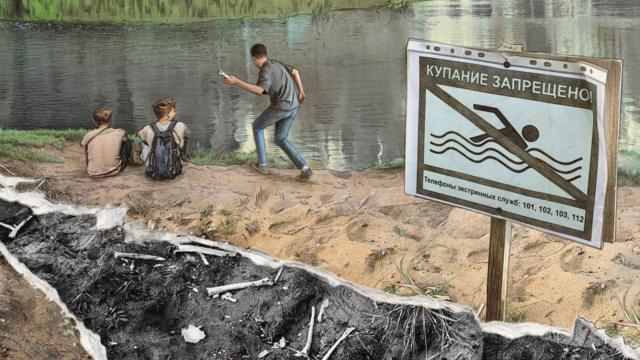

For some, the swimming lake in Emva is a wonderful spot – a picturesque body of water with swans, where it’s lovely to cool off on a hot summer’s day.
Others call it a graveyard.
The whole town knows that bones lie there in layers on top of one another,’ wrote one social media user beneath a photograph of an artificial beach in the northern Russian Republic of Komi.
Local residents have been swimming in this lake for decades. However, it came into being after excavators dug up the soil at the site of a mass grave for victims of the Soviet Gulag system – the infamous network of forced-labour camps.
Residents of the town regularly find human bones on the shore.
There is neither a monument nor a memorial plaque here to commemorate the dead, which might have served as a reminder of the site’s history. The authorities have never designated this area as a burial site.
During a recent debate on what to do with the human remains, Russian officials refused even to confirm that the bones belonged to Gulag prisoners.
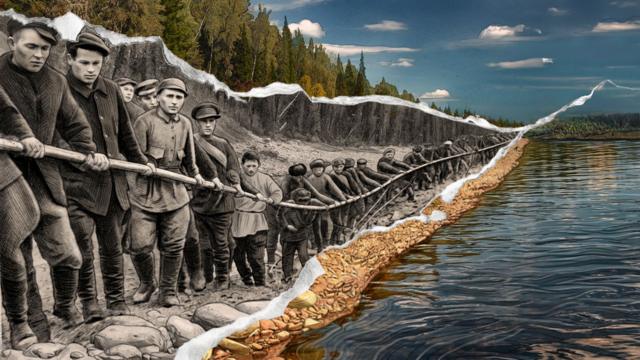
Photo credit: TASS/BBC
In the 1980s, it was decided to create an artificial lake and a beach here, complete with parasols and changing cubicles. During the works, an excavator unearthed the remains and fragments of wooden coffins along with the soil.
However, this did not halt construction at the site, located more than 1,000 km north-east of Moscow.
Water from underground springs was channelled into the excavation pit, and since then the residents of Emva, a town with a population of around 15,000, have been swimming there regularly.
But five years ago, a fire in the area and the arrival of a group of researchers sparked fresh controversy over what to do with the bones.
Some locals argued that the entire site should be excavated again and all the remains reburied. Others called for a cross to be erected on the site. Yet another group argued that there was no need to make a fuss – claiming that the Gulag was not really that terrible, and that the camps were populated exclusively by criminals.
In the end, the local authorities did nothing.
This inaction reflects a wider trend in Russia, where mass graves from that period are rarely marked in any way.
People who try to investigate these events or honour the memory of the victims face persecution, whilst the subject of the Gulag system is becoming increasingly taboo.
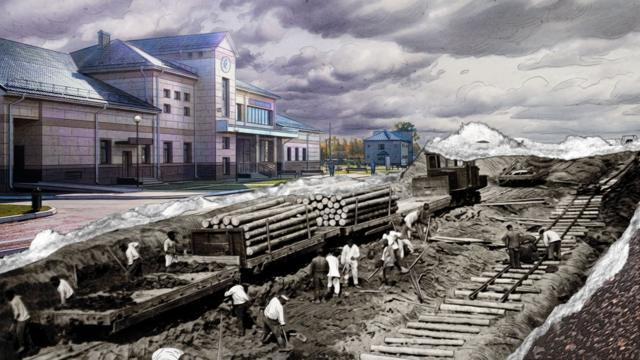
Photo credit: NA Komi /USTR/BBC
According to estimates by the Moscow Museum of the History of the Gulag – which the authorities forced to close this year – millions of people passed through Soviet camps and correctional facilities between 1930 and 1956.
Around four million of them were convicted on political grounds.
During this period of repression, under Stalin and immediately afterwards, more than two million people died in places of detention. Six million were subjected to forced resettlement to remote regions of the Soviet Union.
Emva, which means ‘clean water’ in the Komi language, grew out of a forced-labour camp founded in 1928. Most of the people living in this area are descendants of Gulag prisoners or their guards. The same is true of the Komi region as a whole. Even now, there is a men’s penal colony operating in Emva.
Living conditions in the northern camps, surrounded by subarctic taiga, were brutal. There was a severe shortage of accommodation for prisoners. Even in winter, when temperatures dropped to -50 °C, many lived in dugouts or tents.
From morning till night, they felled trees to build a railway through the forest. Their daily ration consisted of 400 g of bread and a plate of soup.
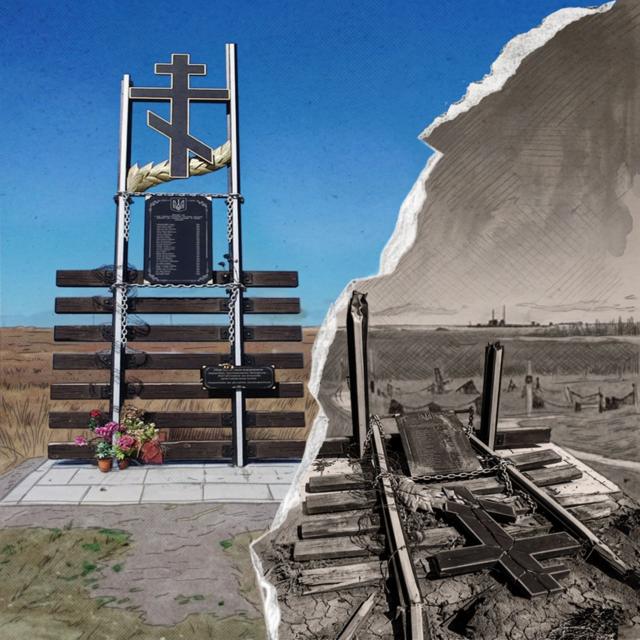
Photo credit: T.me/Officially_vorkuta/BBC
Historians estimate that over a million prisoners – both political and criminal – passed through the camps in Komi, although there are no precise figures on how many of them died there.
When firefighters were called out in 2021 to put out a grass fire nearby, they discovered the bones of at least three people there. This prompted the local authorities to intervene.
Investigators established that the remains were at least 15 years old and showed no signs of violent death. They decided not to open a case due to the absence of a criminal offence.
The investigators’ report noted that the site where the bones were found had served as an unofficial mass burial ground for Gulag prisoners between 1930 and 1950.
And that would have been the end of the matter, had it not been for a group of researchers specialising in the history of the Gulag arriving six months later from the regional capital, Syktyvkar.
“We went to the quarry, and we didn’t even have to look for anything – the bones were right there,” Grigory Spichak, a writer and local historian, told BBC News.
Photo credit: TSGALI SPB/BBC
Another researcher, Igor Sazhin, then remarked:
“We found ribs and pelvic bones. It’s impossible to mistake them for animal remains.
Leaving them like this is simply inhumane. Emva carries on with its daily life, unwilling to acknowledge this horrific reminder of the past.
Under Russian law, the authorities are obliged to register and mark newly discovered burial sites — including the graves of victims of mass repression — and, where necessary,7 (7). I contacted the public prosecutor’s office, but nothing happened.
. That this is a grave of Gulag prisoners
However, others are far more certain of this. ‘Shovels,’ wrote researcher Orest Romanko on social media.
The history of mass repression in Russia is a politically sensitive topic, and people attempting to locate mass graves are being persecuted.
The court fined Nikolai Arakcheyev, the museum director, for operating without the necessary authorisation.
Robert Latypov, head of the Perm branch of the historical organisation Memorial, became the subject of a criminal investigation after he, together with five Lithuanian volunteers, tidied up an abandoned cemetery near a former settlement for special resettlers and erected a cross on one of the graves.
The case was closed the following day after it was brought to Vladimir Putin’s attention at a meeting of the Russian Human Rights Council in 2019.
However, at the same meeting, the president spoke out against unrestricted access to Soviet archives.
‘We know how the NKVD operated in the 1930s, and it may not always be pleasant for relatives if their ancestors’ cases are made public,’ Putin stated.
Swimming prohibited
In 2025, the Russian State Archives began classifying the files of victims of political repression as documents for official use only.
This year, the independent cultural space Revolt Centre in Komi, which was engaged in collecting, researching and disseminating information on political repression, was designated an extremist organisation — as was Memorial, an organisation established to investigate human rights violations in the USSR, which has also been banned in the Russian Federation.
Meanwhile, the Moscow authorities have replaced the Gulag Museum with the Museum of Remembrance, dedicated to Soviet citizens who died during the Nazi invasion. Prior to this, the museum had been closed for two years on the pretext of fire safety breaches, and its director, Roman Romanov, was dismissed.
In the summer of 2022, the public prosecutor’s office banned swimming in the lake at Emva. A local court ordered the local authorities to survey the site and reburial all remains by the end of the year.
However, the Supreme Court of the Komi Republic overturned this decision, stating that the site must first be investigated to establish whether it is indeed a burial site for victims of mass repression.
Internalised shame
At the end of last year, enforcement proceedings were initiated to compel Russian officials to investigate the remains in the lake, but these were immediately halted.
The BBC contacted the Russian Federation’s General Prosecutor’s Office, the local administration and the judiciary, but received no response.
Stalin’s repressions remain a taboo subject, noted Lana Pilaeva, editor-in-chief of the independent regional publication Komi Daily, in a comment to BBC News.
“It’s a shameful subject,” she said. “This also applies to the descendants of those who were repressed, perhaps because they still harbour a lingering, deep-seated sense of shame at having been labelled ‘enemies of the people’. The descendants of the perpetrators, too, do not wish to explore this subject.”
This summer, the authorities erected a ‘No Swimming’ sign on the lakeshore. However, people continue to swim, according to local residents.
Pilaeva explains: ‘What is truly surprising is that people have no qualms whatsoever about swimming amongst the bones.’
Additional material was prepared by Olga Ivshina.