

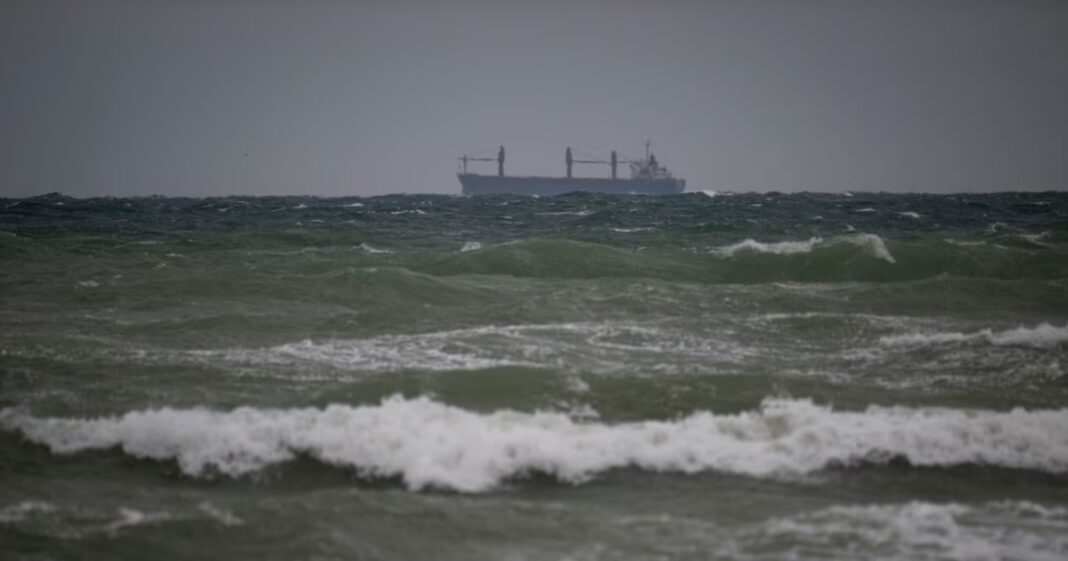

Ministers in Brussels will discuss Black Sea security on 16 November following a series of incidents involving civilian vessels off the coasts of Romania and Bulgaria. The focus will be on a joint maritime security centre, which Romania and Bulgaria plan to set up with the support of the European Commission: the Commission has pledged to allocate up to 50 million euros for this purpose.
The meeting will take place following a session of the EU Foreign Affairs Council, according to Radio Free Europe’s correspondent in Brussels. The centre will be based at facilities in Constanța, Romania, and Varna, Bulgaria. It will monitor the situation at sea, facilitate the exchange of information on threats and provide early warning of incidents, as well as help to protect critical infrastructure — ports, undersea cables, pipelines and maritime trade routes. The European Commission expects the centre to become operational in 2027.
Romanian Foreign Minister Dan Neculescu spoke about the latest incidents ahead of the meeting. According to him, over the weekend, four alerts were issued in the country within a 24-hour period due to the threat of drones, and three vessels were struck. “This is unacceptable,” he said.
Earlier, the Romanian Prime Minister reported that three commercial vessels had been attacked by drones near the Danube Delta, close to the town of Sulina. On the evening of 14 November, the Romanian military scrambled fighter jets twice in that area.
Another incident occurred on 28 October: drones attacked the container ship CONTSHIP JET off the coast of Bulgaria. The Bulgarian Navy rescued 18 crew members. No one has officially been held responsible for these attacks.
Neculescu stated that he intends to call on his counterparts from other countries to continue providing Romania with the necessary resources and capabilities, as well as to seek coordination between NATO and the EU.
Bulgaria’s Minister for Foreign Affairs, Velislava Petrova-Chamova, emphasised that the rise in the number of attacks affects all countries in the Black Sea region. “Finding a solution to this problem will be a key priority for us,” she said.
The European Commission expects that the centre will help strengthen the protection of maritime routes and critical infrastructure. Last week, European Commission President Ursula von der Leyen visited Romania and Bulgaria and announced the allocation of up to 50 million euros to speed up the centre’s establishment.
According to Petrova-Chamova, Bulgaria intends to discuss the practical use of these funds during the meetings. “It is important to understand exactly what the 50 million, which the President of the European Commission announced last week, will be spent on. We will therefore hold talks with our Romanian colleagues, with our Turkish colleague, who is also here, and with the European Commission to clarify how this funding will be implemented,” said the minister.
In addition to maritime security, participants will discuss the development of alternative trade routes between Europe and Asia, including the Middle Corridor through the Caucasus and routes to the Persian Gulf. Developing these routes should help Europe diversify its energy supplies and logistics chains.
The original version of this article first appeared on Glob-News.com.