

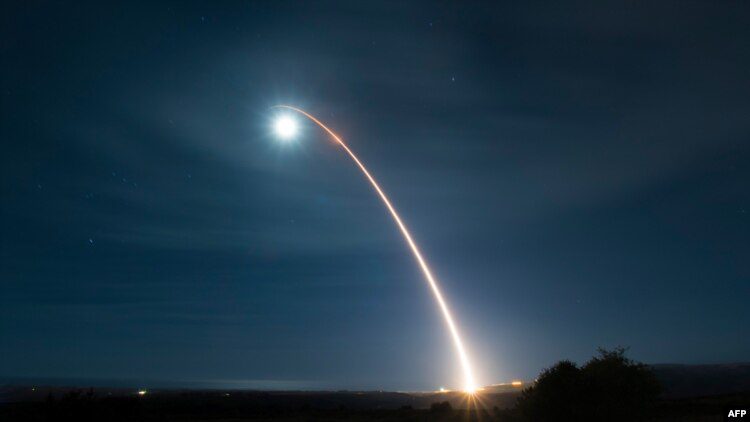

The US on 5 November test-fired an unarmed Minuteman III intercontinental ballistic missile from Vandenberg Base in California, the country’s Air Force Global Strike Command said.
The test, dubbed GT 254, was intended to assess “the current reliability, operational readiness and accuracy of the ICBM system that is the backbone of US national defence,” it said.
“GT 254 is not just a launch, it is a comprehensive assessment to test and validate the ICBM system’s ability to fulfil its critical mission. The data collected during the test is invaluable in ensuring the continued reliability and accuracy of the ICBM weapon system,” said Lt. Col. Curry Ray, 576th Flight Test Squadron commander
The command notes that this launch is part of a series of routine and periodic activities that are critical to evaluating and validating the capabilities of the Minuteman III.
The unarmed ICBM warhead reportedly flew more than 6,700 kilometres to a missile defence test site in the Marshall Islands.
Minuteman III missiles have been in service with the US Army since the early 1970s and are regularly modernised. The missile has a maximum range of 15,000 kilometres. It can carry from one to three nuclear warheads with a yield of 0.3-0.6 megatons. Now there are about 400 Minuteman III on combat duty in the US.
US President Donald Trump said on 30 October that the US would “immediately” begin testing nuclear weapons because “other countries are doing it”.
Trump made the decision to test during a trip to the Far East and after meeting with Chinese leader Xi Jinping. It was also announced after Russian leader Vladimir Putin twice in the past week reported successful tests of Russian nuclear-powered weapons: the Burevestnik missile, which is supposedly impossible to intercept, and the Poseidon underwater vehicle (torpedo).
Subsequently, US Energy Secretary Chris Wright clarified that the nuclear tests planned by President Donald Trump’s administration do not yet envisage the detonation of nuclear warheads, but are so-called “systemic or non-critical tests”.