

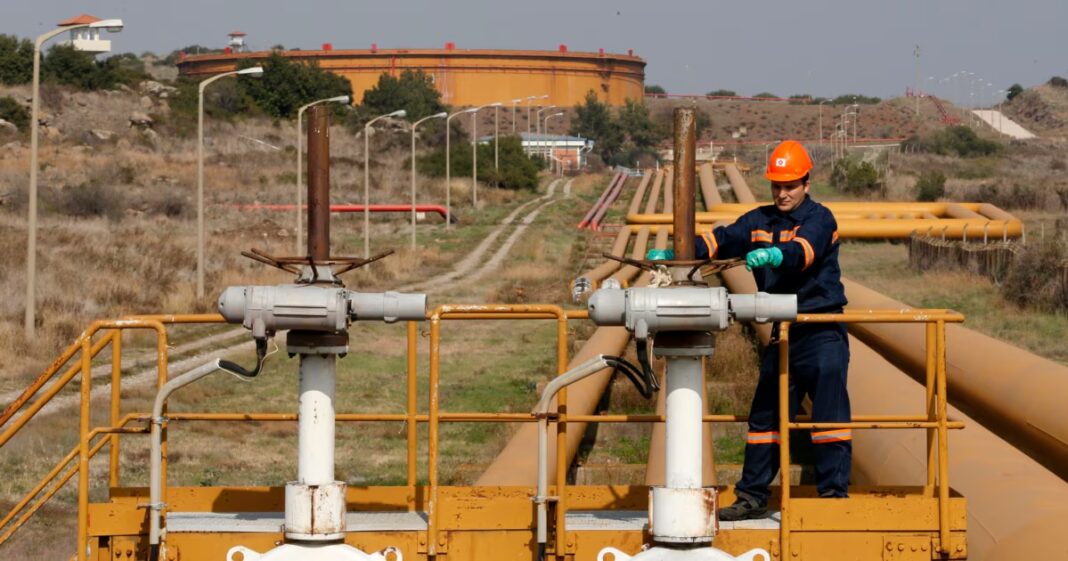

Turkey’s Energy Minister, Alparslan Bayraktar, stated that the disruption to shipping through the Strait of Hormuz demonstrates that the world needs alternative routes for transporting oil, and that Ankara is in talks with Iraq regarding the expansion of new energy export corridors.
In an interview with the state broadcaster TRT, Bayraktar said that Turkey and Iraq are discussing the construction of a pipeline from the Silopi-Habur border crossing to Basra, which would allow some of Iraq’s oil, as well as oil from the Gulf states, to reach global markets without being entirely dependent on the Strait of Hormuz.
He noted that, in the first phase, the pipeline between Iraq and Turkey to the Turkish Mediterranean port of Ceyhan would be able to transport up to 750,000 barrels of Iraqi crude oil per day.
According to Bayraktar, the route’s current capacity is 1.5 million barrels a day, and Turkey has proposed expanding the infrastructure and extending it to Basra, increasing capacity to 2.5 million barrels a day.
The Turkish minister stated that around 20 million barrels of oil pass through the Strait of Hormuz every day, and that ongoing tensions in this waterway have highlighted the need for reliable alternative routes for energy exports.
He added that in future, in addition to Iraqi crude oil, the corridor could also be used to export oil from Kuwait and other Gulf states.
Earlier, US President Donald Trump stated that an agreement to resume traffic through the Strait of Hormuz could be reached “tomorrow or the day after tomorrow”, adding that progress had been made in the negotiations.
Trump’s statement came after Axios reported, citing sources, that the United States, Iran and Oman were close to reaching a temporary agreement on the Strait of Hormuz, a waterway through which, prior to the US and Israeli war against Iran, approximately one-fifth of the world’s oil and gas transit passed.
Trump warned that if Iran refused to reach an agreement, the country would face “severe strikes”.
The war, which began with US and Israeli air strikes on Iran in late February, has led to sharp fluctuations in oil prices – rising when the attacks intensified, and falling when hopes of a negotiated settlement re-emerged.
Iran had previously threatened to impose charges or duties on ships passing through the Strait of Hormuz.
The United States and other countries insist that the strait is an international waterway and is not under the control of any single country.
Washington has resumed its naval blockade of Iran in the Strait following the breakdown of the truce between the US and Iran signed in June.
Iran has also, at times, effectively blocked the waterway, in particular by attacking ships which, it claims, had not received the necessary authorisation from Tehran.