

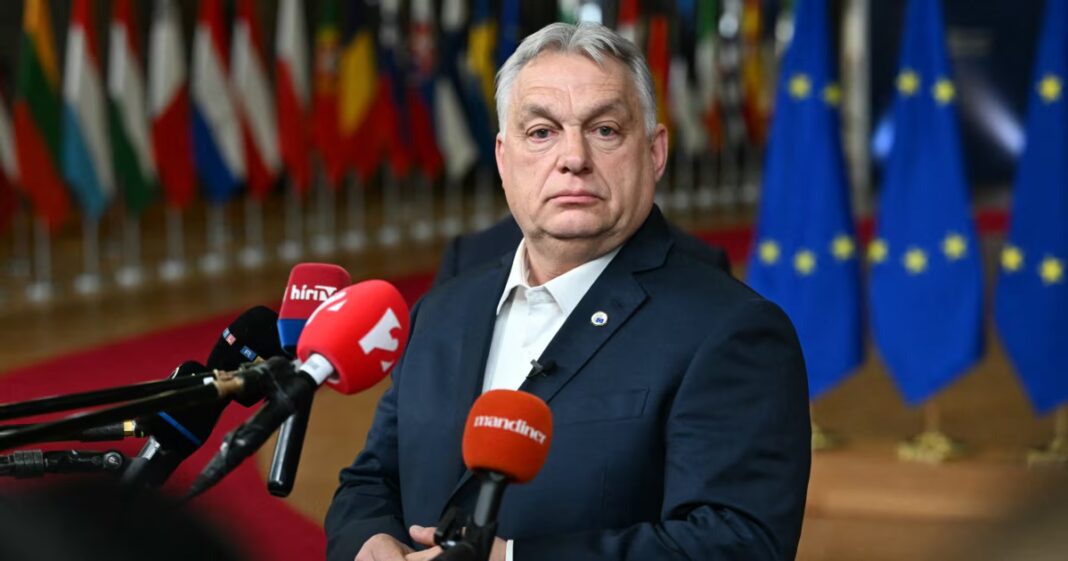

Russia’s Foreign Intelligence Service (SVR) has considered a scenario in which an assassination attempt on Hungarian Prime Minister Viktor Orban could be staged in order to raise the rating of his Fidesz party ahead of the parliamentary elections to be held on 12 April, The Washington Post reported citing European intelligence data.
According to the report, this scenario was discussed in an internal report of the SVR, received and authenticated by the European intelligence service.
WP specifies that it is not known at what level of Russian authorities the proposal was discussed, but Kremlin spokesman Dmitry Peskov called the report “disinformation.” Orban’s spokesman Zoltan Kovacs did not respond to a request for comment, while Russia’s Foreign Intelligence Service declined to comment.
According to journalists, the idea of an “assassination attempt” arose because Russian intelligence services were concerned about a sharp drop in Orban’s and his party’s ratings on the eve of the election.
According to the latest polling data, Orbán’s party’s rating barely reached 40 per cent, while the rating of its opponent, the Tisa party, exceeded 46 per cent.
In a related development, according to data previously released by the Financial Times, Russia has launched a social media campaign in Orban’s favour, run by the Kremlin-linked Social Projection Agency, and reportedly even sent political technologists to Hungary.
In an internal report obtained by European intelligence agencies, Russian intelligence services in Hungary proposed a scenario that would “fundamentally change the entire paradigm of the election campaign” and shift the focus “from the rational sphere of socio-economic issues to the emotional one,” according to the document seen by WP.
According to the report, the idea of the “assassination attempt” probably came about after Hungary’s relations with Ukraine were sharply aggravated by the stoppage of cheap Russian oil pumping through the Druzhba pipeline: this caused a rise in petrol prices in Hungary and increased social discontent with the Orban government.
Because of the stoppage of the Druzhba pipeline, Hungary blocked another loan to Ukraine, causing Ukrainian President Volodymyr Zelensky to declare that he would give the Armed Forces a “one-man EU address,” referring to Orban.
Hungarian authorities criticised these statements by Kiev and spoke of “real threats” from Ukraine.
There have been no real attacks on Orban so far, Washington Post journalists note. At the same time, the existence of such a plan, in their estimation, indicates Moscow’s high interest in the outcome of the Hungarian elections.
In 2024, there was an assassination attempt on Prime Minister Robert Fitzo in Slovakia, which neighbours Hungary. However, the assassination attempt was not election-related and had no effect on the politician’s ratings. The suspect in the shooting stated that he was not in agreement with the government’s policy.
Earlier, Russian Ambassador to Budapest Yevgeny Stanislavov said that Moscow is not involved in any way in the election campaign in Hungary. According to him, Russia only wants to “ensure the continuation of normal bilateral relations and the development of mutually beneficial co-operation”. The Hungarian government denied any Russian interference.