

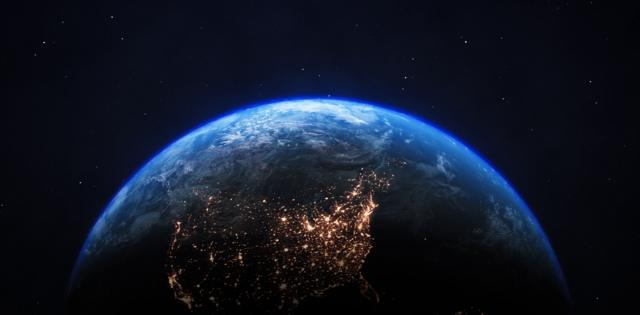

The fate of the Universe is one of the most mysterious topics in science. And there are still more questions than facts.
Scientists paint several scenarios. Perhaps the stars will slowly fade away, and space will become almost empty and cold. Or everything will explode in an instant: rips, catastrophes, a destructive force that will change the very fabric of space.
And perhaps the end will not be the end, but the beginning of something entirely new and even grander.
To understand where we are going, we must first remember where it all began.
Everything that exists, and more
The universe is everything. It encompasses all space, all matter (everything that occupies space and has mass), all energy, and even time itself, as NASA explains.
The origin of the universe is most often explained using a hypothesis known as the Big Bang theory. It has about 13.8 billion people behind it
This hypothesis is called the Great Freeze or the Thermal Death of the Universe. The idea is simple: eventually, all the atoms in the universe will reach thermal equilibrium – everywhere will be the same temperature – and motion, processes and life will simply stop, explains Britain’s Royal Institution.
“All indications are that the universe will become emptier, colder and more distant,” adds Raul Abramo of the University of São Paulo.
“Galaxies will get farther away, stars will age and disappear. This is the final state in which the universe will essentially become a huge cosmic graveyard.”
Photo: Arctic Images via Getty Images
The Big Rip
If such an ending seems too calm, there is another scenario – a more dramatic one.
It’s based on the fact that the universe expands faster under the influence of dark energy.
If dark energy proves to be unstable, the universe could collapse to the point where stars, planets, and even atoms “disintegrate,” NASA explains.
The Great Compression and New Beginnings
There are significantly darker scenarios for the universe.
If dark energy weakens or changes its influence, gravity could take over and then the universe would begin to contract, eventually converging at a single point. This scenario is known as the Great Compression.
An even bolder hypothesis is the Great Bounce. It proposes that the full contraction is not the finale, but only a transitional phase. After the collapse, a new Big Bang could occur and another universe would be born, which would begin to expand again, forming galaxies, stars and planets.
In this model, universes can appear and disappear over and over again in an infinite number of times
Earth will disappear much sooner: in about six billion years, the Sun will expand to the stage of a red giant and swallow up the inner planets.
“We actually know very little about cosmology,” Abramo admits.
The limited capabilities of today’s instruments prevent us from measuring the universe accurately while at the same time opening up space for even bolder hypotheses – such as the idea of multiverses, where our universe could be just one of many.