

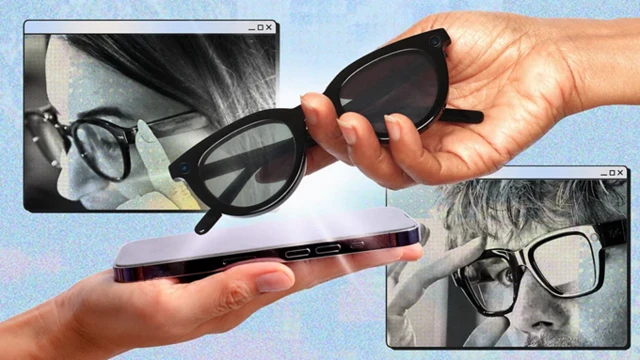

For decades, tech companies have been vying for our attention on screens. Now they want us to look at them far less often. Is this a way to overcome screen addiction, or another technological dystopia?
Apple, Meta, Snap and other Silicon Valley giants are increasingly promoting devices designed to free us from constantly staring at our smartphones.
Apple, according to reports, may launch AirPods with built-in cameras next year.
However, these cameras aren’t intended for photos or videos. According to Bloomberg, they will transmit information about the surrounding world to the Siri voice assistant, opening up new ways of interacting with devices — without having to look at the screen every time.
Apple has not yet confirmed or denied these reports. However, Bloomberg’s report is based on information from a journalist who has long been regarded as one of the most reliable insiders when it comes to the company’s products. And the most interesting thing here is that AirPods with cameras are just part of a much bigger trend.
For the past sixty years, the screen has been the primary interface between humans and computers. But now it may gradually be taking a back seat.
Alongside smart glasses and other next-generation devices — from headphones to personal AI gadgets that can be worn around the neck or on clothing — the biggest tech companies are creating a whole ecosystem of products designed to reduce the time we spend in front of screens.
If this idea does indeed come to fruition, it could completely transform the way we use technology.
Admittedly, the consequences could vary widely. At best, technology will become less intrusive and blend more naturally into our lives. At worst, it will become even more deeply ingrained.
But before that happens, millions of people will have to answer a simple question: do we actually want this at all?
Goodbye, screen?
Last week, Snap, the creator of Snapchat, unveiled its new Specs smart glasses with built-in artificial intelligence. The price is staggering: $2,195.
However, it wasn’t the technology that was the main talking point after the launch.
During a television interview, the glasses were pressing so hard against Snap CEO Evan Spiegel’s ears that it looked rather painful. He later joked: ‘It’s just these ears of mine.’
The glasses are indeed larger and heavier than most of their competitors. Although a company spokesperson assured the BBC that they can be worn for hours without much discomfort.
But the new model offers capabilities that were virtually unheard of before. Most importantly, the glasses can operate independently, without a constant connection to a smartphone. Most such devices still rely on a phone.
“For decades, computers have forced us to look down, sit still or lose touch with the real world,” says a Spiegel press release. “These specifications mark the beginning of a new digital era.”
It’s worth clarifying this point. The lenses have a built-in display — as in some models of meta-glasses. But it does not overlay the real world, nor does it remain in front of your eyes all the time. Digital information is merely superimposed briefly onto what the wearer sees around them.
There are probably few people willing to pay that amount whilst wearing such bulky glasses. But for this particular audience, Specs really does offer something new.
Meanwhile, the market for smart glasses and other wearable devices is growing rapidly.
The most popular are Meta glasses — according to available data, the company has already sold around seven million devices. What’s more, this week it unveiled a new, more affordable range of models.
But as popularity grows, so do the questions.
When the camera is always there
To say that smart glasses are controversial is still putting it very mildly.
A whole category of bloggers has already emerged online who use the built-in cameras on Meta glasses to secretly film passers-by or carry out various acts of provocation. Often, people aren’t even aware they’re being recorded.
Meta and Snap glasses have a small indicator light that comes on when recording. However, many believe this is not enough.
The BBC spoke to CNBC journalist Brenda Zadrozna about the privacy issue.
‘One morning I went out for a run and asked a city park employee when the drinking fountains would be turned on. He was wearing Meta glasses,’ said Zadrozny. ‘And even for me, a journalist who writes about technology, it was a very uncomfortable feeling.’ We’re expecting a strong negative reaction from the public.
A world without screens, or even more technology?
At the same time, according to media reports, Meta is considering the possibility of creating glasses that will work with audio only and will not have any cameras at all.
And if anyone can navigate the minefield of privacy debates, it’s probably Apple. Privacy has long been an integral part of its brand.
It is not difficult to see how the company might get round some of these issues.
If Bloomberg’s report is correct, the cameras in the AirPods won’t allow you to take photos or record videos in the same way as a conventional camera.
Furthermore, Apple could, in theory, process all visual data entirely on the user’s device — without transmitting any data to the cloud or storing it there.
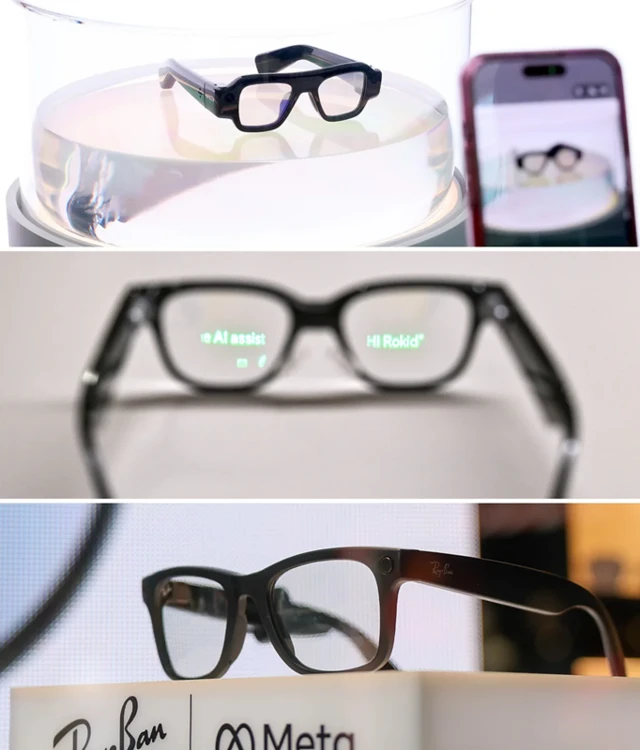
Photo credit: Getty Images
If you set aside the issue of privacy for a moment — although you certainly shouldn’t ignore it — what might such a world look like?
There are two scenarios.
The first is an optimistic one.
Cameras in AirPods would allow you to interact with the outside world without taking your phone out of your pocket or looking at the screen.
You could ask about objects in front of you, have a look in the fridge and get ideas for dinner using the ingredients you have, or use navigation that takes into account what you can see around you.
What’s more, there could be new, less intrusive ways to control devices — for example, using gestures.
Perhaps you don’t need any of this. On the other hand, there are very few tasks on a smartphone or computer today that can be carried out without looking at that same rectangular screen.
Don’t be too quick to say goodbye to your smartphone
‘Apple would hardly have added such a feature if it didn’t see real-world applications for it,’ says Ben Wood, chief analyst at CCS Insight, a research firm that has been studying the smart gadget market for years. “The only limit here is our imagination – what people can do with such devices.”
This approach echoes one of the most exciting promises of artificial intelligence. Ideally, AI should allow us to interact with a computer as naturally as we do with a human being, one that can carry out tasks on our behalf.
Apple is already taking its first steps in this direction by developing an updated version of Siri based on artificial intelligence.
As a result, we’ll be able to walk down the street, go about our business and use technology without taking our eyes off the real world.
In an age when more and more people are trying to spend less time in front of screens, this prospect looks rather appealing.
But there is another scenario — a far less optimistic one.
The tech industry is too reliant on screens. For example, Apple still makes almost all its money from the devices that feature these screens.
If screenless gadgets become mainstream, they may not replace smartphones, but simply add another way of interacting with technology.
We’ll continue to spend just as much time on our smartphones as we do now, and the new gadgets will fill in the moments when we don’t usually look at a screen — for example, on the way to work or simply whilst out for a walk in the city.
“I am absolutely convinced that the smartphone isn’t going anywhere. It has already become an integral part of modern society,” says Wood. “But I think that both the tech industry and many users really want to finally look up.”