

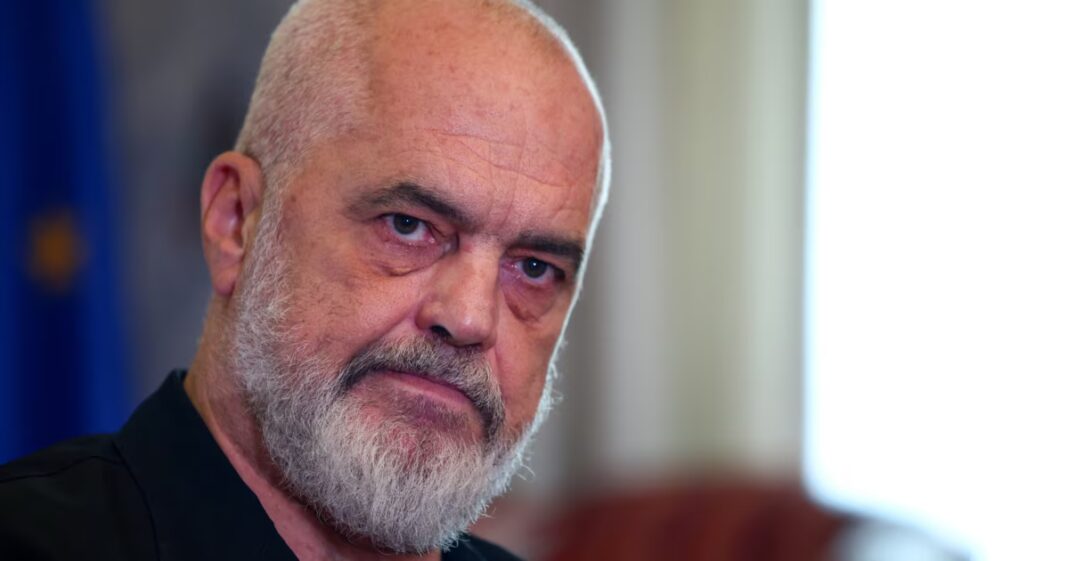

Albanian Prime Minister Edi Rama has stated that his country will continue to support Ukraine as it fights against Russian aggression. He wrote about this on social media platform X, commenting on President Volodymyr Zelenskyy’s statement that Ukraine would not recognise Kosovo’s independence, which had drawn criticism.
“What a shame to lose sight of a simple truth: freedom does not work on a ‘cashback’ principle.” Being against a war of aggression and in favour of a just peace is not a receipt that you tear up when the victim of barbaric aggression disappoints you. It is not a favour exchanged for a favour, but who you are and what you stand for in this chaotic world. And, fortunately, Albania is not a petty person who keeps score of who owes whom, but the Europe of the Balkans, which shows the way through its belief in freedom, democracy and peace, as well as through the power of its example,” Rama wrote on social media platform X.
The Albanian Prime Minister emphasised that Ukraine “may be mistaken, and is mistaken, regarding Kosovo”, but its right to be free remains unconditional, and the struggle for that right is a struggle for Europe and for Albania as well.
Volodymyr Zelenskyy’s statement came during his first visit to Serbia, and against the backdrop of the protracted political crisis in Kosovo. After Zelenskyy told journalists at a press conference in Belgrade on 8 August that Ukraine’s position on Kosovo’s independence “remains unchanged” — meaning that Kyiv still does not recognise it — a large Ukrainian flag was taken down in the centre of Pristina, and government officials made critical comments.
In February 2008, the Pristina Parliament voted in favour of a declaration of secession from Serbia. 90 per cent of Kosovo’s population are ethnic Albanians. Kosovo was proclaimed a democratic, sovereign and multi-ethnic state. The Serbian authorities at the time categorically opposed Kosovo’s independence. Serbia was supported by Russia, which proposed annulling Pristina’s decision and imposing a series of tough measures against it. The events leading up to Kosovo’s independence were preceded by a prolonged period of inter-ethnic tension and systematic oppression of the Albanian majority by the Serbian authorities, which escalated significantly in the late 1980sfollowing the abolition of the region’s autonomy by Slobodan Milošević. The former President of Yugoslavia, Slobodan Milošević, was charged with war crimes and crimes against humanity for his role in the wars in Bosnia, Croatia and Kosovo in the 1990s.
He is also accused of complicity in genocide during the Bosnian War of 1992–95, in which around 100,000 people were killed. Milošević was arrested and stood trial at the International Criminal Tribunal for the former Yugoslavia in The Hague from 2002 to 2006.
Milošević died in prison in The Hague on 11 March 2006. This led to the 1998–1999 Balkan War between the Kosovo Liberation Army and Yugoslav forces, marked by widespread ethnic cleansing and numerous casualties (in Srebrenica alone, in July 1995, 8,000 Bosniak Muslim men and boys were killed by Bosnian Serb forces). The war was brought to an end by a NATO air campaign. After the war, and in accordance with UN Resolution No. 1244, Kosovo was placed under the provisional administration of the United Nations Mission in Kosovo (UNMIK) and the international peacekeeping force (KFOR), following which protracted international negotiations under the auspices of the UN regarding the region’s final status failed to produce a compromise with Serbia. The state of Kosovo is currently recognised by the majority of UN and EU member states, although Serbia still regards it as its autonomous province.