


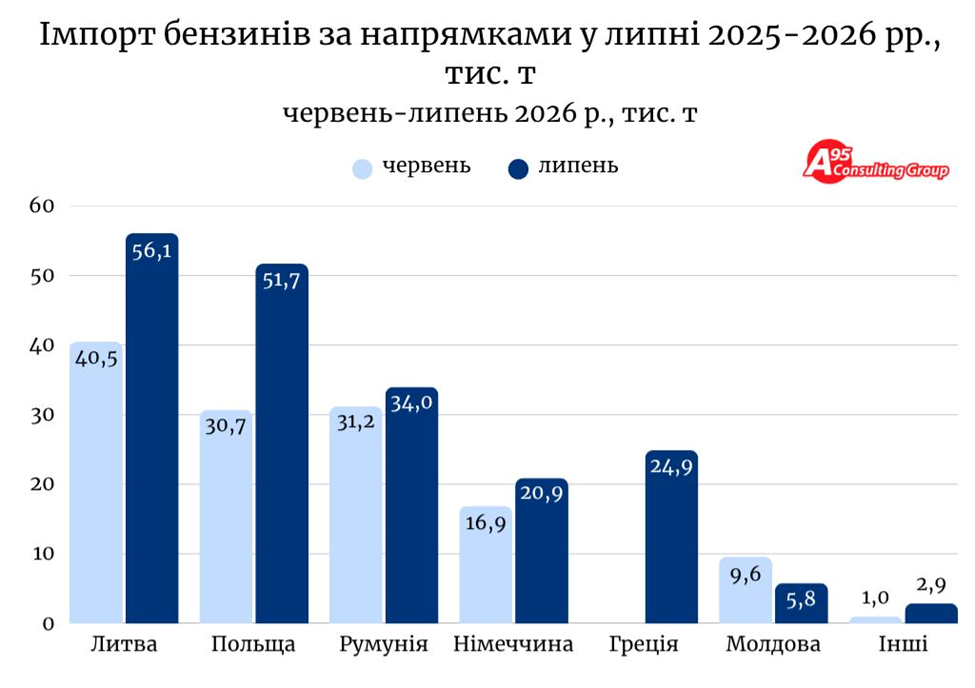
According to the Experts Club think tank, citing data from the ‘A-95 Consulting Group’, the Ukrainian petrol market continues to rely heavily on supplies from Poland and Lithuania: in July 2026, these two countries accounted for 55 per cent of total imports.
Ukraine received 56.1 thousand tonnes of petrol from Lithuania and 51.7 thousand tonnes from Poland. Together, this amounts to around 107.8 thousand tonnes out of a total import volume of approximately 196 thousand tonnes.
Imports from Poland, in particular, are showing exceptionally high growth rates. Compared with July last year, the volume of supplies increased by 68 per cent, reaching its highest level since August 2025.
The ORLEN oil refining group plays a key role in both markets. The group’s plants in Poland and Lithuania supplied around 97,000 tonnes of petrol to the Ukrainian market.
‘A-95’ estimates that ORLEN accounts for more than half of imports. Comparing the rounded figure of 97,000 tonnes with the total volume of 196,000 tonnes, this represents roughly half of the market.
On the one hand, the large and stable refineries in Poland and Lithuania enable Ukraine to rapidly scale up purchases during periods of heightened demand and to compensate for shortfalls from other suppliers.
On the other hand, more than half of the supply comes from just two geographical regions, and a very significant proportion of the supplies is linked to a single oil refining group.
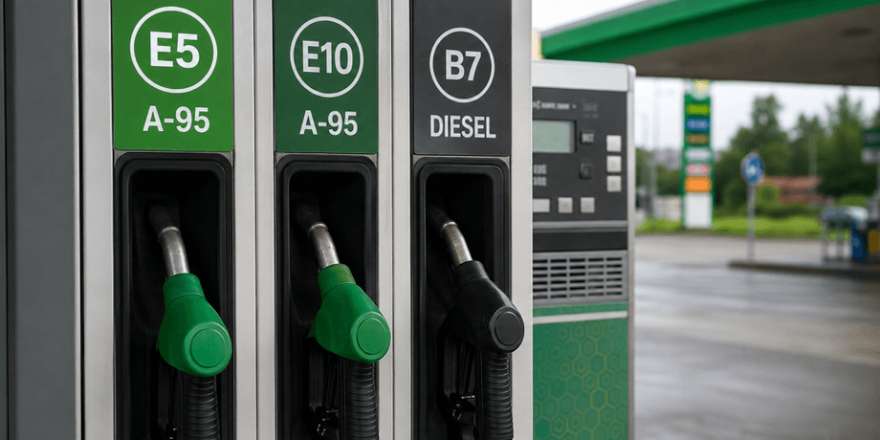
Poland’s importance has increased particularly since Ukraine switched to E10 petrol. The change in standard has limited the ability to source from certain traditional suppliers, including some Greek refineries.
That said, Greece has not disappeared from the market entirely. In July, Ukraine imported around 25,000 tonnes of petrol produced by Motor Oil.
Germany has also emerged as another rapidly growing market. A total of 21,000 tonnes of petrol were supplied from there, which is 78 per cent more than in July 2025. The entire volume was imported by the UPG network.
Thus, the structure of July’s imports demonstrates two parallel trends: the strengthening of ORLEN’s role as a key supplier and, at the same time, attempts by the largest Ukrainian retail chains to diversify their procurement via Germany, Romania and Greece.