

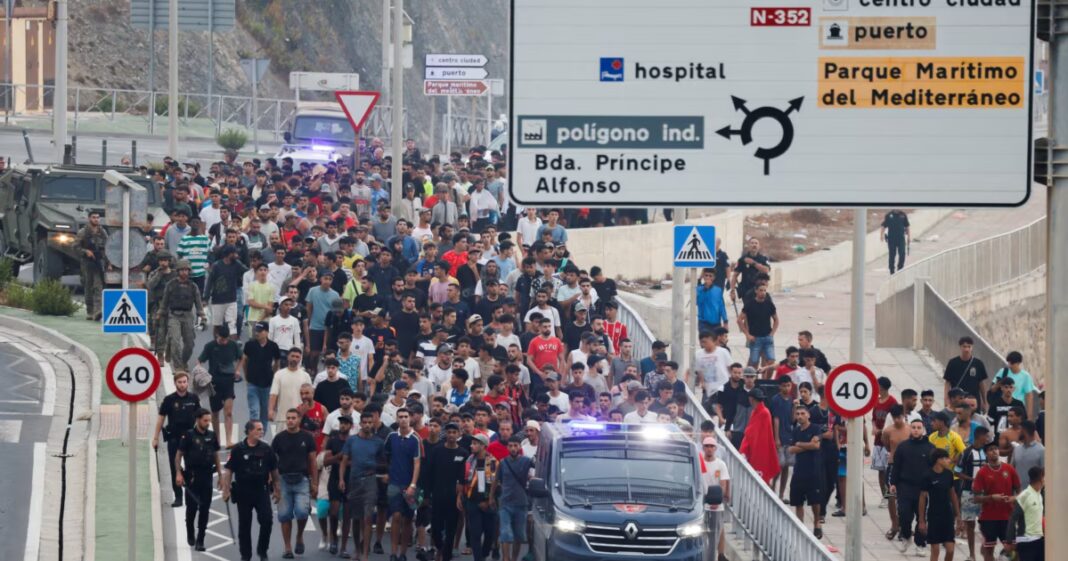

In the Spanish North African enclave of Ceuta, where tens of thousands of migrants from neighbouring Morocco stormed the border last week, there are still between 3,000 and 5,000 people who have crossed the border in recent days without following the established procedures. This was reported on Monday by Juan Vivas, the head of the autonomous city.
He said that although most of the migrants had returned to Morocco, life in the city had not yet returned to normal.
Vivas noted that on Thursday and Friday, up to 80,000 people entered the city by sea and land – almost as many as Ceuta’s permanent residents. Following the intervention of the authorities, who deployed army units to Ceuta in particular, the majority of migrants left the city. Some, however, remain, and their immediate deportation is fraught with difficulties, reports The Objective.
A recent ruling by the Spanish Supreme Court prohibits the immediate deportation of people who have arrived in Spain by sea. For deportation to take place – if a person does not wish to be repatriated voluntarily – administrative proceedings must be initiated, and a decision by the local authorities to deport them can be appealed in court. And if an asylum application is submitted, the process can drag on for years.
On Monday, the Moroccan authorities stated that the influx of migrants into Ceuta was the result of a coordinated disinformation campaign on social media – people were led to believe that they could enter Ceuta unhindered and regularise their stay in the EU. The statement noted that, in particular, people were encouraged to do so by reference to a ruling by the Spanish Supreme Court. Morocco estimated the number of people who entered Ceuta at 40,000, whilst a further thousand or so were reportedly stopped on the outskirts of another Spanish enclave, Melilla. Morocco stated that 11 people died whilst attempting to enter Ceuta, whilst Spain reported more than 70 deaths.
Read also: Spain has announced it will build a barrier on the Ceuta border following the migrant breach
The crisis in Ceuta has sparked controversy amongst EU countries. A number of countries, particularly those with right-wing governments, have accused Spain of condoning illegal migration and failing to protect the EU’s borders. Leaders from 22 countries have called for the situation to be discussed at a pan-European level (such a meeting is due to take place on 4 August).
At the same time, predominantly left-wing and liberal forces claim that the situation in Ceuta was an externally coordinated attack on the EU, and that Spain is the victim, not the culprit, of what has happened. Some commentators have hinted at possible involvement by the US authorities in the incident; however, no evidence of this has been provided, apart from the good relations between the US and Moroccan authorities. Others place the main blame on Morocco. It is also mentioned that Russian state media are actively exploiting the situation to sow panic and discord within the EU.
Spanish Prime Minister Pedro Sánchez has blamed the influx of migrants into Ceuta on criminal gangs profiting from illegal migration. At the same time, he has accused a number of EU countries that have criticised Spain of a lack of solidarity.
Ceuta and Melilla, another Spanish autonomous city in northern Morocco, are the European Union’s only land borders with Africa. These two cities, each with a population of around 85,000, periodically face a sharp rise in attempts by migrants to cross the border in their bid to reach Europe, but the scale of Thursday’s influx was virtually unprecedented.