

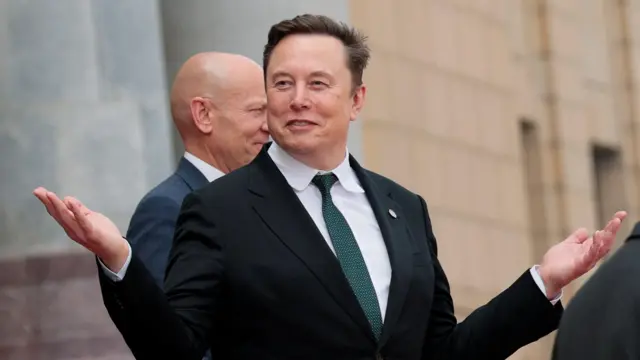

Elon Musk, 54, the world’s richest man, listed shares in his company SpaceX on Friday, becoming the first person in history to have a net worth of one trillion dollars.
SpaceX listed a small percentage of its shares on the NASDAQ stock exchange at an initial price of $135 each, but due to high demand, the price rose to $150 from the opening bell and then climbed to $164 within minutes.
As previously reported by Reuters, pre-orders for SpaceX shares were almost four times the number of shares issued.
As a result, SpaceX immediately took seventh place among the world’s most valuable companies — its market capitalisation at the share’s opening price was estimated at $1.77 trillion, and after trading began, it exceeded two trillion.
SpaceX is best known for building space rockets, spacecraft and satellites, but it also includes the artificial intelligence company xAI and the social network X, formerly Twitter.
Elon Musk, in addition to SpaceX, controls the electric car manufacturer Tesla.
In the future, the share price may rise or fall depending on the volume of securities offered for sale and investor demand.
Ultimately, the market price of shares is determined during open trading on the stock exchange, which is essentially an auction.
Tom Mueller, SpaceX’s first official employee and current founder of Impulse Space, told BBC correspondent Michel Fleury in an interview that he could hardly believe his eyes seeing how the company had changed.
Müller recalled SpaceX’s early years: the launch of the first rocket engine, its explosion, the crash of one of the rockets, and how, after a series of setbacks, the company eventually managed to successfully launch a rocket into orbit in 2008.
“It has been a truly incredible journey,” he said.
Müller left SpaceX in 2020 but still holds a significant stake in the company.
The listing of shares on the Nasdaq technology exchange is seen by many as a precedent for other private companies whose valuations are approaching $1 trillion, including Anthropic and OpenAI.
Both companies recently announced preparations for a listing, which is likely to take place this year.
Although SpaceX will become a public company and its operations will be under the close scrutiny of investors and regulators, Elon Musk will retain almost complete control over the business.
With two classes of shares — Class A and Class B — Musk will own approximately 40% of SpaceX’s capital, giving him over 84% of the voting rights when corporate decisions are made.
Meta has a similar structure, with co-founder and CEO Mark Zuckerberg controlling the various classes of shares. However, his share of the voting rights is around 60%, which is significantly less than Musk’s level of control over SpaceX.
Such a high concentration of power means that SpaceX is not even required to include independent directors on its board — that is, individuals with no personal or financial interest in the company’s activities.
According to an analysis by Harvard Law School, even if Musk decides to sell some of his Class A shares in the future — which would likely further increase his already record-breaking wealth — he would still retain effective control of the company thanks to his holdings of Class B shares.
The authors of the study note that this governance structure poses certain risks for investors, as SpaceX’s management will be able to make decisions on major deals independently, including the potential acquisition of other companies owned by Musk, as well as determine the size of his remuneration.
SpaceX has already acquired the start-up xAI, which, in turn, bought the social network X in 2025. Musk acquired this platform, formerly known as Twitter, in 2022.