


The actions of the European Union member states on the high seas against “shadow fleet” tankers are limited by international law, EU sanctions envoy David O’Sullivan said on 13 January.
Asked about the possibility of intercepting sub-sanctioned tankers following the US example, the EU’s special envoy for sanctions said that “it is not easy in international law to take and seize vessels on the high seas.”
“The legal situation regarding sub-sanctioned vessels in international waters is complex and not suitable for this type of military intervention… Our Member States remain guided by full respect for international law. We are acting through sanctions, discussions with flag states, and encouraging countries importing Russian oil to prevent sanctioned vessels from entering their ports. So we are gradually limiting the effectiveness of the “shadow fleet”. Russia is now struggling to find those who can transport its oil. We prefer to apply pressure in this way,” O’Sullivan explained.
Earlier this month, the Pentagon said the United States would intercept all “shadow fleet” vessels transporting Venezuelan oil.
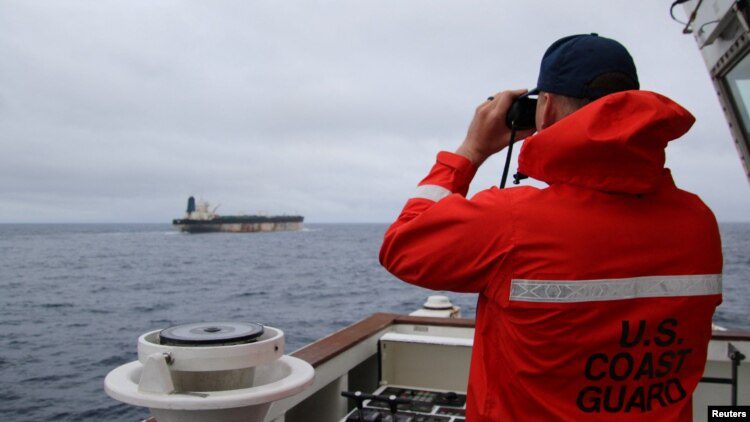
9 In January, the U.S. Coast Guard detained the oil tanker Olina near Trinidad and Tobago. According to Reuters, it was the fifth vessel detained in recent weeks.
The US military detained two “shadow fleet” tankers, the Bella 1 (Marinera) and Sophia, on 7 January. Both vessels are on the US Treasury Department’s sanctions lists due to carrying sub-sanctioned Iranian, Venezuelan and Russian oil.
In late December, the U.S. Coast Guard attempted to detain the Panama-flagged tanker Bella 1, bound for Venezuela, in the Caribbean Sea. The crew, consisting of citizens of Russia, Ukraine and India, refused to comply with the US military’s demands and changed course, after which the Coast Guard began its pursuit. The tanker’s crew members painted a Russian flag on its side. A few days after the incident, the vessel was renamed Marinera and entered into the Russian Maritime Register of Shipping.
U.S. Vice President J.D. Vance said after the vessel was detained that it was a “fake Russian tanker.” “They were trying to pass themselves off as a Russian oil tanker to get around the sanctions regime,” he told Fox News.
Following the seizure of the tanker, the Russian Transport Ministry released a statement saying the Bella 1 had received a temporary permission to sail under the Russian flag. The ministry said that in accordance with the norms of the 1982 UN Convention on the Law of the Sea, “on the high seas there is a regime of freedom of navigation, and no state has the right to use force against ships duly registered in the jurisdictions of other states.”