

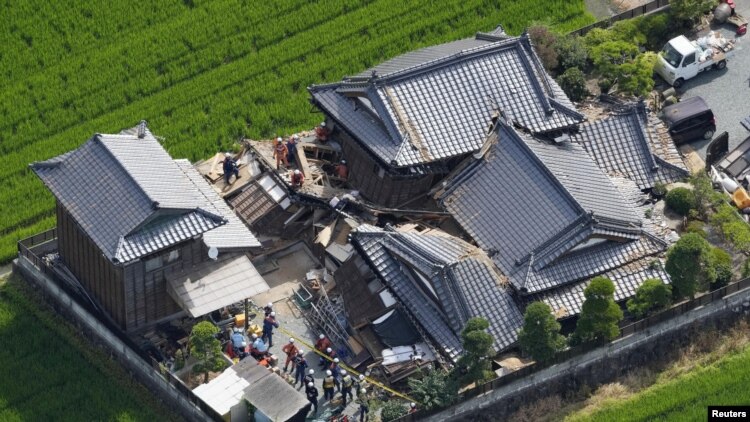

According to media reports, around 4,600 members of the Self-Defence Forces were deployed to assist at the earthquake site, and around 480 police officers from 11 prefectures were also sent.
Following the earthquake on the afternoon of 28 July, an explosion occurred at a shopping centre in Kasumi, Kumamoto Prefecture, operated by the Aeon Group. Local authorities reported that two women had been confirmed dead, one woman had been found unconscious, and a further five people had been injured.
Akio Yoshida, president of shopping centre operator Aeon, stated that three people had died at the site in Kashima, and that there were fears for the safety of one further victim and three people who were missing.
Japan experiences numerous earthquakes every year, most of which do not cause significant damage. In 2016, the Kumamoto region was hit by two devastating earthquakes – one with a magnitude of 6.5 and the other with a magnitude of 7.3; more than 270 people were killed and over 2,800 residents were injured.
Japan is one of the world’s most earthquake-prone countries. On 11 March 2011, an earthquake with a magnitude of 9.0 struck the country, one of the strongest ever recorded, triggering a powerful tsunami that swept far inland, destroying towns and their key infrastructure and causing a serious accident at the Fukushima Daiichi nuclear power station. More than 18,000 people lost their lives and nearly half a million in the region were forced to flee their homes.