


Lithuania is updating its national security strategy, the country’s public broadcaster LRT reported, citing officials.
The document warns that the country is dealing with an existential threat and Russia may be capable of going to war against NATO before the end of this decade.
The revised strategy states that the security situation in Lithuania has deteriorated dramatically. The main pillars of the country’s defence are named as its military and public stability and allies. Officials quoted by LRT believe this highlights the need to prepare the state and society for defence in times of war.
Russia’s full-scale invasion of Ukraine four years ago confirmed the assessments of Lithuania’s previous security strategy, approved two months before the invasion, said Vice Defence Minister Karolis Aleksa. The war against Ukraine only emphasised the strategy’s conclusions, he said.
The updated strategy is different in that it clearly defines the existential threat to the state. Aleksa said the assessment reflects Russia’s continued willingness to use military force and its ability to rebuild combat capabilities despite the war in Ukraine.
“Looking ahead to 2030, the likelihood of military conflict could increase,” he said.
Laurynas Kasciunas, a member of parliament’s national security and defence committee and former defence minister, said some Western experts and intelligence analysts believe – Russia could be ready even earlier, noting that Moscow is already stockpiling military equipment.
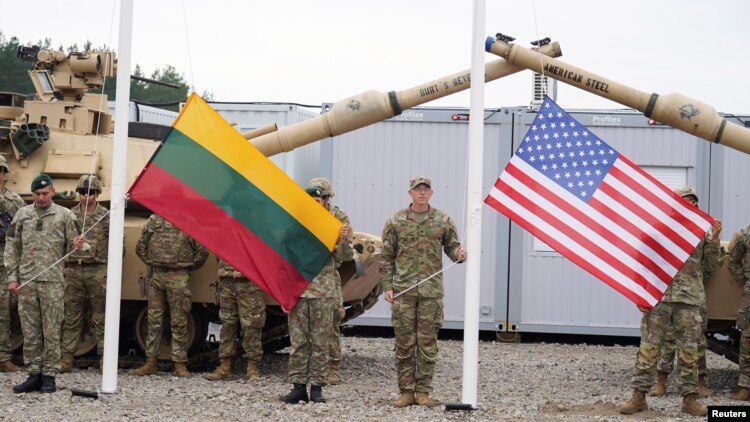
The strategy emphasises armed defence, the creation of a military division and building national resilience, and stresses the importance of deterring allies, especially the presence of US troops in the region.
According to Alexa, the strategy clearly defines the US military presence as a fundamental cornerstone of Lithuania’s security. At the same time, Washington called on Europe to take greater responsibility for its own defence, indicating intentions to reduce its military presence on the continent.
The updated strategy states that defence spending should reach between 5% and 6% of GDP. Lithuania’s defence budget is expected to exceed 5% next year.
Laurynas Kasciūnas, a member of the parliament’s National Security and Defence Committee and former defence minister, believes that current funding levels make it possible to achieve this goal, provided funds are spent efficiently.
The revised national security strategy will be considered by the State Defence Council and then must be approved by Parliament.
The day before, it became known that the Lithuanian Defence Ministry was equipping bridges on the border with Russia and Belarus with “engineering structures for attaching explosives”.