

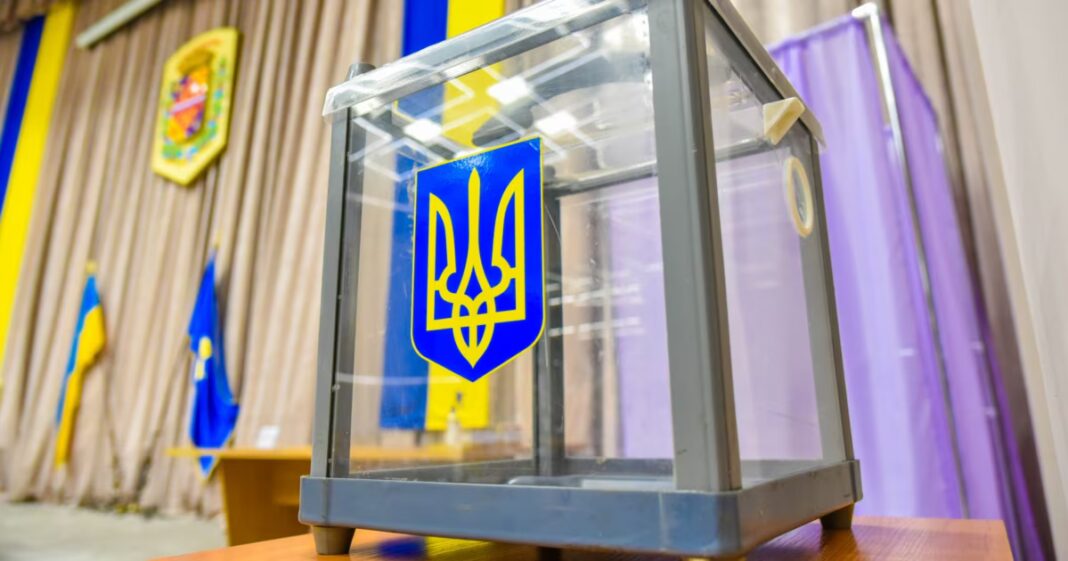

Russia has created an “intractable problem” for Ukraine – on the one hand by demanding that it hold elections as a precondition for a final peace treaty, and on the other hand by refusing the ceasefire necessary to hold such elections, the American Institute for the Study of War (ISW) writes in a new report.
“The Kremlin has repeatedly claimed that President Volodymyr Zelensky and the Ukrainian government are illegitimate because Ukraine has not held elections in 2024, ignoring the fact that Ukraine’s constitution and legislation prohibit holding elections during martial law. For example, Deputy Chairman of the Russian Security Council Dmitry Medvedev said on 19 March that Russia would never consider Zelensky as a legitimate negotiator or as a person who could legitimately sign a future agreement to end the war,” ISW recalled.
Analysts note that Russia’s repeated rhetoric regarding legitimacy and elections is intended to show Ukraine – not Russia – as an obstacle to negotiations. In addition, the Kremlin’s statements indicate that it plans to abandon any future peace agreement signed with Ukraine at a time of its choosing, the Institute for the Study of War said.
The ISW stressed that Ukraine remains committed to holding secure, free and fair elections, but the Kremlin refuses to honour the ceasefire necessary to hold such elections.
The Times reported on 20 March that members of an official Ukrainian working group analysing the possibility of holding the upcoming election said they had not resolved key questions about how to ensure free and fair elections, given the possibility of Russian strikes or interference in the election. Serhiy Dubovik, deputy head of Ukraine’s Central Election Commission, told The Times that “everyone”, including members of the Verkhovna Rada, agreed that active fighting must stop, there must be a “clear” line of demarcation on the front, and six months must pass before Ukraine can hold elections.
Dubovik said Ukraine could hold the vote without changing the constitution and legislation on martial law and elections, but the working group ruled out holding elections while fighting continues.
“ISW continues to assess that in order to prepare and hold legitimate elections after the lifting of martial law, Ukraine needs a long-term ceasefire throughout the theatre of hostilities, but Russia has repeatedly rejected such a ceasefire,” the report said.
On 3 March, President Volodymyr Zelensky said in an interview with the Italian publication Soggiege Della Sera that elections in Ukraine will be held after the war with Russia is over, not during a temporary ceasefire.
“The real question is: when can we hold elections? They will definitely take place after the end of the war, not during a temporary ceasefire. And I’m not at all sure I’ll run; I’ll see what the Ukrainians want,” Zelensky said.
Earlier, Ukrainian government officials and Zelensky himself did not rule out holding the election even before peace agreements with Russia were concluded, but said that a ceasefire agreement that would be in force for at least several months was a condition for holding the election.
According to Ukrainian law, it is impossible to hold elections during martial law. Because of this, presidential and parliamentary elections could not be held on time – in 2024 – and Zelensky has been president for almost seven years, although he was elected for a five-year term.
It was reported that the United States was seeking elections from Ukraine, President Donald Trump said. In reaction to this, representatives of Kiev said that they could theoretically organise elections, but only on condition of security guarantees for the duration of the elections. In particular, in December 2025, Zelensky stated this. In February 2026, he said that Ukraine was ready to hold elections on the condition of at least a two-month ceasefire.
The American Institute for the Study of War (ISW) has previously said that the Kremlin continues to discuss the upcoming elections in Ukraine to advance its false claim that the current Ukrainian government is illegitimate by insisting on means to control Ukrainian politics.
Analysts noted that the Kremlin continues to signal that it will reject any election results that do not result in the formation of a pro-Russian government in Ukraine.