

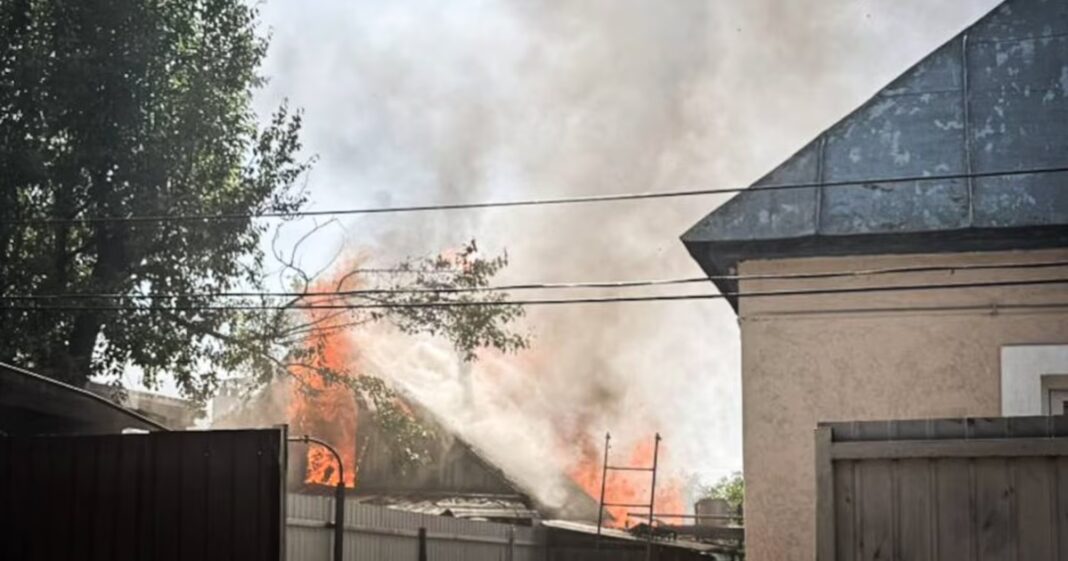

Russian military attacked a mourning column on the outskirts of Sumy on 23 May, killing one person and injuring at least nine others, the head of the regional military administration, Oleg Grigorov, has said.
“To our great regret, a man died in hospital after receiving super-severe injuries as a result of a Russian strike on a mourning column in Sumy… The identity of the deceased is now being established,” Grigorov wrote in a telegram.
According to the OBA, over the past 24 hours recorded almost 100 shellings on 41 settlements in 22 communities of Sumy region, 12 people were injured as a result.
The Russian military regularly attacks Ukrainian cities and civilian infrastructure in all regions of Ukraine with various types of weapons – strike UAVs, missiles, KABs, MLRSs.
The Ukrainian authorities and international organisations qualify these strikes as war crimes by the Russian Federation and stress that they are purposeful.
Shelling of the population’s life-support systems and health care institutions in order to deprive people of electricity, heat, water supply, communications, medical care and other necessary conditions for life is a sign of genocidal actions During the large-scale war, Russia is committing against Ukrainian citizens all kinds of crimes that can fall under the definition of genocide, according to lawyers, genocide researchers and human rights activists. Namely:
Announcement of intentions to exterminate Ukrainians: the Russian president and representatives of the Russian authorities have repeatedly stated that Ukrainians as an ethnicity “do not exist”, that it is an “artificially created” nation, and those who do not think so “must be destroyed”, and Ukraine and Ukrainians should not exist in the future;
public calls for the destruction of Ukrainians;
Targeted shelling of the population’s life support systems and health care institutions in order to deprive people of electricity, heat, water supply, communications, medical care and other necessary conditions for life;
persecution and extermination of people with a pro-Ukrainian position in the occupied territories;
extermination of intellectuals: teachers, artists, people who are carriers of Ukrainian culture and educate others in it;
introduction in educational institutions in the occupied territories of a system of education and upbringing aimed at changing the identity of children;
deportation of children without parents to Russia in order to change their identity;
the removal and destruction of Ukrainian books from libraries, the looting of museums and the targeted theft of artefacts pointing to the ancient history of Ukrainians.
The Convention on the Prevention and Punishment of the Crime of Genocide was adopted by the UN General Assembly in 1948.
The member states of the Convention , and there are 149 of them today, must prevent and punish acts of genocide in times of war and in times of peace.
The Convention defines genocide as acts carried out with the intent to destroy, in whole or in part, a national, ethnic, racial, religious or ethnic group as such.
Signs of genocide include: killing or causing serious bodily harm to members of a group; deliberately creating living conditions calculated to destroy a group; preventing childbearing and forcibly transferring children from one group to another; public incitement to commit such acts.
The Russian leadership denies that the Russian army during a full-scale war is conducting targeted attacks on the civilian infrastructure of Ukrainian towns and villages, killing civilians and destroying hospitals, schools, kindergartens, energy and water supply facilities.