

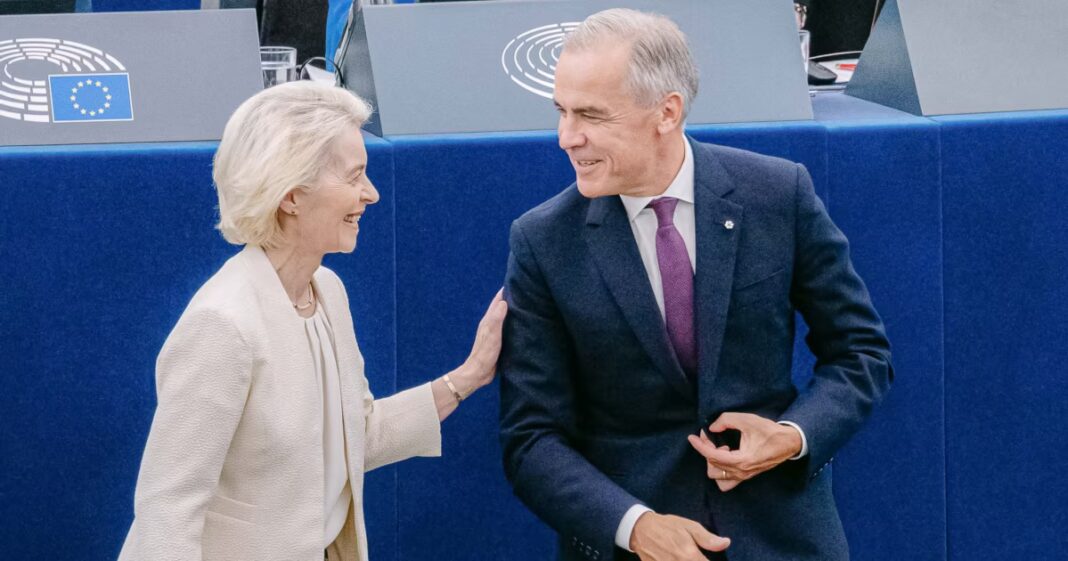

A two-day summit between Canada and the European Union began in Montreal on 29 October. One of the main topics is the possibility of granting Canada the status of the EU’s first ‘associated member’. A similar model had previously been proposed to Ukraine as an intermediate step towards full membership of the European Union, according to Radio Free Europe’s correspondent in Brussels.
“Canada, of course, cannot become a full member of the European Union due to its geographical location. But we both aspire to take our relationship to the highest possible level. That is precisely why we are discussing the idea of making Canada the first associated member of the European Union,” said European Commission President Ursula von der Leyen in Montreal.
According to her, this would involve an “association without accession”, which would allow for a partnership closer to full EU membership than any previous model.
“We can replace accession with shared ambitions and a shared vision. We can build a partnership that will be closer to membership than any model we have created before,” said the President of the European Commission.
The term ‘associated membership’ has raised questions among some EU countries. At a European Commission briefing on 29 October, journalists criticised Ursula von der Leyen’s office, claiming that they had “simply copied the title from an unofficial document” which the German Chancellor had presented earlier this year, proposing associate membership for Ukraine.
In May 2026, German Chancellor Friedrich Merz proposed granting Ukraine this status as an intermediate step towards full EU membership. Ukrainian President Volodymyr Zelenskyy rejected this initiative at the time, as it entailed non-full membership.
Responding to questions from journalists, European Commission spokesperson Paula Pinhu emphasised that Canada, unlike Ukraine, is not a European country and therefore cannot claim full membership of the EU.
“This is the closest form of relationship we can achieve with a country located outside Europe,” she said.
According to Reuters, the leaders of Canada and the EU excluded the idea of associate membership of the European Union from the summit’s joint declaration. Instead, they agreed on an “ever closer association”.
The declaration, which is expected to be published on Friday, states that work on defining the nature of the relationship between Canada and the EU will continue until the next summit, scheduled for next year.
Strengthening ties with Europe is part of the Canadian Prime Minister’s strategy to reduce the country’s economic dependence on the US and lessen its reliance on the US in the security sphere. This move followed President Donald Trump’s imposition of tariffs on a range of Canadian goods.
Trump, for his part, has viewed Canada’s attempts to forge closer ties with the European Union with suspicion and has threatened to impose ‘heavy tariffs’ if Canada’s ‘associate membership’ proved to be hostile towards the US.
Earlier, Canadian Prime Minister Mark Carney stated that the country was not seeking to join the EU, but rather wished to create a ‘unique alliance’: Canada and the European Union are united by similar values and priorities, and their strengths complement one another.
According to him, the aim is not to dominate others, but to strengthen resilience so that ‘no one can control our open markets, restrict our sovereignty, threaten our territorial integrity or undermine freedom, democracy and the rule of law’.