

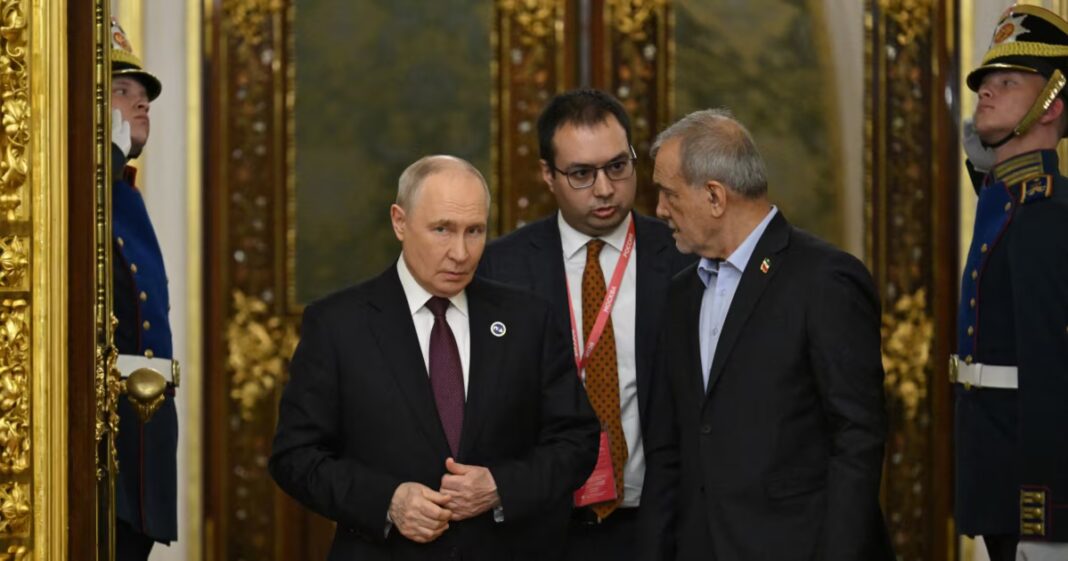

During talks in Moscow on 27 October, Vladimir Putin and Iranian President Masoud Pezeshkian stated the need to continue consultations on the situation in the region. This was reported by pro-government Russian media against the backdrop of the unresolved conflict between Iran and the US.
Following the meeting, the Iranian President’s office stated: “The Presidents of Iran and Russia discussed the state of bilateral relations and the progress of joint projects, emphasising the need to develop cooperation in various fields and to continue consultations on the situation in the region.”
Earlier, Putin said that during a one-on-one meeting he had discussed the situation in the Middle East with Pezeshkian.
The Iranian president’s visit to Moscow was preceded by a trip to Tehran by Russian Foreign Minister Sergey Lavrov, who visited the Iranian capital on 19 October.
On 18 October, US President Donald Trump, whilst explaining his position on Russia’s war against Ukraine, commented separately on Moscow’s role in relations with Iran.
“Russia is doing practically nothing to help the Islamic Republic of Iran – if it is helping at all – although it could be doing much more. And I want it to stay that way, and I will ensure it does, unless some fools stand in my way,” Trump wrote on his social media platform, Truth Social.
Israel and the US launched a joint military operation against Iran on 28 February 2026. In response, Tehran attacked Israel and other countries in the region. American servicemen were killed as a result.
The large-scale reciprocal strikes ceased in June, when Washington and Tehran signed a memorandum of understanding providing for an immediate cessation of hostilities. The armed conflict resumed briefly. Trump has suggested that the operation against Iran may be continued to prevent Tehran from acquiring nuclear weapons.
One of the economic consequences of the war has been a serious disruption to shipping through the Strait of Hormuz. Around 25 per cent of global oil trade and approximately 20 per cent of liquefied natural gas pass through the strait. This led to Brent crude oil prices rising above $100 per barrel.