

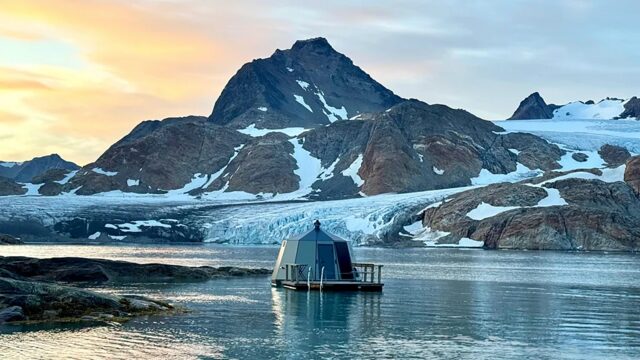

In this one-bedroom floating hut, the nearest person is a satellite call away. Isn’t this the best place for those who want to get away from it all?
“If a polar bear comes,” says Nikko Segreto, “you won’t find a safer place. Just go inside and lock the door.”
That’s easy for him to say. Segreto is a local glacier guide. He’s also the founder of a floating ice hut that’s moored in a desolate glacial bay in wild and remote East Greenland… and he’s going to set sail on a boat and leave me for dead.
It’s not polar bear season, but after a week in this part of the world, I’ve heard enough stories to know that it doesn’t always matter. A few years ago, there’s the local Amazon harbour between Colombia, Peru and Brazil, and a cottage on the Bleberry River in the Canadian Rocky Mountains where you’re unlikely to meet a single person.
And there’s this place: a perfectly insulated Finnish-made hut with a glass ceiling for observing the stars and polar lights. Its geometric shape is reminiscent of a rocket capsule re-entering the atmosphere. There is something of the loneliness of space in this place.
But loneliness is commonplace here. If you walk along the east coast of Greenland north of this place, you will reach the village of Sermiligaak with a population of 209, and then for 800 kilometres there is simply nothing.
Subsequently, only Ittokkorturmiit remains, with a population of 345 people. It’s known as one of the most remote settlements on the planet. And there are icebergs, polar bears and narwhals as far north as the most remote corners of the world: part of a wider trend of escaping from everything.
“Silence” has become one of the key travel trends this year, along with the growing popularity of off the cuff travel and “digital detox” retreats. It suggests that for many of us, the noise and stress of modern life has reached such a level that we need a complete break from everything.
The watchwords are calm and relaxation. Even the luxury travel industry, which used to be rife with redundancies, is now all about simplification. The idea is that when you’re on holiday, you’ll have to make fewer decisions, not more. Less now undoubtedly means more.
Alone in the cabin, after Segreto has cooked for me honey-glazed salmon he caught in a net excavator-freezing the surface of the sea. The colour floats like smoke in the sky. I lie on my bed and look up at those lights and I’m perfectly warm and quiet until morning.

Photo: Laura Hall
When I wake up, the sky is clear and pale blue. The entrance to the fjord is beginning to be covered in ice. Well rested, I take a moment to immerse myself in the completely icy sea (the cabin has a toilet, but no shower). Now I’m ready to explore.
And also to talk to another human being.
Segreto picks me up in his boat and gives me a quick lesson in glaciology before we put on our cats to explore an ice cave on the other side of the bay. He discovered it by accident 10 years ago and has brought about 400 people there over the past decade, mostly as a tourist guide from Tasiilaq.
“When I found it, the orphans had my back,” he said.
“I wasn’t looking for her. It’s a muddy, sandy floor that hasn’t seen daylight since the beginning of the ice age.
You can hear the sound of a river from somewhere. Glacial caves are formed by water flowing under the ice through gaps and cracks. We enter the wide vaults, tilting our heads as we go.
As we stand under the ice, it rains – it’s water from melting. I am fascinated by the air bubbles locked in the ice millions of years ago, formed from ancient compressed snow.
I don’t really like dark underground spaces, but I am fascinated by the idea that looking through the vaults, I am peering through time – through the snow of millions of years up to last year’s snowfall, which is now the top layer of ice.
Leaving the cave, we eat focaccia and Greenland salmon. Sitting in the sun, overlooking the glacial tongue and the hut floating behind it. Next