

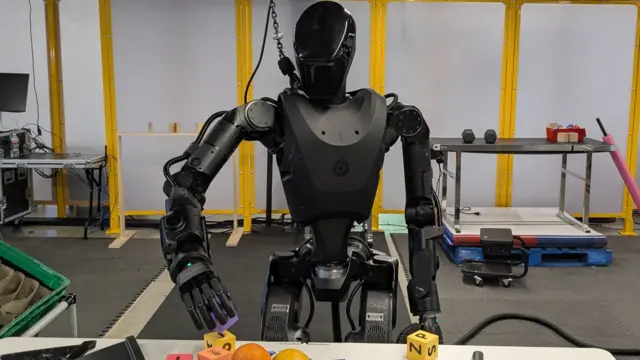

I arrived at the production site in a technologically advanced part of San Francisco, expecting to see a stern, humanoid robot soldier carrying out some sort of combat operation – and, perhaps, a glimpse of the future of ground warfare.
Instead, the shiny black, featureless Phantom robot is simply playing with a pile of colourful children’s building blocks.
‘We need data from it to get it to interact with its surroundings… [and] that’s all for today,” explains Sankatka Patak, co-founder and CEO of Foundation Robotics, a two-year-old start-up developing Phantom for military and civilian applications.
Later, he pushes the robot’s 80-kilogramme steel body into the room to demonstrate its stability, and shows me how it walks.
Whilst many companies are creating autonomous humanoid robots for use in industry or everyday life, and even as companions, Foundation Robotics claims to be the only American firm developing them specifically for a wide range of defence tasks.
This includes support functions such as delivering supplies, conducting reconnaissance, evacuating equipment or casualties, and assessing hazards. But there are also more controversial roles, such as engaging in combat and neutralising threats, which Patak refers to as ‘cutting-edge weaponry’.
He argues that arming robots can protect soldiers from danger. Robots can enter and search buildings where there may be deadly ambushes.
They can also minimise collateral damage. Ground-based autonomy can be more precise than autonomous targeting from the air, he says.
But none of this is on the horizon just yet.
Hands are essential for holding a weapon
The company’s first-generation model, the Phantom MK-1, which I was shown, has no battery, is not dust- or water-resistant, and cannot get back up if it falls over.
Its arms – which remain a major challenge for robotics – lack strength and manoeuvrability, and it does not yet have articulated wrists.
The second-generation model is being built in another secure area of the facility. The Phantom MK-2 will not only be weather-resistant, says Patak, but will also have a larger battery providing around six hours of operation. This robot will be able to get back on its feet if it falls and will be more stable.
The arms are crucial. In the next model, they will be much more mobile, with wrists that will help the robot fire weapons, says Patak.
He adds that his company’s goal is to produce at least 40,000 units a year by the end of 2027, with an estimated cost of less than $20,000 each.
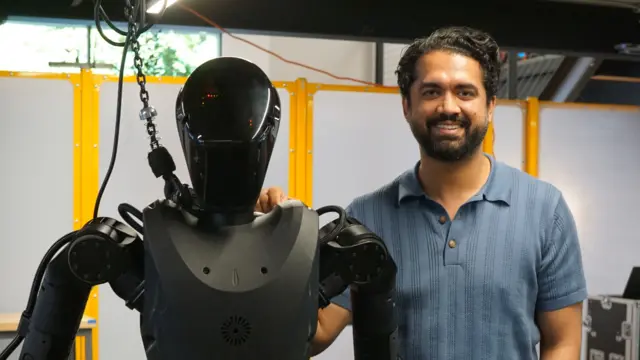
Photo by Zoe Corbin
Patak emphasises that China is keen to develop this technology, and the West must not fall behind.
He envisions hundreds of thousands of humanoid robots equipped with artificial intelligence forming ground forces, just as autonomous drones are now proliferating in the skies. According to him, an army of humanoid robot soldiers could become a major deterrent in conflict.
The foundation has research contracts worth $24 million for the US military to test its technology, as well as two prototypes currently being tested by the Ukrainian military.
According to Pathak, American pilots are limited to weapon delivery functions, whilst the trials in Ukraine involve the use of weapons.
The company attracted attention earlier this year after Eric Trump, the US president’s son, became an investor and adviser to the start-up.
Foundation Robotics also represents an opportunity for Pathak to rebuild his professional reputation: Synapse, the financial firm he founded and led, filed for bankruptcy in 2024.
The use of humanoid soldiers is ‘absolutely inevitable’ – as proven by Ukraine
But does the military actually need humanoid robot soldiers, how difficult is it to build them, and what ethical issues do they raise?
The military is clearly interested, says Dean Funkhauser of Robozaps, a humanoid robotics consultancy that tracks the market for commercial systems. He points to the ongoing call for the US military to procure humanoids that could ultimately support soldiers across a wide range of missions.
Funkhauser says the company sees a business opportunity in using this technology as a weapon, and that this is “absolutely inevitable”.
There are many simpler robots, namely drones and even some ground-based robotic systems used to transport explosives, missiles and other payloads, with their use on the battlefield being particularly evident in Ukraine.
Some firms are also working on turning four-legged, dog-like robots into weapons, although we have not yet seen them frequently in active combat, notes Funkhauser.
But other companies say that turning them into weapons is a red line they do not wish to cross, due to ethical considerations and the risk of causing harm to people.
Patak disagrees, arguing that the danger lies in other developers not following his company’s example.
He argues that humanoid soldiers make sense because the world is run by humans. But repurposing existing tools – from screwdrivers to weapons – makes no sense.
People must be ‘in the loop’, approving any use of lethal force before a robot employs that force, says Patak. At the same time, he envisages exceptions where autonomous firing may be necessary to avoid catastrophic consequences, and considers scenarios where human authorisation is less important.
Artificial intelligence for humanoid robots
Perhaps the biggest challenge facing all companies developing humanoid robots is the creation of artificial intelligence capable of functioning in the real world and coping with unpredictable and complex situations.
Phantom runs on an artificial intelligence system called Cortex, and a new version is also being developed.
The idea is that Phantom is given a task – such as transporting ammunition or mapping the interior of a building – based on a task for which it has been specifically trained using video, images and text.
It then navigates its surroundings using cameras mounted on its helmet, which provide a 360-degree view, enabling its AI system to assess the environment and adapt its movements.
Photo: CFOTO/Future Publishing via Getty Images
At Cortex, according to Pathak, two types of AI models work together.
A ‘reasoning model’, trained on specific task examples, interprets the objective and formulates Phantom’s plan of action.
A broader ‘world model’, trained on internet videos as well as data collected whilst interacting with the physical world – including its play with those same children’s building blocks – predicts the environment’s response and helps Phantom move safely and carry out actions.
Having a human form does not imply possessing human capabilities
However, not everyone is convinced that a humanoid form is the most effective for robots.
Other robots, such as quadrupeds, can move faster and more efficiently, says Funkhauser of Robozaps.
He also notes that, based on what he has seen in the commercial sector, humanoid technology still has a long way to go.
Today’s commercial humanoid robots can barely handle warehouse packaging, let alone open doors, says Funkhauser.
“If a war were to break out in Taiwan today, the prospect of China militarising its humanoids and fighting effectively seems implausible,” he adds.
Although we have already seen several impressive demonstrations where Chinese robots have proved themselves as striking exhibits at trade fairs, these demonstrations took place under strictly controlled conditions, which are the complete opposite of real-world combat conditions. However, Funkhauser adds, everything could change in five to ten years’ time.
Robert Griffin works on humanoid robots at the non-profit Florida Institute for Human-Machine Studies, which includes humanoid projects funded by the military but focused on non-combat uses for robots.
One of its subsidiaries was later acquired by the Foundation to secure some of its core technologies.
Griffin sees the value of humanoids in reducing the risk to human soldiers, but also says that the main obstacle remains the unpredictable environment.
It is difficult to get a robot to jump through a window of unknown height, land on an uneven surface and immediately find its bearings in an unfamiliar room.
“When you see a humanoid robot… But [these robots] don’t yet know how to cope with unlimited uncertainty,” says Griffin.
He adds that human soldiers easily circumvent artificial intelligence systems by doing something ‘unconventional’, such as turning a cardboard box upside down or putting it on their head.
Practical and ethical challenges
Practical challenges are also not easy to solve.
For example, there is the issue of operational time – this is ‘the nightmare of every humanoid developer’, because the robot’s movement and joint motion require a great deal of energy. Achieving a robot that could operate for six hours would be ‘impressive’, says Griffin.
Whether the Foundation is capable of creating arms capable of handling weapons designed for humans remains to be seen.
“[The company] presents its team of engineers with extremely complex challenges that they must either overcome or fail at,” he says.
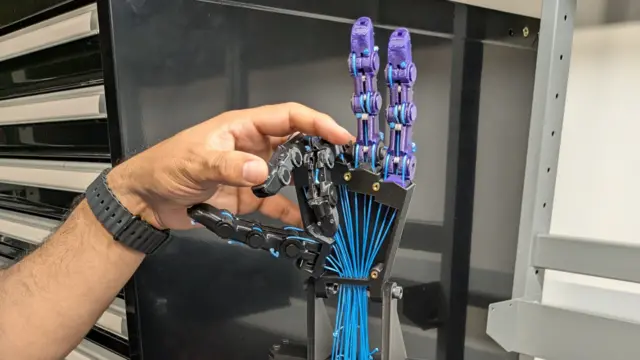
Photo by Zoe Corbin
At the same time, it seems there are even more ethical issues associated with the use of humanoid soldiers.
Lethal autonomous weapons, whatever form they take, lower the threshold for waging war, dehumanise conflicts and undermine accountability, says Nicole van Royen, executive director of Stop Killer Robots, a global coalition of non-governmental organisations.
But she also considers the humanoid form to be ‘particularly dangerous’. Human-like machines may seem familiar and trustworthy as their civilian use grows, increasing the risk that people will misjudge the dangers they pose.
The response to the current technological arms race, she argues, must be new international rules to de-escalate it.