

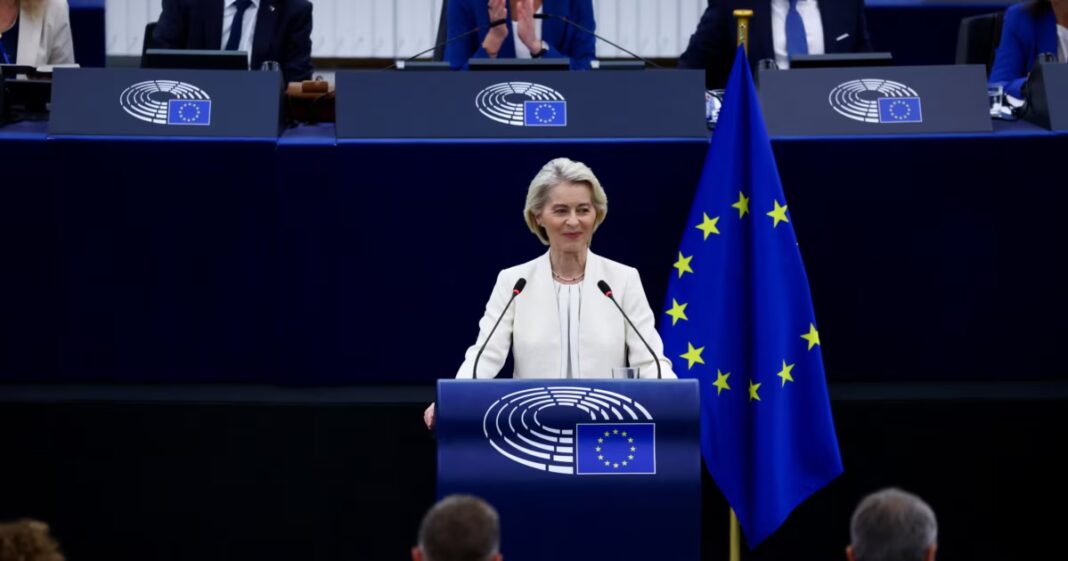

The European Union is facing growing threats that are not limited to traditional forms of warfare. European Commission President Ursula von der Leyen, presenting her annual State of the Union address, expressed concern about the situation, emphasising that hybrid threats are becoming increasingly real and require an adequate response from Europe.
One example of such threats was the incident in Leipzig, where, in August this year, a drone loaded with explosives was discovered near a Ukrainian Antonov transport aircraft at Leipzig/Halle Airport. Von der Leyen described this incident as an attack involving military technology, carried out by Russian operatives on European territory, which poses a threat not only to an individual state but also to the European Union as a whole.
In this regard, von der Leyen announced her intention to develop a new security strategy in collaboration with the High Representative for Foreign Affairs, Kaja Kallas. According to her, the EU’s current decision-making system is failing to keep pace with the rapidly changing reality. A special mechanism is needed to respond to hybrid threats, which would complement Article 4 of the NATO Treaty, providing for consultations between allies in the event of a threat.
Von der Leyen proposed the development of a European version of Article 4, which would serve as a kind of emergency security protocol. Its activation would enable all EU Member States to come together to coordinate their actions and minimise the consequences of potential threats. The President of the European Commission also noted that Ukraine could be involved in this process, alongside other strategic partners of Europe, such as Canada, Norway and the United Kingdom.
In conclusion, von der Leyen emphasised the importance of establishing a European Security Council, which would serve as a platform for discussing security issues across the continent. This initiative could form the basis for a new level of cooperation between EU countries and their partners in tackling contemporary challenges.