

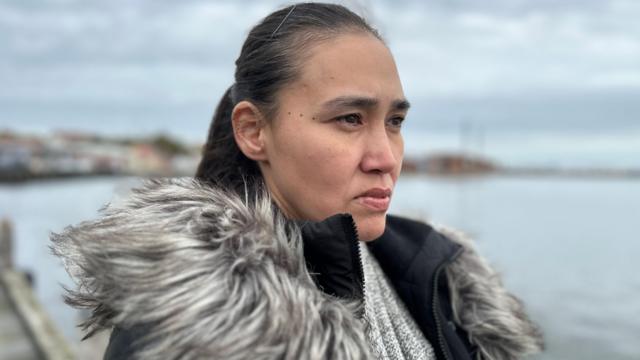

When Kira’s daughter was born last November, she was allowed to stay with her for two hours and then the baby was taken into care.
“As soon as he arrived, I started counting the minutes,” Kira, 39, recalls.
“I kept looking at my watch to see how much time we had left.”
When Zammie was eventually ripped from her arms, Kira began sobbing uncontrollably, whispering “I’m sorry” to her baby.
“I thought part of my soul was dead.”
Kira is now one of many Greenlandic families living on the Danish mainland who are struggling to get their children back after they were taken away by social services.
The babies and children were taken away from them by social services after a parental competence test, known in Denmark as FKU. The test consisted of assessing whether they were fit to be parents.
In May this year, the Danish government reversed these figures, as well as tests for general knowledge, personality traits and emotionality.
Defenders of the tests say they provide a more objective method of assessment than subjective testimony from social workers and other experts.
But critics say they cannot accurately predict whether someone will make a good mum or dad.
Opponents have also long argued that the tests are based on Danish cultural norms, and note that they are conducted in Danish rather than Kalaalisut, the native language of most Greenlanders.
This could lead to misunderstandings, they say.
Greenlanders are Danish citizens and are allowed to live and work on the mainland.
There are thousands of people living in Denmark who are attracted by the job opportunities, education and health care.
According to sufficient parenting skills and knowledge to care for a newborn baby on their own.”
Kira says among the questions she was asked were “Who is Mother Teresa?” and “How long does it take for sunlight to reach Earth?”
Psychologists who defend the tests say such questions are designed to assess parents’ general knowledge and understanding of concepts they might encounter in society.
Kira adds that “they made me play with a doll and criticised me for not making enough eye contact”.
She claims that when she asked why she was being tested in this way, the psychologist told her: “To see if you are civilised enough, if you can behave like a human being.”
Local authorities in Kira’s case said they could not comment on individual families’ treatment of the child.”
In 2014, Kira’s two other children, then aged nine years and eight months, were placed in care after a test showed her parenting skills were not developing fast enough to meet their needs.
Her eldest daughter Zoe, now 21, came home when she was 18 and now lives in her own flat and sees her mum regularly.
Kira hopes to soon be reunited with her baby Zammi for good.
The Danish government has said it will check whether mistakes were made during the Greenland trials.
In the meantime, Kiri is allowed to see Zammi, who is in her care, once a week for an hour. Whenever she visits, she takes flowers and sometimes Greenlandic food, such as chicken heart soup.
“Just to and Zammu, her son was supposed to be taken away immediately after birth.
But because he was born prematurely on the second day of Christmas and the social workers were on holiday, she and her husband Ulrik managed to keep him for 17 days.
“It was the happiest time of my life as a father,” says Ulrik, 57.
“Be with your son, hold him in your arms, change his nappies, make sure Johanna decanted milk before going to bed in the evening.”
Then one day two social workers and two police officers arrived at Johanna and Ulrik’s home to pick up their son. The couple says they begged them not to take him away.
Johanne asked if she could breastfeed him one last time.
“When I dressed my son to give him to foster parents who were already on the road, I felt terrible emotional pain,” she says in 2010.
In 2019, a panel concluded he was “narcissistic” and had “mental retardation.”
She rejects both of these descriptions of herself.
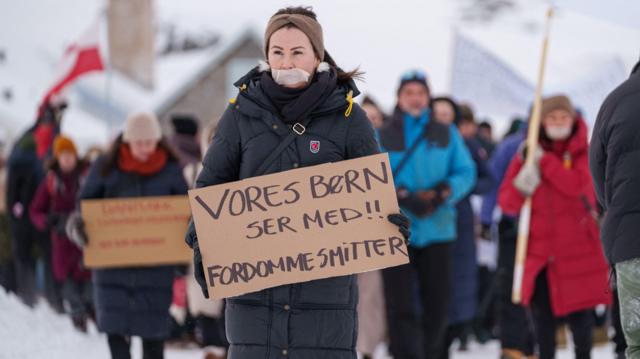
Getty Images photo
He doesn’t have a pass/fail rating on paternity tests. But as Isaac Nellemann, a psychologist who has previously conducted these tests, says in practice, if the results are poor, parents lose their children 90 per cent of the time.
N ellemann argues that the tests are not scientifically valid and were designed to study personality traits, not to predict parenting ability.
However, Turi Frederiksen, a senior psychologist whose team now conducts the tests, defends them, saying that while they are not perfect, “they are valuable psychological tools”.
She also says she doesn’t think the tests are biased against Greenlanders.
When Johanna was asked in 2019 what she saw during the Rorschach test – a psychological test in which people are shown an abstract image – she said she saw a woman gutting a seal. It’s a familiar image in Greenland’s hunting culture.
Johanna claims that upon hearing this response, the psychologist called her a “barbarian”.
The local council, which was involved in the couple’s assessment in 2019, did not 2> I never saw his first steps
After their son Johanne and Ulrik were taken into care, they were allowed to see him during short weekly visits until the boy was adopted in 2020.
He hasn’t been seen since.
“I never saw his first steps, his first words, his first tooth, his first day at school,” says Johanne.
However, he was christened a few days after his birth, creating an official record containing their names and address.
“We needed to create a paper trail so he could come back to us,” says Yohanne.
Their lawyer Jeanette Gyorret hopes to take their case to the European Court of Human Rights.
But Danish Social Affairs Minister Sophie Hestorp Andersen told the BBC that the government will not take up the cases she says: “So far slowly, but we are starting.”
She also says the decision to remove and adopt children is part of a “very thorough process where we look at the family’s ability to care for their child, not just for a year or two, but over the long term”.
This view is echoed by Thordis Jacobsen, head of the social work team in Aalborg in northern Denmark, who says decisions to remove a child in Denmark are never taken lightly.
She says schools or hospitals are often the first to express doubts about children’s safety, and notes that in cases where a child is adopted permanently, a judge makes the decision.
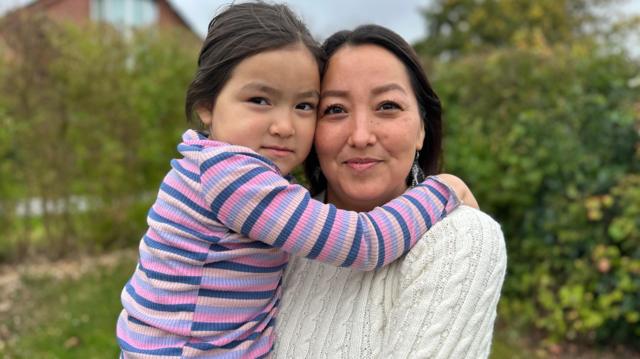
Pilingvak is a rare case of a Greenlandic mother being reunited with her child.
She and her daughter, who was placed in foster care when she was one year old, t;a dysfunctional relationship” and unfit for parenting.
They can take her away at any time
A few months after her six-year-old daughter returned home, local authorities told Pillingwack that her two older children would return to her in December.
The decision to return the children to Pilingwak’s care was made by local authorities. They declined to comment on her case.
More than four years of separation has strained Pilingwak’s relationship with her daughter.
“If I go to the bathroom and close the door, she will have a panic attack and say, ‘Mum, I couldn’t find you,'” says Pilinguake.
She also says she’s afraid of losing her daughter again.
“They can take her away at any time. They can do it again.”