

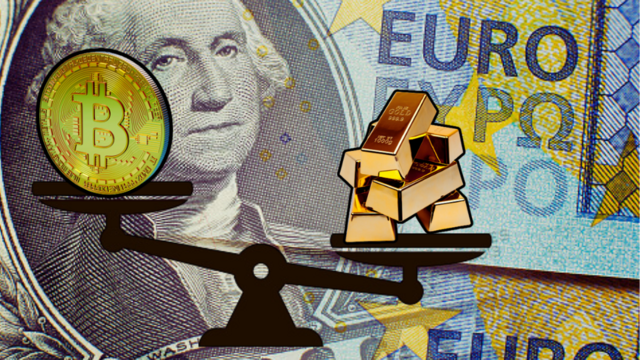

Photo Getty Images, BBC
“What should we do with dollars? Should we exchange them for euros? And in general, what to keep under the mattress now?” – these questions are spreading in waves across headlines and social media after another record-breaking exchange rate breakout in Ukraine.
There is no simple answer. But for those who really want to understand what’s going on, it opens up a gripping thriller in which chaos, gold and the mysterious Fed are playing major roles.
Since the beginning of the year, the US dollar exchange rate, at which Ukrainians are accustomed to keep their savings for a rainy day, has been making strange somersaults: it grows, it falls, sometimes it does it together with the euro, sometimes it does not, and it is the euro that is rapidly becoming more expensive.
Last year the dollar ended almost at the same level as it started – about 42 UAH. At the same time, the euro for 2025 rose by almost 14 per cent – from 43 to almost 50 the dollar’s decline accelerated.
The dollar is “doing great”
The downward trajectory of the US currency became evident last spring, after the so-called “Emancipation Day”, when President Trump announced the introduction of new trade tariffs that should free up the US economy.
Further unexpected announcements by the American president – up to and including a confrontation with the EU over Greenland – each time caused a new weakening of the exchange rate.
“Markets are reacting to the chaotic nature of this administration’s policies – escalation, de-escalation,” explains Robin Brooks, a senior fellow at the Brookings Institution and former currency strategist at Goldman Sachs.
The dollar’s fall actually reflects the fact that this chaotic approach is hurting the US more than anyone else. “A strong dollar,” said the US president back in July 2025. And when asked about the same in January 2026, he said the dollar is doing just fine.
Gold: a safe haven in chaos
Gold prices have been rising all year while the dollar has been falling. The main reason is that investors have started looking for safe and secure assets that don’t depend on the next statement from the US president.
Just in the last year gold prices have doubled, and if we take the last 5 years, they tripled: from $ 1800 to $ 5600 per ounce in January 2026.
Silver prices have also almost quadrupled to $ 118 per ounce against $ 35 a year earlier.
The war in Ukraine, the situation in the Gaza Strip and, especially, Trump’s interest in peacemaking are adding more uncertainty.
And the US President’s statements on possible tariff hikes on eight “insulate” himself from the political risks associated with the US.
By investing in gold in uncertain times, investors get rid of their dependence on other people’s debt in the form of government bonds – primarily the US.
There is another point in this “gold rush” that is directly related to the war in Ukraine.
Some countries have noticed the threat of Russia’s dollar assets being confiscated by global players who support Ukraine, and have begun to view the precious metal as a more attractive neutral reserve,” Wall says.
China has recently become one of the biggest buyers of gold. At the same time, its central bank has been buying gold bars, and citizens have started hoarding jewellery.
But Western investors and countries aren’t lagging behind either.
One example was Tether, which specialises in Ukraine trading at 8% last year.
Bitcoin: “digital gold” has not worked out
At the same time as demand for good old gold is growing globally, there has been a massive correction in the digital currency market, most notably bitcoin.
In the context of prolonged geopolitical instability, it has not worked as a “safe haven” and has not fulfilled the role of “digital gold”, but has remained more of a speculative asset, which is good when all is well.
In early February, the price of bitcoin fell to its lowest level since Trump’s re-election as US president.
Despite the White House’s pro-crypto stance, the average value of bitcoin has halved from its record high at the beginning of October 2025, from $126,000 to $63,000 at the beginning of February 2026
. Meanwhile, according to Checkonchain, the average value of bitcoin has halved from a record high at the beginning of October 2025 – from $126,000 to $63,000 at the beginning of February 2026 .
. It was even useful – it eliminated outright speculators on the virtual currency. And the quick – in less than 48 hours – return to the $70,000 level for bitcoin showed that it actually remains an attractive investment for some.
The Fed and the discount rate: why everyone is watching them
What happens next with the dollar will depend on the state of the US economy and one of the main factors in its well-being – the discount rate, which determines the price of money for both businesses and people.
If the discount rate does fall, the dollar will fall further. But for now, Jerome Powell, the head of the US central bank, the Federal Reserve (Fed), is keeping it unchanged. The main reason is that inflation is quite high, and controlling price dynamics is one of the key functions of any central bank.
Anyone around the world regarded as pressure on it and the independence of the American central bank. And several former Fed chairmen, US Treasury secretaries, as well as the heads of the Bank of England, the European Central Bank and other central banks have spoken out in his defence, in what the Financial Times called “an unprecedented show of support”.
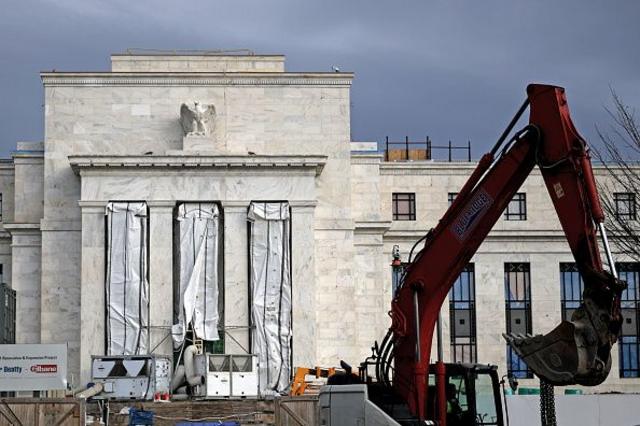
Photo by Alex Wong/Getty Images
Trump has already picked a new Fed chairman, who has yet to be confirmed by the Senate (which could be problematic). That would be Kevin Warsh, who had already served on the Fed’s Board of Governors from 2006-2011 (and was the youngest to hold such a position at the US central bank in its history).
After the 2008 financial crisis, Warsh was in charge of the Fed’s ties to Wall Street. He, like Trump, has been a harsh critic of the current chairman’s policies.
The US president announced an important
“Warsh’s long-standing hawkish views should help counter fears that he could turn into a complete puppet of Trump,” says Stephen Brown, Capital Economics’ deputy chief economist for North America.
Is the era of the dollar coming to an end? Again
All the twists and turns with dollar values and negative outlooks have renewed the debate about whether the era of dollar and Washington’s dominance of global markets is coming to an end.
Those who think so have clearly increased. They say that the automatic confidence in US economic power, which was sustained by the rule of law, predictability and stable institutions, has been lost – especially when the country’s president says the fall of its currency is “remarkable”.
But others believe that the dollar’s fall does not mean a complete abandonment of the U.S. markets of the world. That is, the capital markets infrastructure is sharpened for the dollar.
Many of the world’s commodity markets have also been measured in dollars for decades – starting with oil prices.
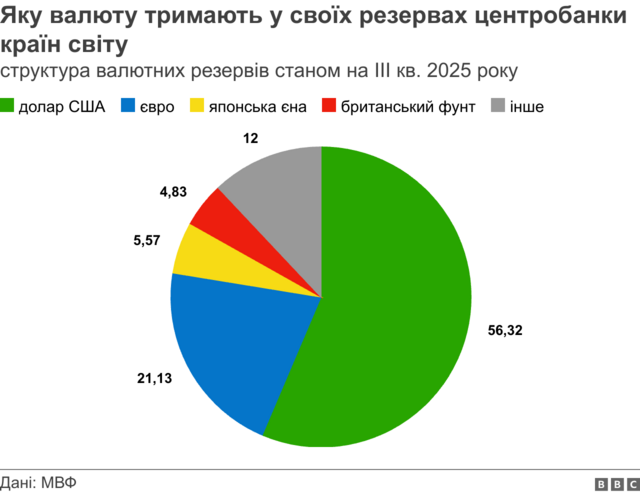
So it is not surprising that the dollar’s share is more than half of the foreign exchange reserves of central banks around the world. According to the IMF at the end of the third quarter of 2025 (the latest statistics), this share was 56.3 per cent.
Kristalina Georgieva, head of the IMF, in which the US is a major shareholder, said she did not expect the dollar’s role in the global economy to change anytime soon.
“We should not get carried away by short-term currency fluctuations. I don’t see changes in the dollar’s role in the near future,” Georgieva said in an interview with Bloomberg.
The IMF director also called for reflection on why the dollar has become so important to the