


Every year, Financial Times journalists make predictions for the new year and say they are mostly wrong by only 3-5 points. Last year they managed to predict at least one big thing – Donald Trump’s return to the US presidency made the world even less predictable. What are analysts’ expectations this year and what does it mean for Ukraine?
One of the Financial Times’ first predictions for 2026 concerns Ukraine – specifically, whether Kiev should give up territories as part of a peace deal with Russia.
FT journalist Ben Hall reckons it shouldn’t. He suggests that US negotiators are leaning towards Russia’s position, but surrendering the rest of Donbass would be too dangerous for Zelensky – for military, constitutional and political reasons.
“A withdrawal to create a demilitarised zone controlled by no one would be the extreme right, led by Marine Le Pen and Jordan Bardella, will not take place.
With presidential elections scheduled for the spring of 2027, most parties are already thinking about that race, FT analysts say. According to the newspaper, no single force will win a majority in this election, and the only party that is capitalising on this is Marine Le Pen’s Rassemblement Nationale. Furthermore, President Emmanuel Macron has rejected any suggestion that he might call an early presidential election.
The far-right Alternative for Germany (AfD) party is predicted by the FT to remain behind the “wall”.

Getty Images photo
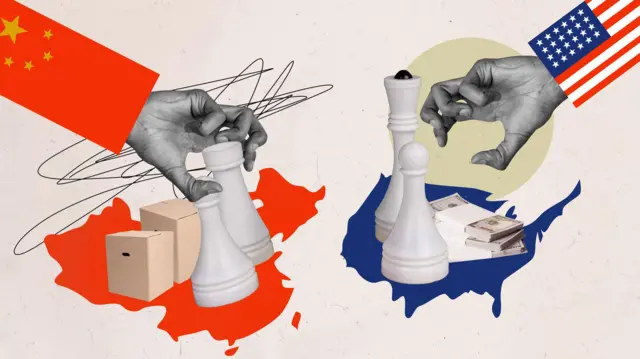
The leader of the centrist Christian Democratic Union (CDU), Friedrich Merz, says he will not continue to work with them either locally or nationally. His stance could be swayed by an AdG victory in China’s trade surplus suggests its currency is undervalued, experts wrote, while a deflationary economy means it will remain so.
“Foreign powers could impose more tariffs on China in 2026, but the authorities are likely to ‘absorb’ them, preventing the currency from appreciating,” the forecasters said.
Last year, the Financial Times made the mistake of assuming that the alliance between Ilon Musk and Donald Trump would remain strong. Now the FT’s answer to the question of whether Tesla’s Ilon Musk can gain market share in the US, EU and China is controversial.
Tesla remains under pressure in the US due to the expiry of federal tax credits for electric cars and relaxation of emission reduction rules.
The outlook in China and Europe is less predictable, while Tesla’s Chinese rivals will bring new models from me,” writes the FT.
The big companies (Google, Meta, etc.) will survive the recession without disaster, analysts say. However, in 2026 they will be expected to “deflate the froth”: venture capital funds and private investors will lose a lot of money, and small companies that bet only on AI may go bankrupt.
Another FT prediction on artificial intelligence is the progress of machines in the music charts.
Although ” AI singer ” Breaking Rust came out on top of the little-known US country chart this year, the tops of the major US and British charts will not be subject to them, the FT analysts believe.
“Songs from Netflix spin-off film KPop’s Demon Hunters show that fictional bands can have big hits – but they are pushed by plots and characters that AI can’t replicate.