


Every November, life in South Korea comes to a brief halt as graduates take the Suning exam. Shops close, flights are postponed, and even the normal rhythm of morning life slows down – students are not to be deterred, for this exam determines which university they get into.
In the evening, graduates walk out of the school gates, exhale with relief and hug their relatives. But not all of them. There are those who stay up late and leave school around ten o’clock in the evening. These are visually impaired students for whom the exam lasts not eight but more than 12 hours.
Suning is a Korean abbreviation for “Unified University Entrance Examination.” It is sometimes referred to as the College Scholastic Aptitude Test (CSAT). More than 550,000 students will take the exam this year – the most in the past seven at 9:48 p.m. – almost 13 hours after the start time.
There is no dinner break – the exam continues non-stop.
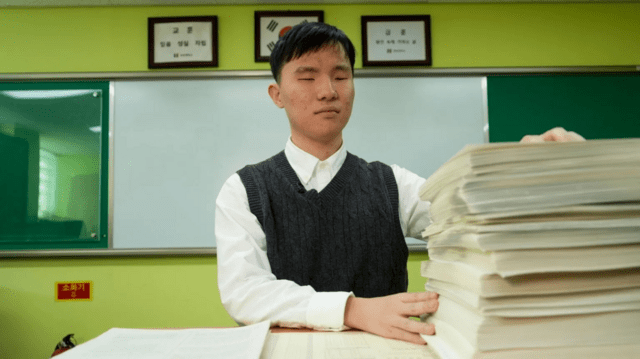
Another reason for this duration is the physical size of the materials. Every sentence, symbol and diagram is translated in Braille, making the exam booklet six to nine times thicker than the standard version. In addition, the braille paper itself is thicker than normal paper.
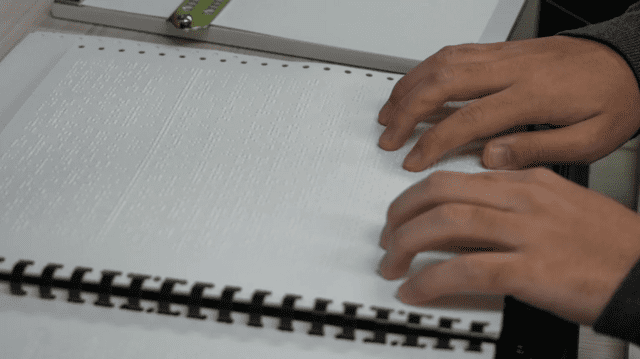
Photo: BBC/Hosu Lee
According to the Ministry of Education and the Korea Institute of Curriculum and Evaluation, 111 students – 99 with partially reduced vision and 12 with severe visual impairment – took the exam for visually impaired students nationwide last year.
Han Dong-hyun, 18, is graduating from Hanbit School for the Blind in Seoul. He was born blind and can’t even distinguish light, so he has a severe visual impairment. To pass the exam, he that he had a particularly difficult time getting a piece of Korean. The standard booklet for this exam is 16 pages and the Braille booklet is about 100 pages. Even the screen-text voicing programme does not save the day: the information heard disappears as soon as it is voiced, unlike the text, which can be seen and reread. All the details of the assignments must be stored in memory.
The maths part is not easier: you have to “see” with your fingers complex graphs and tables translated in Braille.
But now it’s a bit easier,” says Han Dong-hyun. Until 2016, the exam had to be done in your head, but then the blind were allowed to use Hansone, a Windows or Android device with a Braille keyboard and a display that allows them to read electronic text with their fingers.
“If sighted students write down calculations with a pencil, tor photo, BBC/Hosu Lee
Another student at this school, 18-year-old Oh Jung-won, says the hardest part of the exam starts in the afternoon.
“Nothing until lunchtime,” he says. – But at around 4 to 5 p.m., after English and before Korean history, it gets really tough. There’s no dinner break. We’re solving problems at the time we usually eat, and that makes it even harder. But I know that in the end there will be a sense of satisfaction with the work done, and that motivates me to keep going.”
He says it is very difficult to concentrate all the time and use your hands and hearing at the same time.
“When I use my fingers to read Braille and listen to information at the same time, it is much more tiring than for sighted students,” he explains.
But applicants themselves say the real difficulty lies not in the length of the exam or the long hours of work, but in the limited availability of study materials.
Popular textbooks and online lectures for sighted students are often not suitable for blind students. There are very few braille versions, and converting materials to audio format requires text files that are not easily available. In many cases, entire books must be manually transcribed to be usable.
Online lectures also pose a challenge: many lecturers explain the material using visual notes, charts and graphs on the screen, which cannot be understood using audio alone.
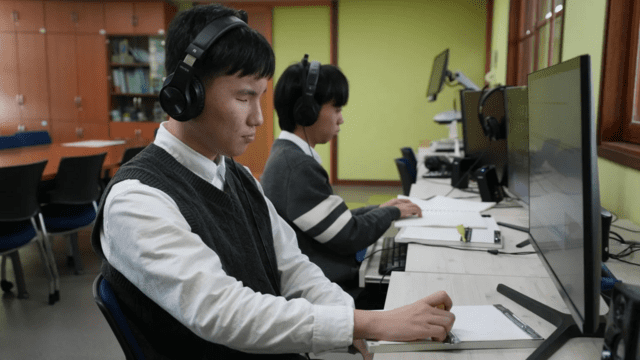
Photo: BBC/Hosu Lee
One version of the Braille version of the EBS preparation guides, a core set of materials closely related to the national exam, is often provided to blind people months later than other students.
“Sighted students receive the EBS books between January and March and study them throughout the year,” says Jung Won. “And we don’t get Braille materials until August or September, when the exam is only a few months away.”
Dong-hyun agrees with him:
“The Braille materials were ready less than 90 days before the exam,” he says. “I kept hoping that the publication process could be accelerated.”
The National Institute of Special Education, which is responsible for producing the braille versions of the EBS materials, told the BBC that preparation takes at least three months for each book because, among other things, the materials are produced in separate volumes.
The Korean Blind Union has long raised the issue with the authorities and plans to appeal to the Constitutional Court, demanding wider access to Braille versions of all textbooks.
Photo: BBC/Hosu Lee
For these graduates, Suning is not just a university entrance exam, but proof of the years of effort and patience that have led them to this day.
Jung Won describes the exam in one word: perseverance.
“There is not much you can do in this life without perseverance. I consider it a training for my willpower,” he says.
Their teacher Kang Seok-joo, who watches blind people take the exam every year, notes that their endurance is simply impressive:
“Reading braille means constantly driving your fingers over the convex dots. The friction often makes your hands ache. But