

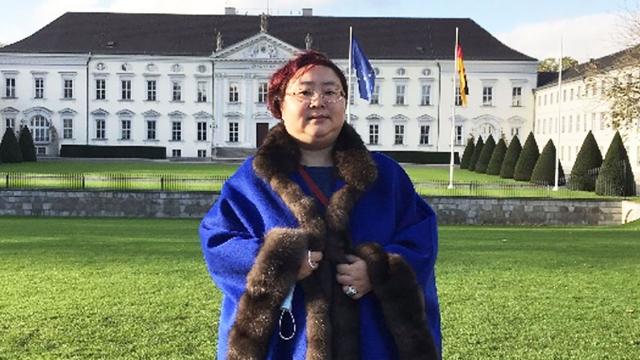

A woman accused of buying billions of pounds worth of cryptocurrency from funds stolen from thousands of Chinese pensioners will stand trial in London this week on suspicion of money laundering.
After fleeing China, she settled on a luxury estate in north London, where a year later police raided and carried out one of the world’s largest cryptocurrency seizures.
More than 100,000 Chinese had invested in her company, which promised to develop high-tech medical products and mine cryptocurrency. In reality, according to police, the funds were misappropriated.
The affected investors told the BBC that they hope to recover at least some of their funds through the British authorities.
“If we manage to gather all the evidence, we hope that the government, prosecutors and the High Court will show the wealthy heiress antiques and diamonds and hired a former fast food worker as her personal assistant. She was tasked with converting cryptocurrency into cash and property.

Metropolitan Police photo
As the price of bitcoin skyrocketed, Qian was able to show investors the promised returns – the illusion of “easy riches”.
Her assistant Wen Jian received six years for money laundering last year. She told the court that Qian spent her days lying in bed, playing games and shopping online.
However, her diary shows a bold six-year plan for future fraud. By 2022, Qian planned to set up an international bank, buy a Swedish castle, win the favour of a British duke, and her main goal was to become queen of Liberland, an unrecognised microstate on the Croatian border and adniks.
“With each new piece of evidence, we realised that she was not just a participant, but the organiser of the scam. She’s smart, she’s clever, she’s convincing,” says Detective Joe Ryan.
One investor, Mr Yu, recalls that he and his wife initially invested 60,000 yuan ($8,429) each. The company paid a small dividend each day – about 100 yuan ($14) – creating the illusion of profitability. “It gave us the confidence to take out new loans and invest even more,” he admits.
Each new entrant provided additional payments to previous depositors – a typical pyramid scheme.
It reached some 120,000 people across China, with total deposits exceeding 40 billion yuan (US$5.6 billion).
The company skilfully played on feelings of patriotism and concern for the marchers held in the Great Hall of the People, where China’s legislature sits, said investors who attended the events.
“These promoters would take something red and convince you it was white, take something black and prove it was red,” Mr Yu recalled, highlighting the mastery of manipulation.
The enigmatic “Flower”
Despite heading such a well-known company, Qian remained extremely mysterious. To most clients, she was known only as Hua Hua, or “Little Flower,” communicating almost exclusively through poems on her blog.
But for the biggest investors – those who had invested at least 6 million yuan ($842,000) – she arranged more private meetings, says one such client, Mr Li.
“When we were there, you could tell we were mesmerised,” he recalls. managers to reassure investors, and she absconded with the money to the UK.
Qian was not entirely indifferent to the plight of her investors – in her diary, she detailed a plan to repay the debt in China when the price of bitcoin reached £50,000 per coin. However, the entries make it clear that her real aim was to rule and develop Liberland, to which she had earmarked millions of pounds.
When she was finally apprehended in York, in the north of England, last April, police found four other people in the house. They had been specially brought to Britain to work for Qian. They shopped, cleaned, guarded – and worked illegally.
At the time of his arrest, Qian denied all charges, but in September unexpectedly pleaded guilty in court to unlawful purchase and possession When asked what level of evidence was required to participate, the prosecutor’s office said details were not being released at this time.
For Mr Yu, the losses have been more than just financial.
“It has affected the family, led to a divorce and an almost complete loss of contact with his son,” he told the BBC.
Despite everything, he considers himself still lucky. One lawyer added that many Qian investors were left without money even for food or medicine.
Yu knew one such woman from Tianjin in northern China. She died of breast cancer after being discharged from hospital without being able to pay for treatment.
“She was on the verge of death and knew I was writing, so she asked me to write an elegy for her if the worst happened.”
Yu kept his word and wrote a poem in her memory, which he published online. It ends with the following lines:
Let us become a pillar,