

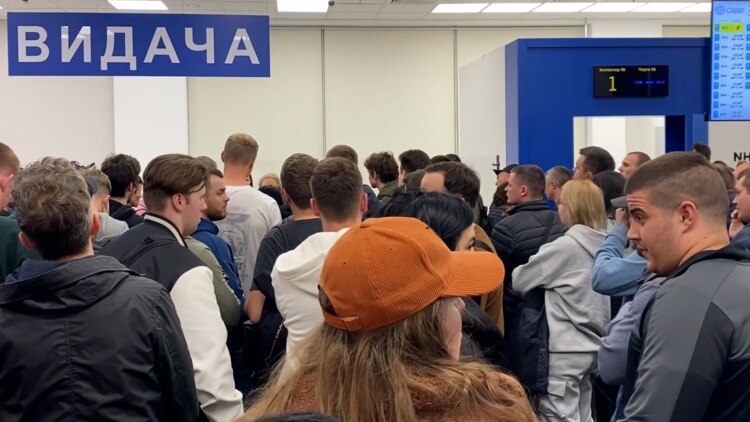

The Danish government has announced that it plans to amend the rules on granting residence permits to Ukrainian refugees, noting that men aged between 23 and 60 who are not exempt from military service will no longer be eligible for such permits.
The government will tighten the rules to prevent Ukrainians from using them to avoid mobilisation into the Ukrainian army, according to a statement on the website of the Danish Ministry of Immigration and Integration.
“Denmark stands shoulder to shoulder with Ukraine in the fight for freedom. That is why we are now amending the special law on Ukraine, because we do not want our residence rules to be used to avoid mobilisation into the Ukrainian army. This undermines Ukraine’s military efforts and weakens Ukraine’s ability to defend itself against Russian attacks,” said the Minister, Morten Bedskov.
The Danish government added that the proposal will not affect residence permits that have already been issued.
The ministry also clarified that, as of early May 2026, approximately 47,600 displaced persons from Ukraine had been granted residence permits in Denmark under the special law on Ukraine.
On 26 June, the European Commission is due to present a proposal to extend the temporary protection mechanism for people who have fled Ukraine due to Russia’s full-scale invasion.
Following the European Commission’s presentation, the proposal will be considered by EU Member States, which are due to take a final decision on the continued operation of the Temporary Protection Mechanism at the Council of the EU.
The Temporary Protection Mechanism, which the EU activated following the start of Russia’s full-scale war against Ukraine in March 2022, is currently in force until 4 March 2027. It grants Ukrainian citizens and certain categories of other individuals the right of residence, as well as access to the labour market, education, healthcare and social services in European Union countries.
During previous discussions, it was proposed that the forthcoming extension of this status should not apply to new male applicants of conscription age who arrive in the EU after the new rules come into force.
Meanwhile, the day before, the Council of Europe’s Commissioner for Human Rights, Michael O’Flaherty, called on European countries not to impose general restrictions on temporary protection for Ukrainian men of conscription age, noting that such measures could contravene states’ international human rights obligations.
With the start of the Russian Federation’s large-scale armed aggression against Ukraine and the imposition of martial law and general mobilisation in the country, restrictions were imposed on men aged between 18 and 60 who are liable for military service or subject to conscription, limiting their right to travel abroad.
In the summer of 2025, Ukraine permitted men who had not yet reached conscription age – those aged between 18 and 22 – to travel abroad.