

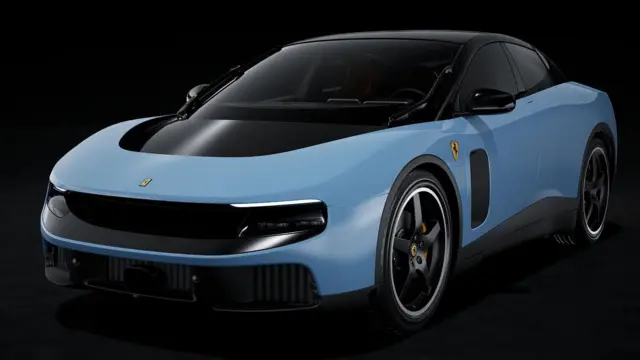

The new Ferrari Luce, the brainchild of iPhone designer Sir Jony Ive, is unlike anything the Italian carmaker has ever created – in fact, the wave of outrage it has faced.
Its unveiling was such a big deal that Italian President Sergio Mattarella and Pope Leo were invited to see the luxury brand’s first electric vehicle (EV).
However, online critics, investors and even politicians criticised Luce (which means ‘light’ in Italian).
The company’s shares fell 8 per cent the day after the unveiling, while many memes mocked the $640,000 (£475,625) car, which is also their first five-seater.
It comes at a time when the global car industry is facing some serious challenges, including stiff competition from Chinese carmakers.
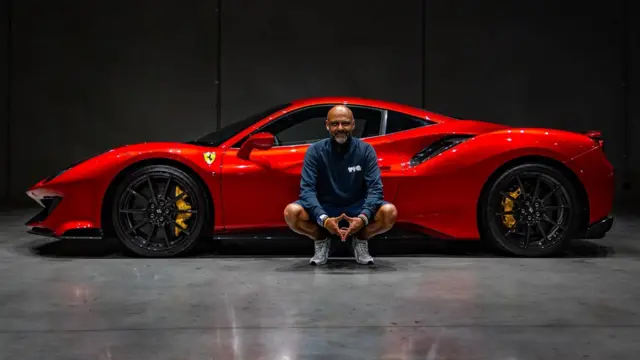
Photo by Sean Baker
The unveiling of Ferrari’s electric car marks a dramatic shift for a brand built on sophisticated petrol supercars known for their roaring engines.
For years, the company has been banking on a shift to electric propulsion – even when much of the automotive industry has already made the move.
The Luce is certainly as fast as many supercars: acceleration from 0 96 km/h takes about 2.5 seconds and the top speed is over 300 km/h.
But it is its appearance that has attracted the most criticism.
Former Ferrari chairman Luca Cordero di Montezemolo told reporters on Tuesday that Luce “risks destroying a legend” and the company should remove its iconic logo from the car.
Australian premium car dealer and collector Sean Baker told the BBC he called Luce (pronounced “loo-che”) nothing less than a “loser”.
“Ferrari was the dream brand they wanted to own. But with Luce they have ruined their image,” he said.
The Luce doesn’t have the low stance of a typical Ferrari. Equipped with electric motors, it also lacks the characteristic engine noise.
“And that’s supposed to be innovation? I wonder what Enzo Ferrari will say,” said Italian deputy prime minister and transport minister Matteo Salvini, referring to the company’s founder.
Luce looks like anything but a car from a galloping horse,” he added.
While some on the internet have praised the car, calling it a “masterclass” of design, for example, there is no shortage of critics.
“Disgusting,” one commenter wrote.
“Enzo Ferrari will rise from the grave and take control of the company again,” another noted.
Some social media users compared it to the much cheaper Nissan Leaf and Chinese electric cars – rebukes that Ferrari boss Benedetto Vigna was quick to deny.
Others have published variants of the Luce’s design with artificial intelligence, giving it a sportier look.
“They were done in 10 seconds and still look better than what Ferrari came up with,” said Baker, who has owned more than 50 of the brand’s cars.
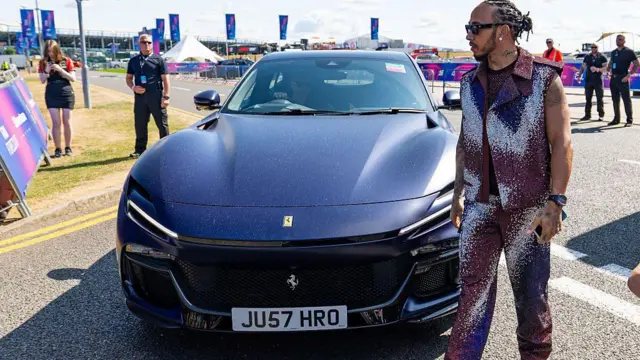
Author photo, Getty Images
Vigna, who has led Ferrari for the past five years, is used to mixed reactions from the public.
The company’s first SUV, the Purosangue, shared public opinion when it was launched in 2022.
Critics claimed that the four-door model would tarnish Ferrari’s image as an exclusive supercar brand. Nevertheless, it sold well, helping the company enter a new market.
Ferrari isn’t the only automotive giant facing a wave of outrage over the transition to electric cars.
In 2024, Jaguar sparked a heated debate when it announced plans to become a luxury electric car brand and unveiled a concept car called the Type 00, which was unlike any previous model from the British luxury car maker.
Critics said the car, with its ultra-long bonnet and massive wheels, was a departure from the origins of the iconic E-Type.
“Jaguar needs to be bold and revolutionary to move forward and realise our vision,” chief executive Rodon Glover told the BBC at the time.
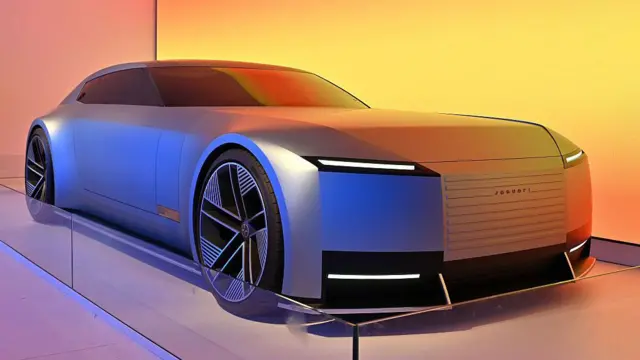
Photo Getty Images
Today, Ferrari faces similar accusations of losing its identity.
Singapore-based automotive analyst James Wong praised the Luce’s interior design, but said that overall the car is “unrecognisable” as a Ferrari.
The Luce’s dazzling cost also looks particularly high against the increasingly cheap and luxurious electric cars already on the market, said sustainability expert Jessica Chiam.
However, Vigna said it was a fair price for innovation and that the car had generated significant interest from potential buyers.
Ferrari’s entry into the electric car market comes at a time when several other major brands are reviewing their plans for battery-powered vehicles.
Supercar rival Lamborghini has scaled back its electric car programme due to weak demand and customer attraction to petrol engines.
After Luce’s presentation, Lamborghini CEO Stephan Winkelmann said his company’s bet on hybrid cars rather than all-electric models was “the right way to go”.
“Every brand, every company has to decide for itself,” Winkelmann told CNBC Business Channel.
Other carmakers including Porsche, Honda and Ford have also scaled back their electric car programmes.
Photo by Getty Images
Global carmakers have also faced stiff competition in China, an important market for luxury brands such as Ferrari. Local car buyers are already used to low prices, a large range of batteries and innovative features.
According to the International Energy Agency, China leads the world in the number of extensive supply chains for electric vehicle parts, helping to reduce production costs by at least 30 per cent compared to the rest of the world.
Aggressive subsidies in the country have also led to a huge growth in the number of carmakers, forcing companies to cut prices and innovate to win customers.
This fierce competition has also forced Western firms, including Tesla and VW, to drastically cut prices in China.
Chinese electric car makers are increasingly targeting the premium market to boost their profits by competing with top-end models from Porsche and Tesla.
Even Chinese companies that are better known for their SUVs and sedans have started producing electric supercars. An example of what Western brands have to compete with is the $250,000 all-electric BYD Yangwang U9. It can accelerate to 96 km/h in just 2.3 seconds.
Perhaps that’s why with the Luce, Ferrari is targeting a completely different market than those looking to buy a regular supercar.
The Luce may appeal to younger buyers who are more open to electric cars compared to Ferrari’s loyal fans, says Chiam.
Given how unusual it looks for Ferrari, Luce could also attract new customers to the brand, Wong noted.
The company could have conducted a “trial run” among regular customers to see if such a design would resonate with them, Wong added.
“But on the other hand, it could all have been deliberate, given the huge media flurry Luce has caused.”
The BBC has reached out to Ferrari for comment on Luce’s criticism.