

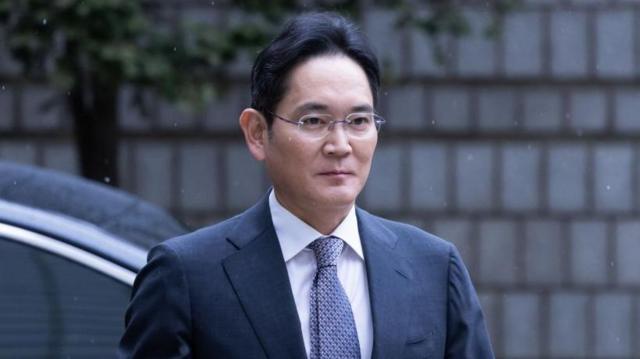

When there is a power transition in large global companies, most people don’t notice it. If the products work, the services are provided, and the shop shelves are full, the person sitting in the boardroom doesn’t really care about the customers.
But when it comes to Samsung, the relationships in the dynasty that owns the company are so complex, and the company itself so important to the South Korean economy, that it becomes front-page news.
That’s exactly what happened in 2017, when Samsung heir Lee Chei she was jailed for her involvement in a corruption scandal that also led to the downfall of the country’s president.
The 57-year-old Lee is the grandson of Samsung’s founder. Geoffrey Kane, author of Samsung Rising, described him as “one of the most powerful men in the history of technology”.
But in 2015, when his father – Samsung’s chief executive – was in hospital after suffering a heart attack, Lee’s succession was not assured.
He was accused of providing funds to foundations controlled by Choi Soon-sol – a close friend and confidante of former South Korean President Park Kin-hye – in exchange for political support for a merger that would have strengthened his control of the conglomerate. He was also accused of using stock market manipulation and accounting fraud during that merger between one Samsung subsidiary, Samsung C&T, and another part of the business.
Prosecutors said he did this in order to get the largest possible stake in the new company and to have control over Samsung Electronics, the jewel in the crown of the empire and a key source of power and influence.
Lee Che Yong has always denied the fraud charges, but in 2017 he was found guilty of bribery.
When the corruption scandal broke in 2016, it sparked weeks of protests that saw millions take to the streets of Seoul and eventually led to the impeachment of the country’s president.
Why was this agreement so important?
Since Samsung was founded as a grocery shop in the late 1930s, the company has remained in the hands of the Lee family.
According to Geoffrey Kane, the family is the “equivalent of royalty” in South Korea.
They turned the business into a true global force, spanning insurance, microchips and construction, along with well-known consumer technologies.
But to keep the conglomerate in the family’s hands, they had to go through a series of complex mergers, acquisitions and power transfers. It was this manoeuvring that led Lee Chey she to prison.
He had been the de facto head of the company since 2014, when his father, then chairman of Samsung, suffered a heart attack. His father had developed the company from a successful South Korean business into a global conglomerate.
In preparation for the handover, Lee Che-yong went through a series of leadership positions.
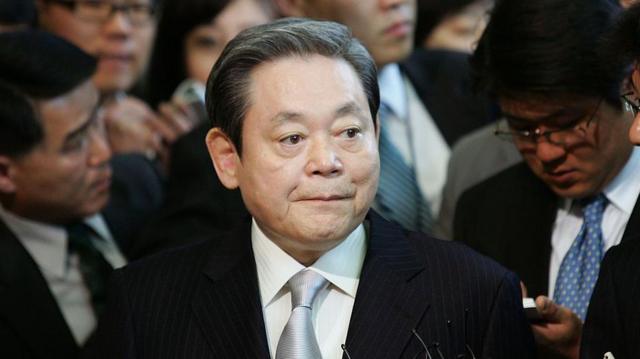
Author photo, Getty Images
However, when he became acting CEO, he was faced with a difficult situation: the complicated processes needed to ensure full family control of Samsung had not yet been finalised.
At that point, the business empire had become complex: it spanned dozens of companies, from Samsung Electronics to retail, from construction to chemicals. They were all tied together by an intricacy of cross-shareholdings.
Another problem was the huge inheritance tax bill – more than $10bn. But if the family started selling their stakes in the companies to pay it, the Li family risked losing control.
Succession risk
As the only son, Lee Che Yong was chosen to lead Samsung after his father’s death. But despite being groomed for the role for three decades, to some he did not look like a convincing candidate to lead South Korea’s largest company and the country’s economic hopeful.
According to Jayon Lee, a reporter for South Korea’s Hankyoreh newspaper, “He was just different… If his father was seen as aggressive and driven, [Lee Chei she] was perceived as shy, quiet and cautious.”
Some thought his sister was more capable, and he himself was criticised for not being uncompromising enough. Questions about his managerial abilities also arose after his e-Samsung project collapsed during the domcom crisis.
The family had already been “traumatised” by one difficult power transition a generation earlier, when Lee’s father Lee CheY she – the youngest son – was elected to lead the company instead of his two older brothers.
There is a dispute about what happened to the eldest son, Lee CheYe she’s uncle Lee Meng Hee, who by tradition is supposed to inherit the business. According to one version, when he was given the chance to run the company, he was unsuccessful. He himself claims to have run the company for seven years.
But whatever the truth, the youngest son, Lee Kun-hee, was named heir in 1976. That decision had been given for decades.
An empty chair
After an uncertain start, Lee Kun-hee presided over a period of success for the Samsung Group in the 1980s and 1990s. But new challenges followed ahead.
In 2008, both Lee Che-yong and his father resigned after a former Samsung lawyer turned whistleblower revealed the existence of a secret fund allegedly used for bribes and political payments.
As described by Jayon Lee of the Hankyoreh newspaper, “the lawyer said he could no longer tolerate corruption. According to him, Samsung was so rotten that work became unbearable.”
Author photo, AFP via Getty Images
This raised questions about the future of the company – and South Korea’s economy. Especially since it was Lee CheY she was considered a candidate to be the next chairman of the board.
Suddenly, the company was without an executive. His father was later acquitted of bribery charges but found guilty of tax evasion and given a suspended sentence and a fine.
He was technically a free man, but there was still a vacancy at the top of Samsung. How could the Lee family regain control?
The 40-year discord
Eventually Lee Kun-hee received a presidential pardon and returned to his position as Samsung’s CEO. But his troubles didn’t end there.
In 2012, his older brother – Lee’s uncle CheYe On – attempted to reclaim what he believed to be his rightful inheritance. It was a move that could derail the plan to hand over power to the next generation.
The eldest son of Samsung’s founder had always believed he would one day lead the business, but he was bypassed during the first handover in favour of his youngest brother.
The conflict was further exacerbated when Lee’s father Lee CheYe she became head of the board and in 1976 divided the empire: his uncle’s branch of the family got a part of the business, which could be considered less influential.
And so, 40 years later, Lee CheYoung and his father faced a lawsuit that could force them to return hundreds of millions of dollars worth of stock to their uncle.
A successful lawsuit would have dismantled the empire and jeopardised the plan to transfer power to Lee Che Yong.
Stabilising the course
In the end, the fraternal dispute and further process may have demonstrated the benefits of a well-defined line of succession.
The court recognised that although some of the uncle’s claims had merit, the time limit for filing suit had expired.
As reporter Jayon Lee notes, “the siblings were angry with each other, and I think that’s why Lee Kun-hee made the line of succession for his children as clear as possible.”
So, when Lee’s father CheYe she was bedridden after a heart attack, it was clear who would take over.
His son, a man who would later find himself embroiled in a corruption and bribery scandal that would last for the next ten years.
Justification
It wasn’t until July 2025 that Lee CheY she was finally acquitted when the Seoul High Court upheld his acquittal on charges of fraud related to a merger that believed to be a merger.
It ended a decade of accusations, court hearings and jail terms for Samsung’s chief executive.
It was also a departure from the tradition of South Korean “chaebots,” or family businesses.
During the trials, Lee Chae-yong announced a change of course for the Samsung dynasty: “I want to make a promise right now – that there will be no more succession disputes. I will not pass on management rights to my children.”
So the question arises: if the eldest son no longer automatically receives the keys to the empire, who will hold them?