



Allegations by anti-corruption authorities that fraudulent call centres were being ‘protected’ have damaged the reputation of the Office of the Attorney General. Thousands of people have fallen victim to fraudsters in recent years, and now they are learning that law enforcement officials may have been involved in these schemes.
In recent weeks, the revelation of the scale of call centre operations in Ukraine has proved equally shocking. Experts say that this business ranks second only to economic crime, surpassing even the drug trade.
Revenue from these fraudulent ‘offices’ across the country can reach one billion dollars a month. These figures come from the international organisation Global Initiative Against Transnational Organised Crime (GI-TOC).
The activities of call centres in Ukraine target not only Ukrainians but also people in several dozen countries. And around 60,000 people, both Ukrainians and foreigners, work in these ‘offices’ themselves.
These are just some of the staggering facts about the operations of these ‘offices’ revealed by GI-TOC. The study sheds light on how they came to be established in Ukraine and their inner workings, which are characterised by strict rules and substantial profits.
The authors of the investigation point out that the report is based on interviews with former employees of the centres, staff from Ukrainian and foreign law enforcement agencies, cyber investigators and journalists.
We have examined this report and also looked into what the Ukrainian authorities and law enforcement agencies have attempted to do to put a stop to these activities.
‘As if under a spell’
Natalia (name changed at her request), a 50-year-old woman from Kyiv, became one of thousands of victims.
The number from which she received the call was the same as that listed on the website of one of Ukraine’s largest banks.
The man introduced himself as a ‘bank security officer’ and asked whether she had transferred money to a specific person. She replied that she had not, whereupon he said that the bank had blocked attempts to transfer money from her card to another account.
The man suggested that this might be due to a leak of personal information from staff at the bank branch where Natalya had opened her accounts, and claimed that the ‘security service’ would have to ‘track down’ this employee.

Photo credit: Getty Images
“I got the impression that he had information about my cards. But I’d never given any numbers or codes to anyone. After that, everything happened as if in a fog. To get a new one so I could put money into it,” she explains in an interview with BBC News Ukraine.
Natalia still cannot understand how she, a knowledgeable person who had previously been sceptical of such suspicious calls and knew how to respond to them, ended up doing everything she was told.
“I was as if under a spell. I was in constant contact with this man and did exactly what he told me to do,” she admits.
Natalia transferred several tens of thousands of hryvnias from a card she had never used before to a supposedly segregated account, the details of which were given to her by the fraudster.
Almost immediately afterwards, she received a call from a man claiming to be from the ‘security department’ of another bank where Natalya held an account, with the same ‘news’ about attempts to steal money. At that moment, she came to her senses and ended the call. But the man continued to call her from different numbers, trying to persuade her, continuing to play the role of a concerned employee, and then began to insult her.
Natalia immediately rang the banks, where she was advised to file formal complaints, but they pointed out that the money transfer had been voluntary.
Calling the cyberpolice ‘hotline’ was also to no avail – she spoke to bots and, after leaving a report about the crime, nobody ever rang her back.
Stories like this are shared from time to time on social media, including by businesspeople.
They all emphasise that, at the time, everything seemed convincing.

Photo credit: Getty Images
How it all began and what makes Dnipro unique
Around 15 years ago, so-called ‘investment schemes’ began to spread in Israel and subsequently in Georgia. People received phone calls from employees of supposedly well-known financial companies, who offered the chance to make a quick profit by investing money in ‘start-up capital’.
From around 2014, technology and top managers from Georgia began moving to Ukraine. According to GI-TOC experts, the conditions for such activities had developed here, not least due to the outbreak of the war in Donbas and the annexation of Crimea.
Many people, particularly young people, were looking for any kind of income. Back then, as now, young people aged 28 and under were the most sought-after for work in these ‘offices’, as they adapt easily to technology and are keen to earn a quick buck, according to researchers.
In recent years, Dnipro has had the most call centres. It is, in particular, the home of PrivatBank, which has been the most technologically advanced bank since its foundation. It was the first to set up legal – and, indeed, genuinely useful at the time – call centres to deal with customers.
‘It was within these organisations that the operational principles of dealing with customers over the telephone, communication scripts and staff management systems were devised, refined and streamlined,’ explain the authors of the study.
Subsequently, former employees and organisers of these legitimate processes utilised the knowledge they had acquired and the ready-made technological models, but transferred them into the illegal sphere by setting up the first fraudulent offices,” they emphasise.
Exposing fraudsters and call centres: The report highlights that the bank’s security service works closely with law enforcement agencies and provides assistance in this area 
In 2026, the authors note that by mid-2023 there were approximately 1,000–2,000 call centres in Ukraine; however, further action by law enforcement agencies ‘reduced this figure by a third’
The authors also highlighted the role of Prosecutor General Ruslan Krav.
“A turning point in the fight against call centres was the appointment of the new Prosecutor General, Ruslan Kravchenko, in June 2025, which led to a wave of large-scale raids on centres in Dnipro and Kyiv in the second half of 2025. This momentum must be maintained,” the report stated.
A few days after NABU’s high-profile announcements regarding Operation ‘Carthage’, Kravchenko himself assured that, upon taking office, he had “set the task of stepping up efforts against fraudulent call centres” and boasted of the results.
According to him, “over 1,050 searches were carried out in 12 months, the operations of around 340 call centres were shut down, and more than 5,000 operator workstations were closed. Currently, 147 criminal investigations are under way, and more than 183 individuals have been served with notices of suspicion. Indictments.”
The now former prosecutor spoke of 5,000 workplaces, whilst according to GI-TOC, the total number of call-centre workers could be as high as 60,000. Researchers also say that after such centres are shut down, they quickly spring up again, as it does not take much effort – just premises, equipment, office supplies and staff.
According to the OpenDataBot platform, court statistics as of September 2026 reveal a disparity between the number of ‘offices’ that have been exposed and the actual convictions handed down.
Since the start of Russia’s full-scale invasion of Ukraine, at least 18 verdicts have been handed down in cases related to the activities of fraudulent call centres. Twenty-seven defendants are implicated in these cases.
The Dnipropetrovsk region leads in terms of the number of court rulings, accounting for more than half of all verdicts – 10 out of 18.
Two verdicts each were handed down in the Kharkiv, Odesa and Zakarpattia regions. A further verdict each was handed down by courts in the city of Kyiv and the Kyiv region.
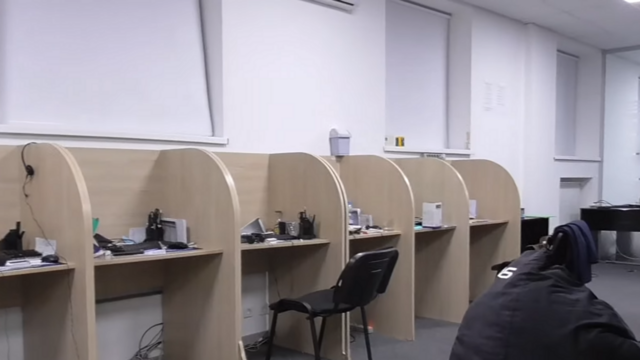
Photo credit: National Police of Ukraine
“Despite the fact that law enforcement agencies regularly report ‘raids’ on duty offices, only two people have actually been sentenced to prison terms of five and eight years,” OpenDataBot told BBC News Ukraine.
The remaining defendants received either suspended sentences or fines.
Attempts by parliament to influence the situation have also had little effect.
In 2023, the Verkhovna Rada set up a temporary investigative commission to look into the illegal activities of fraudulent call centres and pyramid schemes. Following its work in 2024, the committee proposed amendments to the law, but MPs supported only some of them.
Following the public disclosure of allegations against officials from the Office of the Prosecutor General, President Zelenskyy tabled new bills designed to toughen the crackdown on call centres, calling for their immediate adoption.
“We must put an end to the issue of fraudulent call centres in Ukraine,” the President urged MPs.
On 15 September, the Verkhovna Rada adopted one of the president’s bills at first reading. The bill introduces criminal liability for the transfer and use of so-called ‘drop accounts’. Fraudulent call centres use such accounts to transfer and launder funds stolen from citizens.
‘Protection’ for 10,000 dollars
Researchers point out that most large ‘offices’ in Ukraine are grouped into several main networks.
The first are open operations, registered as IT start-ups, marketing agencies and the like, which publish job vacancies on legitimate job-seeking websites.
The second ‘network’ is intertwined with organised crime.
The third is a network operating under a ‘corrupt umbrella’. In explaining how this network operates, the researchers state that the cost of providing this ‘umbrella’ varies, although two interviewees cited figures ranging from 10,000 to 15,000 dollars a month.
The authors of the report refer, in particular, to a Member of Parliament, whose name they do not disclose. He explains that call centres have a specific person responsible for this.
This person contacts the law enforcement agency and informs them that the call centre is prepared to pay a monthly fee for protection. Usually, an agreement is concluded with only one law enforcement agency, but [that agency] must ensure protection from other departments. The agency receives its payment and either shares it with other agencies or does not share it with them.
NABU and the SAP did not specify the exact sums which, according to their investigation, law enforcement officers received from the call centres, however, they claimed that ‘members of the criminal organisation had established a mechanism for systematically obtaining unlawful benefits’ from fraudulent call centres in exchange for not interfering with their operations.
The most high-profile ‘office’ scandals
The anti-corruption agencies’ ‘Carthage’ operation became not only the biggest scandal linked to fraudulent call centres, but also dealt a blow to the reputation of the Public Prosecutor’s Office.
Over the past two months, the National Police have significantly stepped up their efforts to shut down call centres. There are dozens of reports on this on the cyberpolice website.
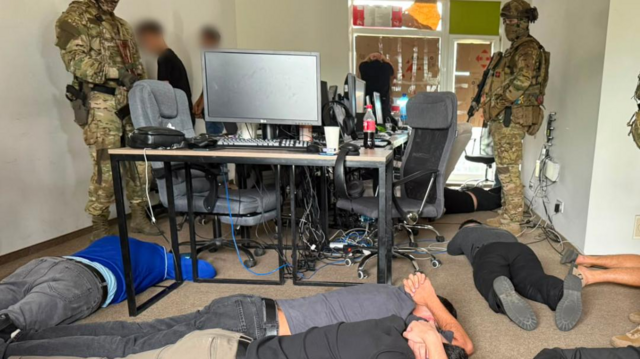
Photo credit: National Police of Ukraine
In particular, in early July, the Cyberpolice Department reported that it had shut down a large-scale call centre in Kyiv which had defrauded dozens of US citizens of more than half a million dollars. The organisers specifically recruited English-speaking operators, including foreigners from West Africa and the Americas, to defraud US citizens.
That same month, law enforcement announced the dismantling of an extensive network operating in Kyiv, Lviv and the Dnipropetrovsk region, which had caused losses totalling more than $210 million.
In August, the National Police and the Security Service of Ukraine (SBU) announced a large-scale operation across Ukraine, which resulted in the closure of around a hundred call centres.
Another scandal involves Mykola Tishchenko, a Member of Parliament from the ‘Servant of the People’ party.
In 2023, he announced that he had begun a crackdown on call centres. He would visit the ‘offices’ accompanied by young people to ‘sort things out’.
However, audio recordings were soon leaked online in which a man with a voice resembling Tishchenko’s discussed how to make money from call centres: by closing down some offices and, in return for a monthly fee, providing ‘protection’ for others.
Following this, the NABU conducted an investigation and charged Tishchenko. The investigators claimed to have evidence that, in August 2023, under the guise of cracking down on ‘offices’, he allegedly demanded over a million dollars from a call centre representative and, in return, promised ‘protection’ from the police. In July 2026, the court imposed a bail condition of 10 million hryvnias on him.
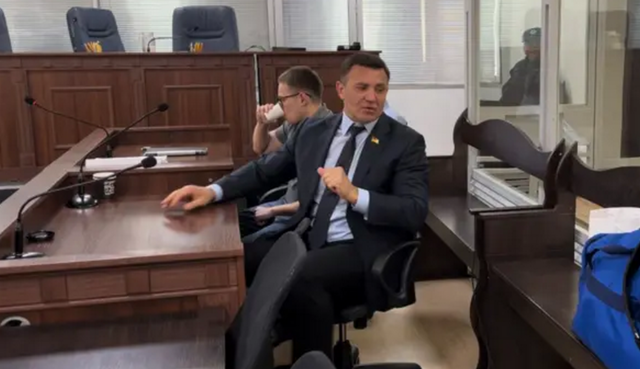
Photo credit: BBC/Sofia Sreda
Tishchenko himself denied his guilt and claimed that ‘the prosecution had not produced any real evidence’.
The activities of the Milton Group caused a major international scandal, extending to many countries, with offices located in Ukraine, Russia, Georgia, Albania and Bulgaria, amongst others.
Call centres defrauded pensioners and other foreign nationals in Europe under the guise of investments in cryptocurrency. The total amount of funds obtained through fraud is estimated at one billion dollars.
In 2020, the Organised Crime and Corruption Reporting Project (OCCRP), an international project investigating corruption and organised crime, published shocking reports on the activities of the Milton Group network in many countries, and in Ukraine in particular.
Incidentally, the OCCRP was one of the key partners in the investigation into the famous Panama Papers, which exposed money laundering in offshore jurisdictions.
OCCRP journalists obtained information from an internal whistleblower – a former call centre employee who had access to a database, recordings of conversations and documents.
In Ukraine, the ‘Milton Group’ emerged in 2016–2017. For a long time, its office was based in Kyiv, in the ‘Mandarin Plaza’ centre.
Officially, the Milton Group positioned itself as an IT company providing financial services.
Subsequently, when the case went to court, Milton Group’s executives claimed that they merely provided platforms for currency trading and were not to blame for the fact that people did not know how to trade.
“Many clients lose money because they do not understand how it works. When clients lose money, why should we give it back to them?” stated Yakov Keselman, former head of Milton Group, in an interview.
However, the staff were involved in investment fraud. Victims were offered the chance to invest a small sum in cryptocurrency or shares via bogus platforms. When they agreed and handed over the money, they were shown capital growth on the fake platforms and tricked into investing ever-larger sums.
Thousands of elderly people across Europe fell victim to this scheme; some of them lost their homes and took their own lives.
Investigators established that in 2019 alone, a single call centre in Kyiv generated over 65 million euros in revenue.
Law enforcement officers from European countries travelled to Kyiv to carry out joint raids with their Ukrainian colleagues.
A few years later, they succeeded in exposing and arresting the criminals in Europe, and in 2025–2026 several people were sentenced to various prison terms.
In 2020, when the Milton Group network was exposed, Radio Free Europe’s Ukrainian service officially approached the National Police and the Security Service of Ukraine (SBU) to enquire whether any cases were under investigation relating to the activities of the Milton Group’s call centres in Ukraine.
The response was negative.
***
The exact number of victims of the fraudulent call centres’ activities in Ukraine over the years remains unknown.
Many did not report the incidents — either out of embarrassment or because they did not believe that the law enforcement agencies would be able to help them.