


Author photo, BBC/ Planet Earth
Twenty years have passed, and we are once again reminded of an iconic scene from Sir David Attenborough’s Planet Earth. It’s a fragment that changed our understanding of how polar bears adapt to survive.
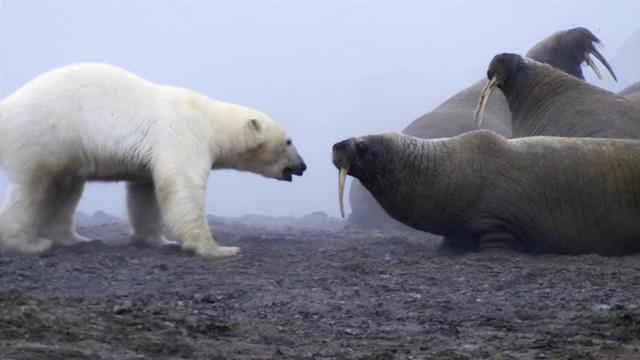
It’s an amazing scene: a lone male polar bear attacks hundreds of walruses. He circles around them and persistently tries to penetrate their fifteen centimetre layer of fat to get his long-awaited food.
The bear uses the fog as cover and sneaks up on the walrus colony.
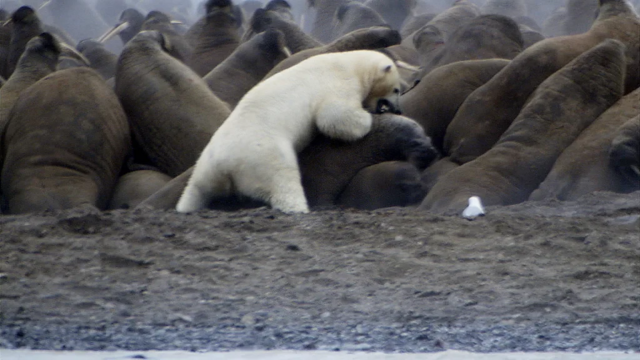
The adult animals act coherently: they push the babies into the centre and create a barrier of tough skin and fat. The bear begins the ambush cautiously. He jumps on the walrus’ back to find a weak spot in the “armour” and get to the cubs.
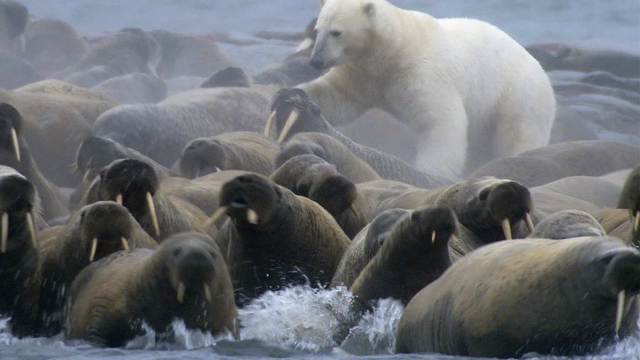
The predator targets the female and repeatedly bites her neck. She fiercely defends her cub, and his claws and teeth cannot penetrate her thick skin. The herd begins to flee into the sea. The bear grows increasingly desperate and attacks the adult walruses.
The chance for the first meal in months is vanishing before our eyes. The bear grabs the adult walrus, but the powerful animal resists and escapes his clutches. At the end of the episode we see the bear limping – he is defeated and badly wounded by the walrus’ tusks.
Titled underwater cameraman Adam Ravetch captured this dramatic sequence of footage in 2004.
He had spent two years in the Arctic filming footage for the Ice Worlds series of Project Earth, the outstanding nature documentary series presented by Sir David Attenborough.
This moment of high drama subsequently became the hallmark of the entire series. However, it was more than just a striking television show.
The battle was an indication of how polar bears are adapting to survive in the world’s harshest environments.
Author photo, BBC/ Planet Earth
In the second year of filming, Ravetch and his guide had already been in their third “ambush” in a remote area of the Arctic Ocean for a fortnight. When food supplies began to run low, Ravetch decided to stay on location himself.
Soon after the long swim, an emaciated polar bear appeared. According to Sir David, the animal was attracted to the “pungent odours emanating from the island”. The bear had not eaten for months, so hunger drove it onto land in search of prey.
However, there was a small obstacle in the predator’s path.
“He had to pass me to get to the walruses,” recalls Ravetch.
The bear first circled around the small makeshift hut on whose roof the cameraman was sitting (he called it a “coffin”) and then lunged at the herd of walruses. Ravetch followed him with camera in hand.
“I’ve never felt more in danger and so full of life at the same time in my life,” he shares the memory. Polar bears rarely attack humans, but such incidents are often fatal.
But Ravetch realised he was seeing something amazing. Polar bears usually hunt baby walruses and almost never dare to attack adults.
Until this moment, no one had ever recorded a case of a walrus herd injuring a bear.
“I thought a bear would catch a cub in a matter of minutes, but to see walruses fight back and win was something completely new,” says Ravetch.
The length of this scene also allowed him to film the predator’s many failed attempts.
Author photo, BBC/ Planet Earth
It took the walrus quite a while to escape into the sea. This allowed Ravetch to film this extraordinary behaviour in detail. He says this is the first time we’ve seen so closely how walruses band together to protect their young and slowly back away from the bear into the water. He calls it “an amazing display of defence and maternal instincts”.
People have seen polar bears hunting walruses before, but it’s been rare. Ravetch notes that the shot of the bear coming face to face with the walrus is striking: it’s incredible to see the walrus force the predator to back off with a single glance.
This iconic scene documents how polar bears are changing their behaviour due to the rapid melting of sea ice caused by climate change.
The animals are forced to swim vast distances, exacerbating the risk of drowning or starvation. The Planet Earth team aimed to show animals suffering extreme seasonal changes. For this story, they chose a top Arctic predator that risks its life by attacking a herd of walruses.
Vanessa Berlowitz, producer and director of the “Ice Worlds” episode, believes that this scene perfectly illustrates the polar bear’s predicament. She notes that the viewer both admires the courage of a predator forced to attack such a powerful opponent and realises that this is a true “battle of the titans”.
“You sympathise with the walruses when they are attacked, and you sympathise with the polar bear,” she says.
“It’s a very balanced scene. There are no winners here. Everybody suffers.”
Tom Smith, a wildlife professor at Brigham Young University in Utah, agrees. He says most people stand in solidarity with both the polar bear and the dead bear protecting the cub. Such life-and-death contests are always fascinating because we feel them on an instinctual level.
“Without food, this bear will not survive. If global warming continues, and the Arctic ice melts earlier and earlier each year, more bears will share this fate,” commented Sir David.
Shortly after filming, Ravetch was evacuated from the location by aeroplane, so the fate of the same bear remains unknown.
Since 1979, the Arctic has warmed almost four times faster than any other place on the planet. Polar bears depend on sea ice over which they hunt seals.
Reduced habitat forces them to den more often on land and leads to exhaustion. Polar bears have long been adaptable in their search for food; they take advantage of every opportunity and seek out new prey throughout the Arctic.
It is known that they can feed on beluga whales, reindeer, berries, and in some cases even each other.
Inuit hunters in Canada and Greenland have long observed cannibalism among polar bears, but researchers warn: this type of hunting may increase due to melting ice as bears lose access to seals.
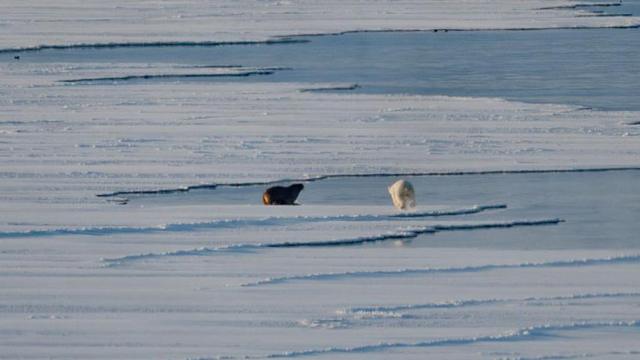
While climate change isn’t the only reason for finding food on land, the earliest ice melt is forcing predators to increasingly hunt ashore.
Author photo, Getty Images
In some parts of the Arctic, the strategy of risky land-based hunting is paying off.
For example, recent research in Svalbard shows that polar bears in the Norwegian Arctic are getting fatter and healthier despite the melting ice.
Researchers monitored 770 bears for 24 years: at first, their body condition deteriorated, but improved after 2000, coinciding with a period of rapid ice loss.
The study suggests that polar bears compensated for their limited access to seals by hunting walruses and reindeer. While these bears have shown high resilience to climate change, in other subpopulations the decline of sea ice has had unambiguously negative consequences.
Smith cautions that the success in Svalbard does not reflect the state of the entire polar bear population in the Arctic. According to him, people are simply looking for a “ray of light” in this grim story.
While studies have documented bears eating eggs, depredating seabird colonies and killing caribou, those food sources won’t feed the world’s population of 30,000 individuals.
“There’s little reason to be happy,” he notes.
In one subpopulation, scientists have found that bear survival rates drop as the number of ice-free days increases. Pregnant females need sea ice and seal hunting to build up fat reserves before a long hunger strike.
They burrow into dens where they give birth and feed their young without eating at all. One study emphasises that ringed seals remain the bears’ main source of energy; alternative foods from land or freshwater do not meet their needs.
Stories like the walrus hunting scene in “Planet Earth” help us understand the impact of global warming on animals.
“Through incredible filming and storytelling, this topic has captured the public’s attention. It wasn’t news to biologists, but to regular people it was a revelation of sorts,” Smith says.
The scene highlighted the amazing resilience of polar bears in a changing world, despite threats to their existence.
“This is the legacy of our planet, archived for future generations,” Ravetch reflects.
Berlowitz adds that the episode is still referenced today. At conferences, Arctic experts and climate scientists still recall the scene as powerful evidence of the challenges climate change poses to all life on Earth.
In the twenty years since “Planet Earth” was released, the dangers to bears have only become more acute.
“If the ice disappears, the bear disappears,” scientist Stephen Amstrup once aptly observed. After all, even the polar bear’s scientific name, Ursus maritimus, translates to “sea bear.”
However, Ravetch remains hopeful that polar bears will hold their own:
“They are the true masters of their kingdom.”