

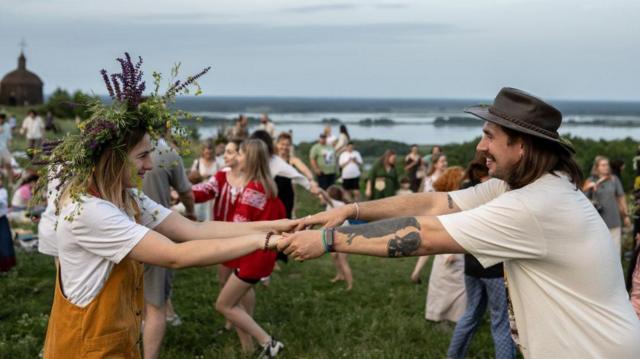

For a long time, the festival of Ivan Kupala in Ukraine has been marked by folk celebrations and various rituals familiar to virtually every Ukrainian — weaving wreaths, floating them on the water, and jumping over a bonfire. And the search for the fern flower, which, according to legend, blooms only once a year. This year, Kupala Night is celebrated from 23 to 24 June.
Due to the transition of the Orthodox Church of Ukraine and the Ukrainian Greek Catholic Church to the so-called New Julian calendar in 2023, the celebration of Ivan Kupala has been brought forward by 13 days. However, some Orthodox Christians continue to celebrate Kupala on the night of 6 to 7 July.
The text contains explicit descriptions of an erotic nature
However, far less is known about the fact that this pagan festival had another side to it in ancient times: great freedom for intimate relations among young people, which the Orthodox Church even referred to as a day of ‘legalised debauchery’.
But the ancient Slavs did not perceive this as ‘debauchery’ in the modern sense, but as a sacred fertility ritual. The festival coincided with the summer solstice — the time when the forces of nature were at their peak. Kupala Night was a time for freely choosing a partner without strict parental control, and the symbolic union of the masculine (fire) and feminine (water) began to be passed on to the people.
However, the archives of early 20th-century ethnographers and modern research provide us with a broader picture of Ukrainian sexual traditions, not only during specific folk festivals, and in particular Ivan Kupala. In ancient times, carnal expressions were viewed somewhat differently than they are today.
The fern flower and eroticism
The young man joked until dawn,
Until he could no longer be seen in the courtyard.
These lines from a folk song have an obvious erotic and scandalous subtext. In Ukrainian folklore, the festivities of young people before dawn were almost always a hint at premarital amorous games and sexuality.
It is worth considering the Kupala rituals in this same context. Despite their well-known magical symbolism, for rural youth, Kupala was first and foremost one of the most important youth festivals of the year, as young people from several villages would gather for this event, thus providing more opportunities to meet one another.
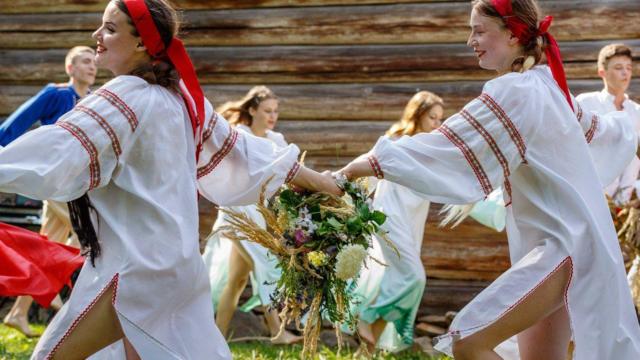
Photo credit: UNIAN
Consequently, a significant proportion of Kupala customs directly or indirectly touched upon the themes of love, sexual relations and marriage.
Weaving wreaths and floating them on the water was a form of divination, whilst jumping over the bonfire was not merely a rite of purification. It is believed that by jumping over the flames hand-in-hand with a loved one, the couple will remain together.
Beliefs associated with the search for the fern flower held a special place.
Legends about the search for it combined notions of wealth, supernatural knowledge and happiness, yet at the same time, in folklore, the phrase ‘go in search of the fern flower’ was often a euphemism for a couple’s romantic solitude, a context imposed upon such a quest.
But overall, Kupala Night in the popular imagination was not so much about sex as about the awakening of love, physicality, fertility and mating.
Therefore, adults and children were not allowed to take part in the celebrations, so as to give young people the opportunity to avoid social conflict.
What is and isn’t allowed
For a long time, the idea of the exceptional chastity of Ukrainian youth in ancient times—especially young women—was widely accepted. But is this really the case?
Ukrainian villages had their own distinctive sexual traditions, with certain limits on the expression of youthful sexuality, as young people sought to strike a balance between ‘what is allowed and what is not’ on their own.
Knowledge of what was permitted was passed on from older girls and boys to younger ones.
In essence, this was a form of ‘street education’, where knowledge about adolescent physiology and sexual relationships was passed on as if it were a great secret.
It was not customary for parents and children to discuss intimate matters. When evening parties ceased to exist as a cultural phenomenon under Soviet rule, the tradition of sharing ways to satisfy one’s sexual needs without penetration – which was forbidden before marriage – came to an end.
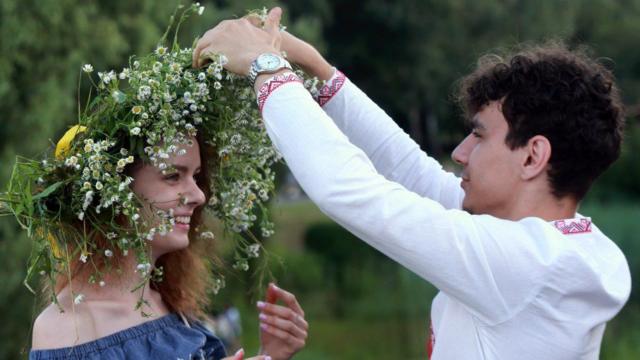
Photo credit: UNIAN
Intimate play between boys and girls was seen as something natural, not worthy of close attention from adults, and even as an essential part of growing up.
And no one would have condemned a young woman 100 years ago, had they seen her adding a little joy to her life whilst hiding from the midday heat under a haystack.
Masturbation by children and teenage girls was also turned a blind eye to — back then, children were simply playing. Girls would hide from adult eyes, lie on top of one another, pull up their skirts and rub their palms together until they reached orgasm. If such a photograph had been taken by a father or grandfather, he would simply have fussed over the children as if they were chicks.
However, none of this meant complete sexual freedom. In a traditional Ukrainian village, reputation, marriage and family remained important, so young people behaved very modestly in the presence of adults.
With the arrival of warm summer nights, girls were sent to sleep further away from home, in a barn or on the haystack, so that boys could visit them freely. A girl had to sleep with the boys, and the more of them there were, the more desirable she was considered as a bride.
This was a huge challenge for a girl: to spend a lot of time alone with boys whilst remaining a virgin.
Knowledge of female and male physiology was very rudimentary, so not everyone was indifferent to the consequences. Certain sexual activities could lead to ejaculation, and pregnancy could occur without sexual intercourse.
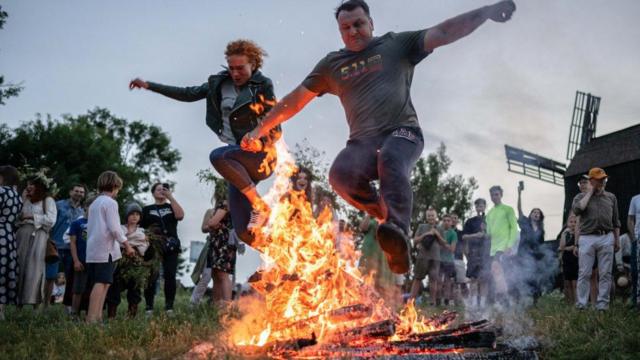
Photo credit: UNIAN
It sometimes happened that lads—mostly not locals, but those who came to the village to work—would tease the girls, promising to teach them how to ‘play at making love’ properly — as premarital sexual activity without penetration was known in ancient times, though sometimes it amounted to full sexual intercourse. A girl who lost her virginity before marriage was severely condemned by society.
Conversely, after the wedding night, having satisfied themselves of the bride’s chastity, they would go to thank her parents for having brought up their daughter properly.
For the peasant community, the pairing of young people had a very clear purpose — marriage. Therefore, bathing festivals or other forms of erotic courtship were not merely entertainment, but a kind of bride market. This is how couples were formed, who, once the field work was completed, could receive their parents’ blessing.
The Ukrainian village was neither a realm of debauchery nor a world of total chastity. It existed somewhere between these extremes, affirming the naturalness of human desire.