

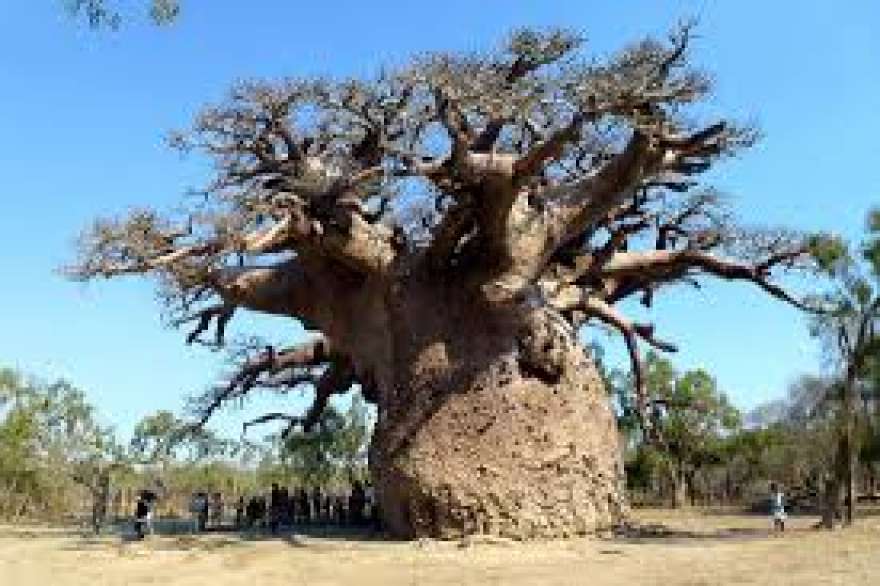

Madagascar’s largest registered baobab, Tsitakakantsa, has come under the spotlight after reports on social media that the tree could die in the next two to three years.
According to the Monumental Trees database, Tsitakakantsa is a Grandidier’s baobab (Adansonia grandidieri) near Andombiry in the Atsimo-Andrefana region of south-west Madagascar. In January 2021, its trunk circumference at 1.3 m was 28.82 m and its height was about 15 m. The Monumental Trees ranking lists it as the thickest recorded Grandidier baobab in Madagascar.
Reports that Tsitakakantsa is “dying” and could collapse completely within two to three years have appeared in recent days on English and French-language social media. They say the tree has lost one of its large branches, which for old baobabs can be a sign of progressive collapse. However, among the primary sources found, there is no official statement from the Madagascar parking service, scientific article or institute profile report that confirms exactly how long the tree has been dead.
Grandidier baobabs are endemic to Madagascar and are classified as an endangered species. Kew Gardens points out that the expansion of agricultural land in Madagascar threatens their extinction.
The history of Madagascar’s large baobabs already knows such cases. By 2018, another sacred baobab, Tsitakakoike, also of the Adansonia grandidieri species, was considered a large living baobab. According to Guinness World Records, it grew in Ambiky Forest, was 14.6 metres tall and had a volume of about 455 cubic metres, but collapsed in 2018.
Scientists attribute the fatigue of old baobabs to a combination of factors: age, droughts, rising temperatures, forest degradation, fires and changes in the landscape around the trees. For Madagascar, this is a particularly sensitive topic as the island is the centre of origin and diversity of baobabs: a study published in 2024 indicates that it is Madagascar that should be considered as the centre of origin of modern baobab lineages.
Baobabs on the island are often perceived as sacred trees, and their local name renala translates as “mother of the forest”.