

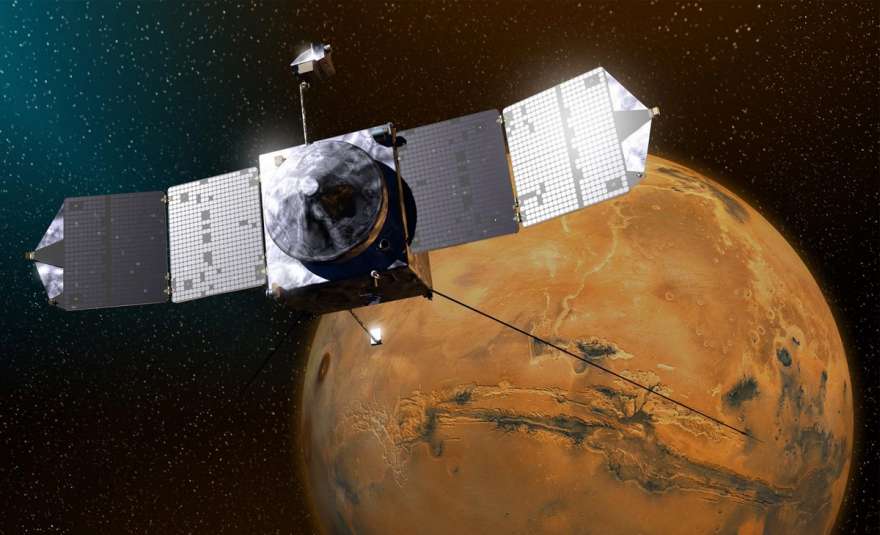

All attempts to re-establish communication, which ceased on 6 December, with the Maven space station orbiting Mars and locating it in a reference orbit have so far failed, NASA reports.
NASA continues to take steps to re-establish communication with its Maven spacecraft, with which communication was lost on 6 December. In conjunction with the Deep Space Network (DSN), the Maven team has sent commands to reactivate the spacecraft and is monitoring the network, waiting for a signal from it, the office said.
The Maven team is also continuing to analyse fragments of tracking data from December 6. This information is being used to create a timeline of possible events and identify the likely root cause of the problem. “As part of this effort, the Curiosity rover team used the Mastcam instrument on 16 and 20 December to attempt to photograph Maven’s reference orbit, but it was not detected,” NASA noted.
Before Maven disappeared behind Mars, the communication worked properly, but when the vehicle came out from behind the Red Planet, it suddenly stopped. Analysis of the short signal from 6 December suggests that the spacecraft was spinning in an unusual way when it came out from behind the Red Planet.
As NASA noted, the upcoming solar confrontation will soon affect the continuation of monitoring.
The Mars solar opposition – the period when Mars and Earth are on opposite sides of the sun – begins on Monday, 29 December, and NASA will have no communication with any of the Martian missions until Friday, 16 January. After the solar opposition period ends, NASA plans to resume efforts to reconnect with Maven.
Launched in 2013, the Maven (Mars Atmosphere and Volatile Evolution) spacecraft studied Mars’ upper atmosphere and its interaction with the solar wind.
NASA has two other spacecraft orbiting Mars that are still operational, the Mars Reconnaissance Orbiter, launched in 2005, and Mars Odyssey, launched in 2001.
Together with Maven, they are communication relays for NASA’s two Mars rovers, Curiosity and Perseverance.