


The development of controlled nuclear fusion is gradually moving from isolated laboratory results towards the creation of full-scale magnets, vacuum chambers, cooling systems and experimental set-ups designed to test the feasibility of stable energy production. This is reported by the Experts Club Information and Analytical Centre in its study.
The most notable achievement of recent months has been made by China. In June 2026, Chinese specialists completed the manufacture and testing of the world’s largest superconducting magnet for a future fusion reactor. Meanwhile, the US is advancing laser fusion and private projects involving compact facilities, Russia continues its experiments on the T-15MD tokamak and is supplying equipment for the international ITER reactor, whilst European and Asian research centres are working on long-duration plasma confinement and materials for future power stations.
Despite the acceleration of research, no country has yet built a fusion power plant capable of continuously generating more electricity than the entire complex of its equipment consumes. Most of the announced launch dates for the first power stations in the 2030s remain targets rather than guaranteed dates.
How fusion energy is generated
Nuclear fusion is the process that powers the Sun and other stars. During the reaction, light atomic nuclei fuse to form a heavier nucleus, and part of their mass is converted into energy.
On Earth, the most promising reaction is considered to be that between two isotopes of hydrogen – deuterium and tritium. When they fuse, a helium nucleus and a fast neutron are produced. Approximately 80 per cent of the energy released is absorbed by the neutron, which is then intended to heat the shell surrounding the reactor. The heat generated is planned to be used to produce steam and drive a conventional turbine, as in a thermal or nuclear power station.
To initiate the reaction, the fuel must be converted into plasma and heated to approximately 150 million degrees Celsius — roughly ten times the temperature at the Sun’s core. On the Sun, the immense gravitational force aids the compression of matter. In an Earth-based facility, this must be replaced by a magnetic field or an ultra-powerful laser pulse.
For sustainable fusion, three conditions must be met simultaneously: achieving a high temperature, creating sufficient particle density, and maintaining the plasma for a sufficiently long time. It is the combination of these parameters, rather than a single temperature record, that determines the facility’s actual progress.
Two main approaches are currently in use.
In magnetic confinement, the plasma is contained within a ring-shaped vacuum chamber. Powerful superconducting magnets prevent it from touching the walls. The most common device of this type is the tokamak. An alternative is the stellarator, which has a more complex magnetic field configuration but is potentially better suited to continuous operation.
In inertial fusion, a small fuel capsule is simultaneously irradiated by lasers. The outer layer of the capsule vaporises, the fuel is rapidly compressed and, for a brief moment, reaches the conditions under which the fusion reaction begins.
China has built the largest superconducting magnet
In June 2026, the Institute of Plasma Physics of the Chinese Academy of Sciences announced the successful completion of tests on a D-shaped toroidal field magnet for future fusion facilities.
It is 21 metres long, 12 metres wide, 3.3 metres high and weighs 582 tonnes. According to the developers, the magnet’s volume is 1.3 times that of a similar component in the international ITER reactor, whilst the magnetic energy it stores is three times greater.
Toroidal magnets form the main magnetic field around the tokamak’s vacuum chamber. The stronger and more stable the field, the higher the plasma pressure and temperature that can potentially be maintained inside the facility.
The creation of such a magnet signifies that China has mastered the production of large superconducting coils, special steel, cryogenic insulation, protection systems and ultra-low-resistance connections. However, a single magnet does not in itself constitute a reactor. A power plant will require a complete set of coils, a vacuum chamber, a cryogenic system, plasma heating, neutron shielding and equipment for tritium production.
China is simultaneously developing several interrelated projects. In January 2025, the EAST tokamak sustained plasma in a high-confinement mode for 1,066 thousand seconds, significantly exceeding the previous record of 403 seconds. The experiment was conducted without generating commercial power, but demonstrated the capability of a superconducting tokamak to operate for extended periods.
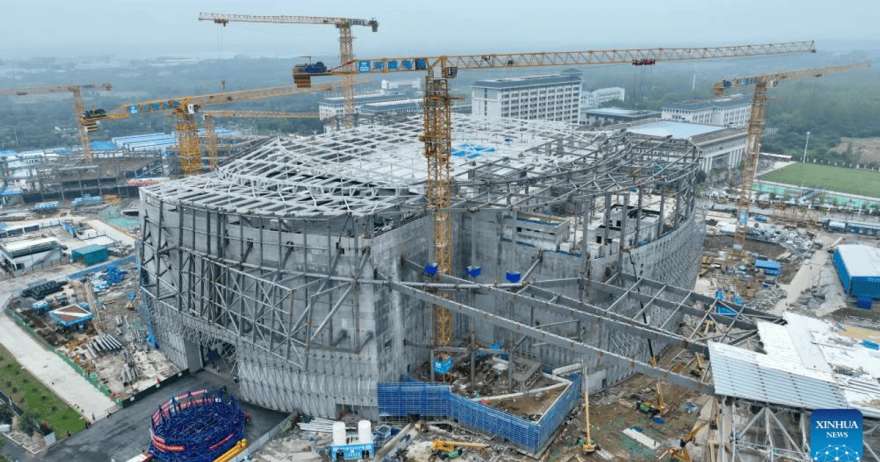
The next stage is set to be the BEST facility, which is currently under construction in Hefei. It is scheduled for completion by the end of 2027. Unlike EAST, BEST is being designed for experiments with deuterium–tritium burning plasma and is expected to achieve between 20 and 200 MW of fusion power. Chinese developers estimate