



Russia’s war against Ukraine is rapidly moving to a new technological level. This is largely a consequence of decisions made by Moscow itself, writes David Hambling, a military expert and author of “Drone Swarm: How Small Drones Will Conquer the World,” in his column for the New York Post.
“Vladimir Putin has created a monster, and this monster can destroy him,” he says, commenting on the rapid development of drone and robotic technologies on the battlefield in Ukraine.
From this thesis, the author moves to a broader picture: the war launched by the Russian president has not only changed the balance of power, but has actually accelerated the start of a new era – the era of fighting machines.
The birth of the “robot war”
As the New York Post columnist notes, Putin has actually started a chain reaction – and its consequences may be unpredictable.
Ukrainian President Volodymyr Zelensky recently reported an unprecedented case: for the first time in the war, an enemy position was captured solely with the help of unmanned systems – with no infantry involved and no casualties.
This episode may become a turning point. War is gradually ceasing to be a clash of people and increasingly resembles a confrontation of technologies.
How Ukraine is levelling Russia’s numerical advantage
Over the past four years, the author reminds us, Russia’s key advantage has been the size of its army. However, Kiev has found a way to change the rules of the game.
By replacing soldiers with robotic systems, Ukraine has reduced its dependence on human resources.
This simultaneously opens the door to a new, darker reality where machines are capable of detecting and destroying humans on their own, Hambling argues.
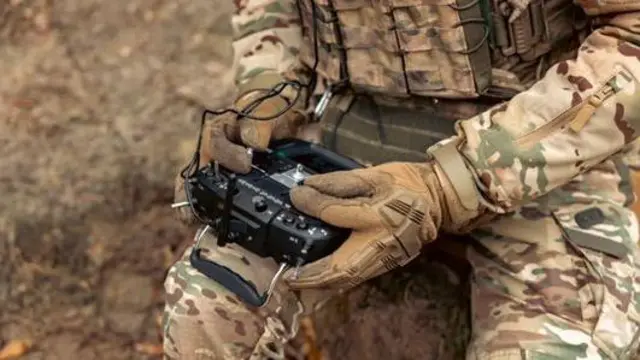
Author photo, Getty Images
From “teletanks” to modern robots
The idea of remotely controlled combat vehicles is actually not new.
Back in the 1930s, the USSR created so-called teleletanks – lightweight vehicles with flamethrowers designed to assault fortified positions. But due to unstable radio communication, these projects were quickly cancelled.
In the 1970s, the work found application in demining. However, it was not possible to turn them into full-fledged weapons for a long time.
Even the US, having deployed SWORDS robotic systems in Iraq in 2007, did not dare to use them in real combat, probably because of doubts about their reliability and the risk of negative resonance.
Russia, for its part, tested the Uran-9 system in Syria, but encountered technical problems: in particular, due to communication failures, the vehicle could lose control and stop. These systems have not been seen in Ukraine.
Why ground operations are difficult
Moving on the ground is much more difficult than flying. That’s why drones have already become a familiar tool of war, while ground work still has problems with navigation, the author of the article explains.
Even civilian technologies are not immune to failures: recently in Miami, a delivery robot drove onto railway tracks – and was hit by a train.
Ukraine is approaching this problem practically and quickly. Here they create inexpensive devices based on commercial solutions, immediately send them to the front and improve them in real conditions.
Work on the front line
At first, ground drones performed simple tasks – delivering cargo where it was too dangerous for people. But very quickly their role began to grow. Now they can evacuate the wounded, lay mines and even participate in battles.
According to a New York Post columnist, videos of armed jobs working right on the front lines are becoming more and more common.
One telling example is the DevDroid system.
It is about the size of a quad bike, reaches speeds of more than 6 kilometres per hour and is equipped with a machine gun. According to the Ukrainian military, such a robot can hold a position for more than a month, periodically returning to the base to recharge and replenish ammunition.
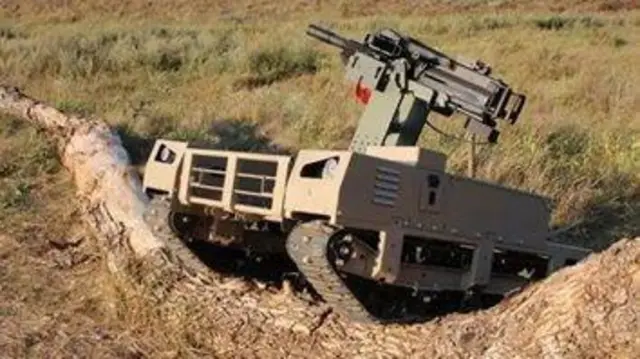
Author photo, Tencore
Nikolai Zinkevich, commander of the NC13 ground robotic systems unit of the 3rd separate assault brigade, gave an illustrative example: the DevDroid robot took a position on the front line and the Russians – without the presence of soldiers.
Ukrainian developers say they can create such systems in a few weeks, while in the West it usually takes years.
But there are still problems. Ground operations still have a hard time getting around obstacles on their own. That’s why they are usually not left on their own: the operator controls from the ground, and the drone from above monitors the situation and suggests where it is better to move.
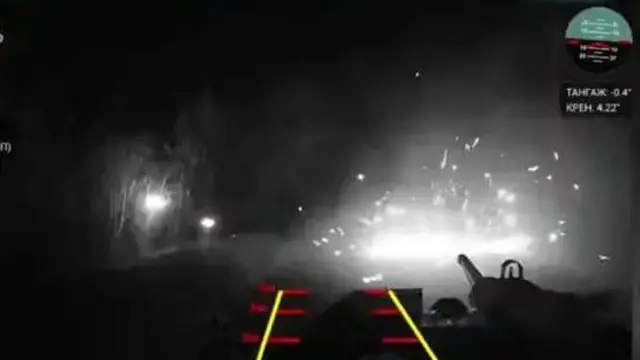
Author photo, Devdroid
According to President Zelensky, Ukrainian forces are already conducting fully robotic offensive operations. They simultaneously use aerial drones and unmanned ground platforms (UGVs).
So far, such operations are being carried out with a limited amount of equipment. But the plans are more ambitious – Ukraine expects to produce about 20,000 ground robots already this year and quickly ramp up production if necessary.
Andriy Biletsky, commander of the 3rd Army Corps of the AFU Ground Forces, said in March that ground operations could replace about 30 per cent of infantry at the front as early as 2026. In the longer term, their share could rise to 80 per cent.
Has the war of the future already begun?
Experts are still doubtful that the works will be able to completely replace humans. This is especially true for urban battles and trench warfare.
Such systems cannot independently enter buildings, occupy trenches or perform complex actions in close quarters.
However, development is proceeding very quickly.
Ukraine is already testing dog-like robots as well as humanoid machines.
And, as New York Post columnist David Hambling points out, this is not a choice from the good life, but a forced move to reduce human casualties.
Ukraine, he says, is determined to win. And if that requires the use of “terminator-like” combat vehicles, it will go for it.
In this logic, Russia’s offensive could face a “wall” of robotic systems that are controlled by operators from dozens of kilometres away from the front.
According to Hambling, this could change the very nature of warfare – not just in Ukraine, but around the world.
The battlefield of the future may become fully mechanised, and direct human combat will look as outdated as sword fights do today.
And that, David Hambling hints, is the main irony: the war that Vladimir Putin has started may eventually set in motion a process that will turn against him.