

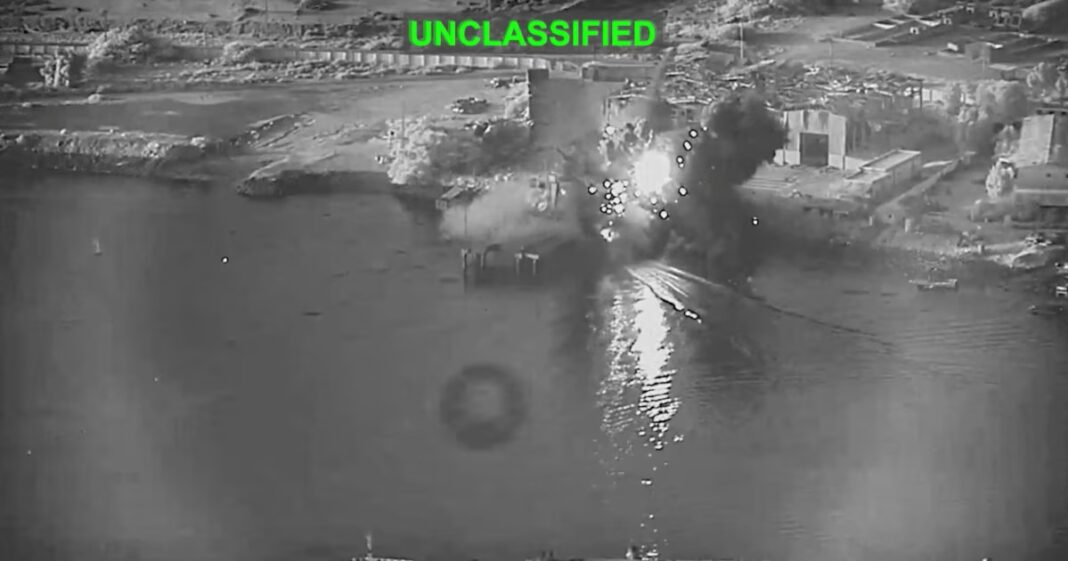

The US military has stated that it has carried out a new wave of air strikes against targets in Iran to help ensure the security of the Strait of Hormuz, just a few hours after President Donald Trump announced the resumption of the blockade of this key waterway.
“These strikes will continue to impose significant costs on Iranian forces and degrade their ability to attack civilians and commercial shipping in the Strait of Hormuz,” according to a statement from US Central Command late on the evening of 13 July, the third consecutive day since the attacks began.
Iranian state media reported explosions on several islands off Iran’s southern coast, including Kish, Qeshm and Abu Musa.
Earlier, on 13 July, US media reported that Trump had notified Congress over the weekend that the United States was once again at war with Iran, thereby initiating a 60-day period during which military strikes could be carried out without the need for formal approval from lawmakers.
Speaking to journalists at the White House late on the evening of 13 July, Trump stated that the attacks were aimed at neutralising Iran’s ability to disrupt maritime shipping in the strait.
He added that, despite three consecutive nights of attacks on Iran, a ceasefire agreement was still possible.
Earlier that same day, Trump told Fox News that the United States could take control of the Strait, which in peacetime handles around one-fifth of the world’s energy transit and has become one of the main battlegrounds of the conflict.
Iran’s Islamic Revolutionary Guard Corps (IRGC) stated that the only way to restore regular shipping through the Strait is to end US military interference in the waterway.
In a strongly worded statement, Iran’s Joint Armed Forces Command declared that the US has no role to play in determining the future of the Strait, warning countries cooperating with Washington that they “bear full responsibility for any instability and escalation of war in the region”.
On 13 July, the United Arab Emirates’ Ministry of Defence stated that two of the country’s tankers had been struck by Iranian cruise missiles in the southern part of the Strait of Hormuz, within Omani territorial waters, resulting in the death of one crew member and injuries to eight others.
Iran has launched attacks on several of its neighbours in the Persian Gulf, as well as on vessels in the strait which, it claims, are violating its rules on transit through the waterway.
According to Tehran, Iranian Foreign Minister Abbas Arakchi met with Omani Foreign Minister Saeed Badr Al-Busaidi at the weekend to discuss mechanisms for ensuring safe navigation through the Strait of Hormuz.
Oman has stated that talks with Iran will continue at both the technical and political levels to reach agreements on shipping through this waterway that are in line with international law.
Radio Free Europe/Radio Liberty has learnt from diplomatic sources that Omani mediators presented the Iranian delegation with proposals aimed at resolving disputes over maritime navigation. Officials declined to comment on the substance of the proposals.
According to diplomatic sources familiar with the talks, Iran walked out of the negotiations, stating that it would return once it had reached a unified domestic position on the proposals, which would allow for freedom of navigation through Omani waters in the southern part of the strait without the imposition of fees.
Shortly afterwards, Iran’s National Security Council responded by firing on a commercial vessel and announcing the closure of the waterway.