

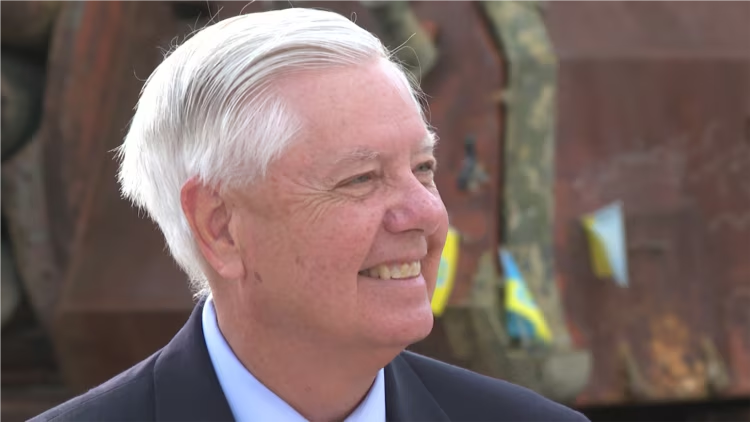

US President Donald Trump has once again called on American lawmakers to include sanctions against Iran in the bill on sanctions against Russia, which was co-authored by the late Senator Lindsey Graham. He wrote about this on the social media platform Truth Social on 19 July.
“This is what Lindsey wanted to do, and that is how it should have been,” Trump said.
He called on Republicans to add sanctions against Iran to the bill, adding that this was “important”.
Recently, when speaking about the bill, Trump also advocated for the inclusion of sanctions against Iran and the pro-Iranian Lebanese group ‘Hezbollah’ (designated as a terrorist organisation by the US and Israel).
On 14 July, a group of US senators from both parties tabled the ‘Russia Sanctions Act of 2026’, presenting an updated package of sanctions and tariffs aimed at restricting Russia’s war funding.
Republican Lindsey Graham, who died suddenly on 11 July, had, together with Democrat Richard Blumenthal, drafted a bill imposing sanctions on Russia in connection with its invasion of Ukraine. He was also one of the harshest critics of Iran in the US Congress and a supporter of the military operation against Iran launched by the US and Israel in late February. He did not, however, publicly state that he wished to extend the scope of the sanctions bill against Russia to include Iran.
The day before his death, Graham stated that the bill had been agreed with the White House, a fact confirmed by several other senators. Following Graham’s death, a new version of the bill was published; it was reported that it had already been backed by more than 60 senators from both parties.
The document is somewhat less stringent than the original version – which had provided for 500 per cent tariffs on countries purchasing oil and gas from Russia (the current proposal imposes 100 per cent tariffs on the five leading importers, with a number of exceptions), but it still provides for tough measures against Russia.
President Donald Trump, according to Axios, has expressed a willingness to sign the bill, although he does not explicitly support it. He had previously suggested that sanctions against Iran and its allies could be added to the bill, but the published version of the bill concerns Russia alone.