

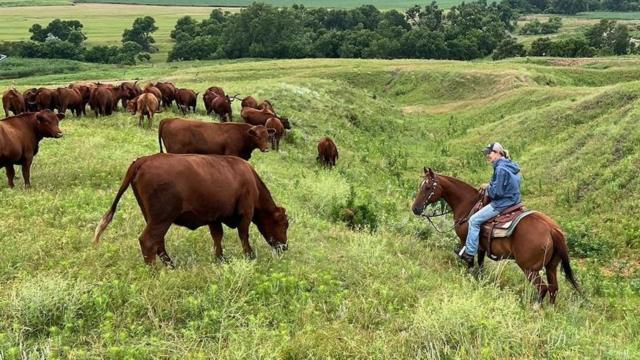

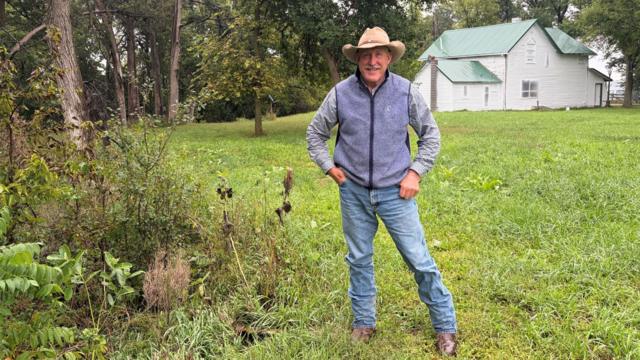
Ivette Mannon, a ranch owner from Nebraska, has had a difficult year.
In April, a bushfire destroyed 1,600 acres (one acre equals 0.4 hectares) of pasture and 21 km of fencing on the ranch she bought in 2002.
The ranch is situated in a picturesque corner of Nebraska, with rolling green hills beneath the boundless skies of the Midwest, where the landscape is dotted with grain silos alongside endless fields of cattle.
Mannon’s 300 head of cattle survived the fire, but the fencing needed to be repaired and the herd still needed to be fed.
As steel prices had reached their highest level in many years and were significantly affected by the tariffs imposed by US President Donald Trump, she had to pay $4.89 per foot, bringing the total cost to over $300,000.
Furthermore, due to the destruction of a significant portion of her high-quality pastureland, Mannon was also forced to use a tractor daily to deliver hay to her livestock, at a time when diesel prices – which had risen sharply due to the war with Iran – were more than 40 per cent higher than a year earlier. Although Trump is attempting to shift the blame onto Ukraine, which, in defending itself against the Russian invasion, is targeting Russia’s energy sector.
Then, in August, the Trump administration announced the import of 300,000 metric tonnes of duty-free foreign beef in an attempt to lower prices for consumers.
This news came just before the period when most calves in the US are weaned from their mothers and sold, which runs from September to November.
The cattle market immediately collapsed.
It felt like a betrayal
“So, we’re ‘Buy American’, we’re going to ‘Make America Great Again’,” says 63-year-old Mannon, who voted for Trump. “But you lot here, I’m sorry.”
It just felt like a betrayal,” she adds.
Many farmers and livestock breeders across the US say they are under attack from all sides.
Recent years have been difficult due to droughts affecting harvests and already historically low livestock numbers.
But government policy has put additional pressure on them, they say.
This has led some residents of Nebraska – a state that overwhelmingly backed President Trump in the last election – to rethink their political allegiances.
Ahead of the November Senate election, Dan Osborne, an independent candidate standing against the Trump-backed Republican Pete Ricketts, is performing unexpectedly well in the polls.
The Republicans seem well aware of the discontent and disappointment amongst farmers.
In recent weeks, both Trump and Nebraska Governor Jim Pillen have announced support programmes aimed at reducing fuel costs for farmers and livestock producers, who, they say, have been in a difficult position for many months.
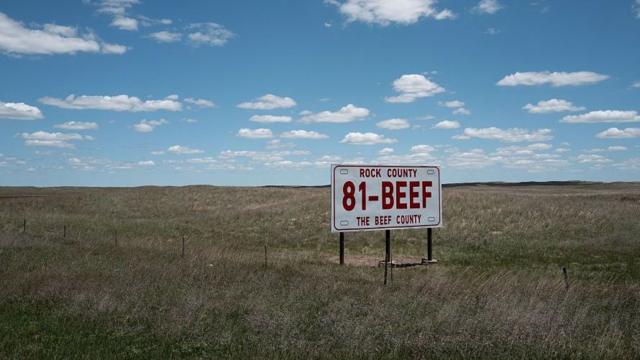
Photo credit: Getty Images
The war with Iran has led to a sharp rise in the prices of diesel and fertilisers, which are daily necessities for agricultural production.
Tariffs have affected the cost of machinery and repairs, as well as the prices of steel and timber.
And decisions by the Trump administration, such as importing foreign beef or opening the southern border to Mexican livestock, have further destabilised markets that were already fragile.
Many producers are losing hundreds of dollars on every head of cattle.
“All of this has had a negative impact on the cattle markets,” says James Mitchell, an associate professor and agricultural economist at the University of Arkansas.
According to him, cattle markets operate in cycles lasting 10–12 years, with good years giving way to bad ones.
Recently, the industry had been experiencing a particularly profitable period, when low supply and high demand drove up prices.
But now the market is clearly in decline.
Jake Wulfinger, 45, is weathering this downturn at his feedlot near Lexington, Nebraska.
He and his wife are originally from Ohio; both come from farming families who have been in the business for several generations.
They moved to Nebraska, which has fertile land and the country’s largest groundwater reserves, to set up their own business.
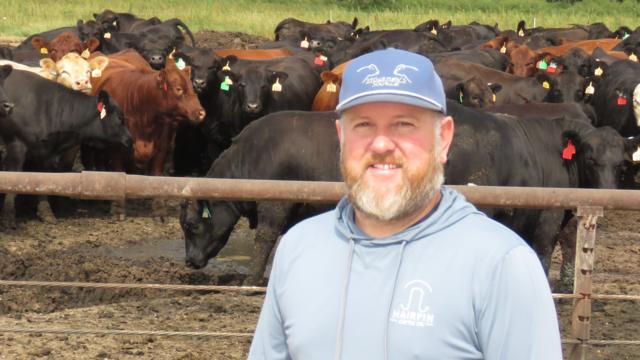
Photo credit: BBC/Lori Potter
The Wolfingers bought an abandoned feedlot in 2010 and turned it into a modern farm with 5,500 head of cattle.
Neighbours hold them up as an example of what can still be achieved through hard work in a challenging area.
But Wolfinger hadn’t factored a war with Iran, tariffs or imports of foreign beef into his plans.
‘Things were going quite well,’ he says, ‘when I was selling cattle for $240 per ‘andeich’ (about 45 kg). But now the price has fallen to $225.
At first glance, this may seem insignificant, but it means a potential loss of hundreds of dollars per head of cattle.
Wulfinger is also having to cope with extremely high diesel costs: some of his machinery consumes as much as 400 gallons a day.
‘It really makes you think,’ he says.
A Trump supporter, Wolfinger says he voted for the president because the country needed his spirit.
He also expressed dissatisfaction with left-wing politicians.
But he is unhappy with the way the president has intervened in the beef market.
‘People need to keep their hands off farmers’ business, for goodness’ sake, because it’s harvest time,’ said Wulfinger.
People need to stay out of farmers’ business
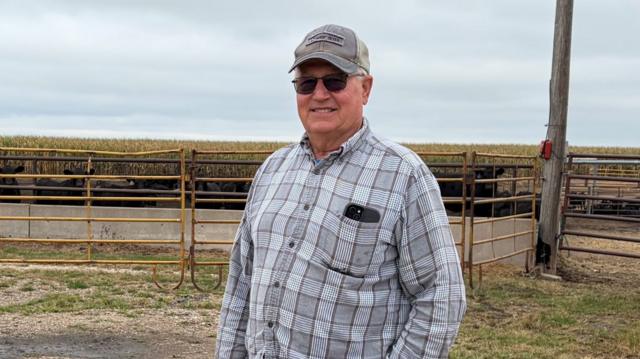
Forty miles to the north-west, near Callaway in Nebraska, 54-year-old Dwayne Kimboll stands in his barn, surrounded by machinery and a huge Trump banner.
Prices are going up every day… It’s quite painful,’ he says. ‘I know lots of people who’ve had to go to the banks and increase their credit limits.
Kimboll believed that the war with Iran should have ended long ago.
But he doesn’t blame Trump for all his financial difficulties.
‘I don’t think it’s fair to put all the blame on this administration,’ he says.
He points to burdensome regulation, as well as rising costs for machinery and fertiliser – trends that began even before Trump’s return to the White House.
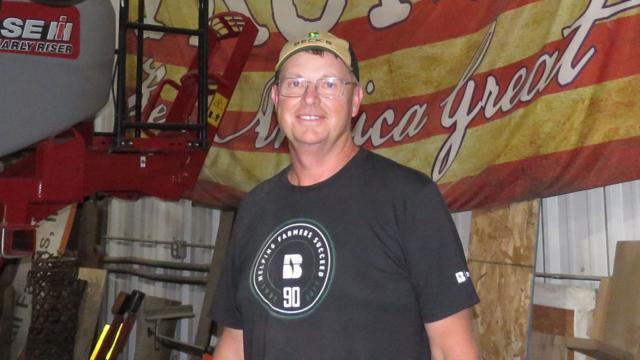
Photo credit: BBC/Lori Potter
Mannon, who returned to her native Nebraska and bought a ranch after a career in banking, believes the agricultural sector will make its feelings known in the mid-term elections.
But, like many here, she prefers not to get drawn into political debates.
This is not the case for her friend Jim Jenkins, who owns the neighbouring ranch.
A former independent candidate for the Senate, Jenkins takes great pride in Nebraska’s agriculture and in his own ranch, situated on land that his family first settled over 150 years ago.
Jenkins was so outraged by politicians who, in his view, are harming Nebraska’s agricultural sector that he wrote a column for a newspaper in Omas this summer.
He has also felt the pressure first-hand from high prices for diesel, fertiliser, timber and steel – everything from barbed wire to fence posts.
According to him, the situation is further complicated by uncertainty over what might happen next and what Trump’s next statement will mean for the sector.
“It’s things like this that keep me awake at night,” says the 69-year-old interviewee speaking to BBC News.
An outspoken critic of Trump, who has never voted for him in any presidential election, Jenkins knows he is an exception amongst his conservative neighbours.
When Trump was first elected president, Jenkins had hoped to see him as a pragmatic businessman.
Now, however, he says, Trump has been anything but pragmatic.
But for many farmers and ranchers who support Trump, the president’s decisions – even if they hit them economically – deserve the benefit of the doubt.
‘We all know this about Trump. He sometimes operates on the principle of “shoot first, aim later”,’ says Wulfinger.
‘I’d like him to put the gun back in its holster first, and then think,’ he adds.
But, he says, for the most part he is trying to steer this country in the right direction.
Don Cantrell, whose grandfather founded a farm on family land that now covers 12,000 acres, says he is feeling the pinch of high diesel prices and admits that the president makes a mockery of things and talks nonsense.
But Cantrell considers Trump, on the whole, to be the best president.
For example, the creation of DOGE – the Department of Government Efficiency – was exactly what, in his view, the country needed.
‘Let’s cut back on wasteful government spending,’ he says. ‘There’s a great deal of it.’
Trump’s positions on social issues, such as abortion and support for Christianity, align with the personal beliefs of many Nebraska voters.
‘I think, generally speaking, if you’re a conservative in this country, you’ll vote for conservatives,’ says Wulffinger.
Don Beaty, 67, agrees: ‘There are plenty of other issues besides agriculture.’
However, he says, it is difficult to ignore economic realities.
Last year, Beaty gave up farming due to a combination of personal and economic reasons.
The farmer, who grew maize and soya, saw maize prices fall from $7 a bushel (approximately 35 litres) at the start of 2022 to $4.29 three years later.
But costs did not fall, whilst tariffs and inflation hit his profitability, he says.
As a result, he was forced to give up his long-held dream of passing on his 400-acre farm to his daughter.
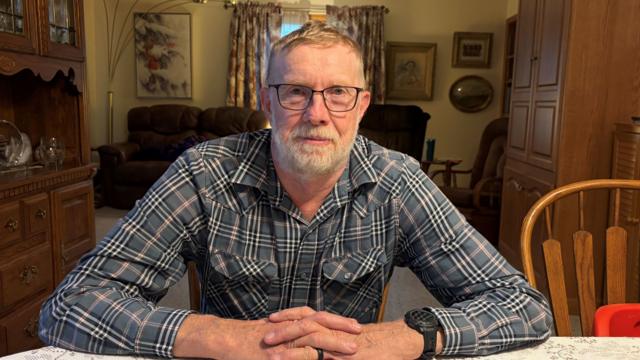
‘It simply wouldn’t work now,’ he says, sitting at the dining table in the house where he grew up.
He only came to this conclusion in the last year, after analysing the figures.
‘I knew things weren’t going very well,’ he says. ‘But when I started working through the figures… I thought: This is going to be bad.’
Beaty voted for Trump in 2016 and again in the primaries, but not in 2024, as he was disappointed with his policies.
He says he has heard similar dissatisfaction across the state.
‘They’re still staunch Republicans,’ he says of these people. ‘But they no longer support Trump.’
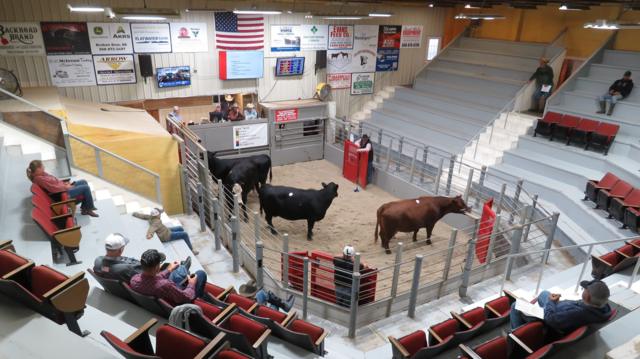
Photo credit: Lori Potter
However, across Nebraska, the industry continues to operate.
On a rainy Thursday in Broken Bow, buyers in cowboy hats, checked shirts and denim gathered for the latest indoor cattle auction.
Calves still need to be bought and sold, and work on the ranches – many of which have been in the same families for several generations – doesn’t stop because of politics.
‘People in agriculture are eternal optimists,’ says Yvette Mannon. ‘Otherwise, we wouldn’t be doing this.’