

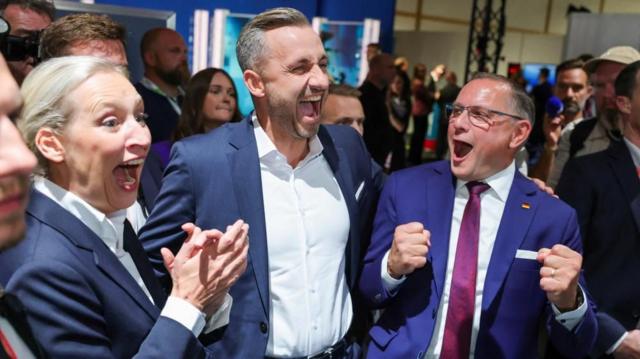

Photo credit: Reuters
The far-right ‘Alternative for Germany’ (AfD), which seeks to redefine the country’s relationship with its Nazi past, has won the election in the federal state of Saxony-Anhalt.
With all votes counted, the party secured 43.8 per cent — more than double its share in the previous election.
Chancellor Friedrich Merz’s Christian Democratic Union (CDU) came second with 17.2 per cent, whilst the Social Democratic Party of Germany (SPD) came third with 9.3 per cent.
The AfD’s result was historic: since the Second World War, no far-right party in modern Germany had ever won an election at the federal state level.
The party went into the election with a programme it called a ‘patriotic turn’. Among its proposals were a reduction in lessons on Germany’s Nazi past and changes to teaching methods
“Uli, you’ve achieved the impossible. Everyone underestimated our chances, but you’ve done it,” said Weidel. She named Sigmund as the future “Minister-President” of Saxony-Anhalt.
However, the AfD will not yet be able to form a government on its own. There are 83 seats in the state parliament, and 42 are needed for a majority. The AfD won 39 seats. The other major parties are refusing to enter into a coalition with it.
A party that was, until recently, marginal
The AfD was founded in 2013.
Initially, it positioned itself primarily as a Eurosceptic force, but gradually shifted far to the right, making the fight against migration, nationalism and criticism of the traditional parties its main themes.
The party has gained a particularly strong foothold in the eastern states of the former GDR, which include Saxony-Anhalt.
In the current elections, the AfD
In the run-up to the elections, AfD leader Alice Weidel stated that, should the party come to power, Germany could relaunch the ‘Nord Stream’ pipeline and resume purchasing Russian gas.
The party also opposes further European integration, proposes abandoning the euro and, in the long term, leaving the EU.
On the issue of Ukraine, the AfD opposes further sanctions against Russia and military aid to Kyiv.
The party’s manifesto does not condemn Russia for its full-scale invasion of Ukraine.
The Russian factor
The AfD’s ties with Russia have become particularly noticeable recently.
As reported by the Financial Times, a senior AfD MP, Markus Fronmaier, met in St Petersburg with Gazprom chief Alexei Miller and Kirill Dmitriev — a Russian official close to
For Germany, this result is of particular significance given the country’s historical experience.
After the Second World War, a strong political taboo developed in Germany against the major parties cooperating with far-right forces. This is precisely why the so-called ‘Brandmauer’ – a ‘protective barrier’ – applies to the AfD: the CDU, SPD and other major parties refuse on principle to enter into a coalition with it.
However, the AfD has now become so strong that it is increasingly difficult to dismiss it as a marginal force.
Its regional branch in Saxony-Anhalt is classified as far-right extremist by the German domestic security service. The AfD itself denies this and describes such accusations as politically motivated.
The party has also been repeatedly accused of using rhetoric linked to Germany’s Nazi past. AfD representatives these