

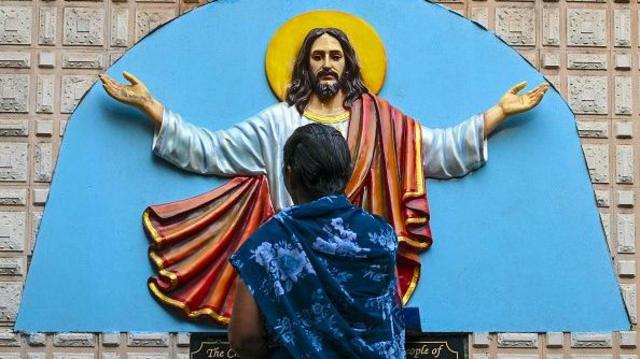

In churches across Mumbai, worshippers may now be asked to sign a document before prayer. In it, the person confirms that they have come of their own free will and that no one has forced them to change their religion.
Their name, sometimes their ID number, and their signature – and the document is kept at the church
Why? In case anyone accuses the church of illegally converting people to another faith.
This form has no legal force. But for the churches, it serves as a kind of safeguard.
“If anyone were to suddenly accuse us of coercive proselytising, we would be able to show that people came to pray of their own free will,” explains lawyer Devdan Tribhuvan.
The reason for these precautions is a new state law.
It prohibits converting a person to another religion through violence, threats, deception, coercion or material inducements.
A violation can result in up to seven years’ imprisonment, and a repeat offence in up to 10 years.
At the same time, the law requires the authorities to be notified in advance of any voluntary change of religion. And in many cases, it is the person who helped another to convert who must prove that everything took place voluntarily.
The concept of ‘luring’ raises the most questions.
The law defines this to include, in particular, offers of employment, free education, promises of marriage, a ‘better way of life’ and even religious healing.
In other words, the line between assistance, persuasion and an unlawful inducement can be very fine.
‘Why did you come here?’
Devdan Tribhuvan says that in practice, this is already being felt.
He is a fourth-generation Christian and works for an organisation providing legal aid to Mumbai’s Christian community.
In recent months, he explains, people have increasingly been approaching him not about legal cases, but about disrupted prayer meetings and questions such as: what are they actually allowed to do now?
Some parishioners say that strangers walk into the church and start questioning them:
‘What’s your name? Why are you here? Did someone invite you?’
If a person’s name does not sound Christian, the questions can become even more direct: “Did someone force you to come here? Did someone invite you?”
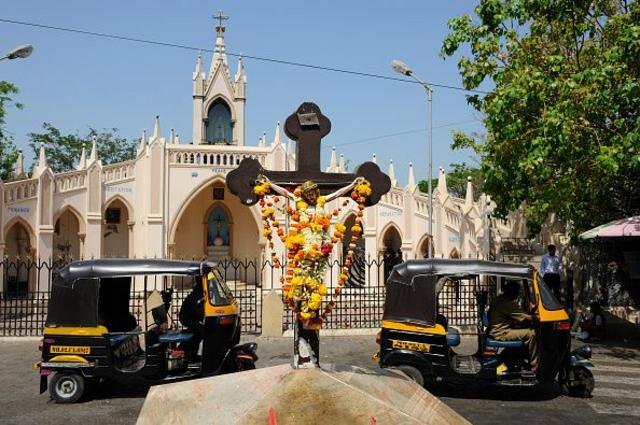
Photo credit: Getty Images
Most of those who contact Tribhuvan do not wish to take legal action. They are trying to understand whether a routine gathering for communal prayer could form the basis for a charge of converting people to another faith.
In July, the Indian Express reported on five incidents in which Christian prayer meetings had been disrupted in various parts of Mumbai between April and July.
Following this, the police opened nine cases: seven against believers or organisers of the prayer meetings, and two against members of the Hindu nationalist organisation Bajrang Dal.
The police did not respond to the BBC’s questions regarding these investigations and the measures taken.
“Does simply holding a prayer meeting in itself count as proselytising?” asks Tribhuvan.
Mumbai, where different faiths live side by side
For Mumbai, this is a particularly sensitive issue.
For centuries, the city has grown thanks to people who have come here from different parts of India and from abroad. They brought with them their gods, traditions and rituals.
Here, the ringing of a church bell can be heard alongside the call to prayer from a mosque. People of different faiths may visit the same place of worship.
In a city like this, any new restrictions on religion quickly become an issue not only for churches, but also for ordinary families and couples.
Maharashtra has become one of more than a dozen Indian states where laws restricting conversion from one religion to another are in force.
In recent years, such laws have become increasingly common, particularly in states governed by Prime Minister Narendra Modi’s party. Some of these provisions are currently being challenged in the Supreme Court of India.
What constitutes ‘inducement’
The new rules are the subject of long-standing controversy.
For years, Hindu nationalist organisations have accused Christians of using money, education and medical care to persuade poor people and members of tribal communities to convert from Hinduism to Christianity.
There is also another theory – the so-called ‘love jihad’. Its proponents claim that Muslim men enter into relationships with Hindu women in order to convert them to Islam.
Critics of such claims believe that they increase the pressure on Christian prayer groups and interfaith couples.
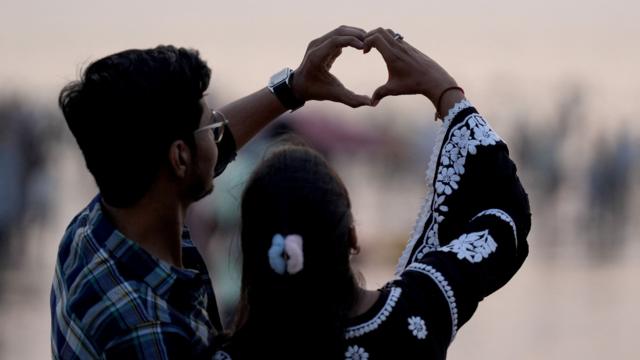
Photo credit: Reuters
At the same time, the Maharashtra authorities insist that no one is prohibiting voluntary conversion. The aim of the law, according to the government, is to combat deception, pressure and coercion.
But this is precisely where the main problem lies: where does a voluntary choice end and ‘luring’ begin?
“We do not support forced conversion to another faith,” says Samsuddin Tamboli, president of the reformist organisation Muslim Satyashodhak Mandal.
At the same time, he is concerned about just how broadly the concept of ‘luring’ is defined.
An offer of employment, free education at a religious institution, the promise of marriage, a ‘better way of life’ or ‘divine healing’ – all of these could, under certain circumstances, fall within the scope of the law.
In some cases, even claiming that one religion is better than another could be considered a breach.
‘The definition is so broadly worded that virtually any benefit received by a person could be declared an inducement,’ says Abhay Tipsay, a former judge of the Bombay High Court.
“If a person receives a certain benefit and consciously decides to change their religion because of it, why should that be considered wrong at all?”
When religion becomes a family affair
There is another detail in the new rules.
Parents, brothers, sisters and other relatives may lodge a complaint with the police regarding the alleged unlawful inducement of a person to convert to another religion.
And anyone accused of organising or facilitating such a conversion will have to prove that everything was done lawfully.
This provision is a particular cause for concern amongst those who work with interfaith couples.
In India, people of different faiths can marry without changing their religion. However, the authorities must be notified of such a marriage in advance, and this information remains accessible for a month.
Lawyer Lara Jesani, who has helped such couples secure legal protection in court, explains that during this time, relatives and Hindu nationalist organisations would sometimes find out about the upcoming wedding.
In some cases, she says, relatives would take the women away directly from the marriage registration office.
Now Jesani fears that the new law will give relatives yet another reason to interfere in a couple’s private life.
‘Even when no one intends to change their religion, couples fear that a relative might accuse one partner of trying to convert the other to their faith.’
The Maharashtra government insists that the law does not restrict a person’s right to change their religion.
State Minister Pankaj Bhoyar has stated that the prior notification is merely intended to ensure that such a decision is voluntary and to prevent deception, pressure and coercion.
But for many, the issue has already gone beyond the realm of marriage.
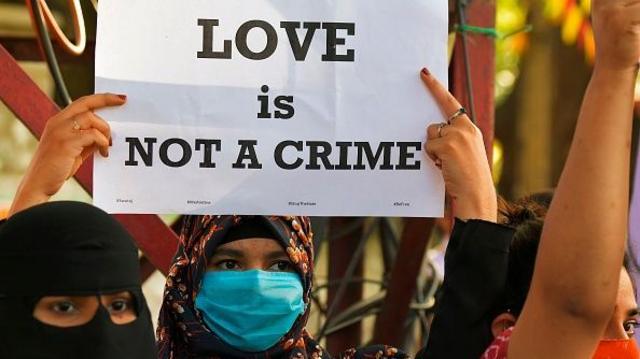
Photo credit: Getty Images
Devdan Tribhuvan says that people have begun to fear even small prayer gatherings near their homes.
Such gatherings can attract 50, and sometimes as many as 100, people. Among them may be followers of other faiths.
And it is precisely this, in his view, that creates a new uncertainty: where does ordinary prayer end and what some might call proselytising begin?
“If someone wants to come and pray, we cannot stop them. That is a person’s right to choose for themselves,” says Tribhuvan.